US Secretary warns against Iranian control of Strait of Hormuz
Source:The Hindu ↗
ఇది ఎందుకు ముఖ్యం
The geopolitics of the Strait of Hormuz directly affects India's energy security and trade transit routes, as it is a critical maritime chokepoint. Additionally, the diplomatic synergy within the Quad, support for ASEAN centrality, and the resolution of bilateral trade tariffs with the US are vital pillars of India's contemporary foreign policy.
సారాంశం
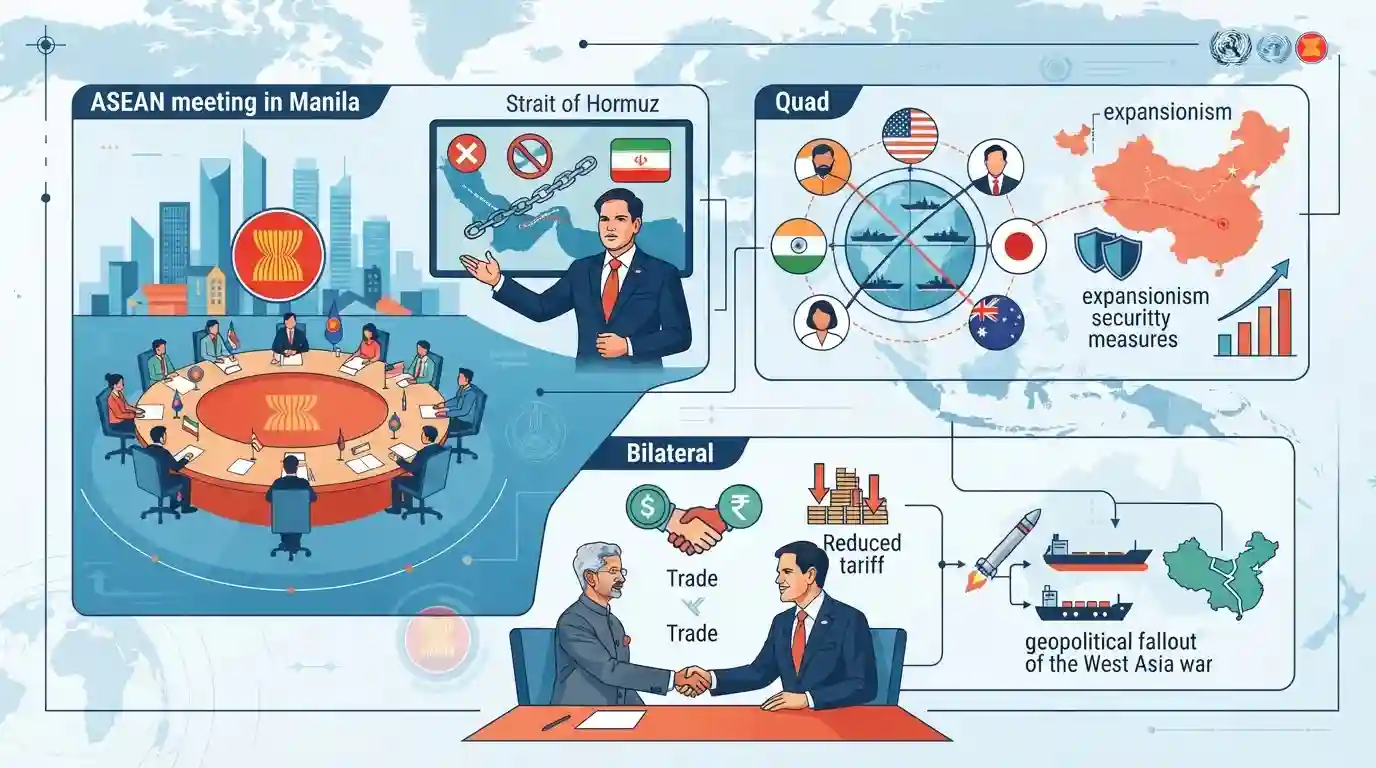
During the ASEAN Foreign Ministers’ meeting in Manila (July 2026), US Secretary of State Marco Rubio criticized Iran's attempts to control and collect tolls in the Strait of Hormuz, calling it a threat to global maritime freedom of navigation. Concurrently, the Quad Foreign Ministers met to strengthen maritime security cooperation in the Indo-Pacific against Chinese expansionism. On the bilateral front, EAM S. Jaishankar and Rubio advanced talks on an almost-complete interim trade deal aimed at lowering US tariffs on Indian goods and discussed the geopolitical fallout of the West Asia war.
ముఖ్య అంశాలు
- US Secretary of State Marco Rubio warned that Iran's demands to control and collect tolls in the Strait of Hormuz threaten global trade, setting a dangerous precedent that could be replicated by other states in waterways like the South China Sea.
- Quad Foreign Ministers (US, India, Australia, Japan) met on the sidelines of the ASEAN meet in Manila, issuing a joint statement reaffirming commitment to Indo-Pacific maritime security and upholding ASEAN centrality to counter Chinese assertiveness.
- External Affairs Minister S. Jaishankar and Marco Rubio agreed that a bilateral interim trade deal to lower US tariffs on Indian goods is nearly finalized, indicating progress in economic diplomacy.
- The resurgent war in West Asia has severely impacted Southeast Asian economies, leading to a strong push for diplomatic cooperation, maritime domain awareness, and supply chain resilience.
ముఖ్యమైన పదాలు
UN Convention on the Law of the Sea (UNCLOS)

An international treaty (1982) establishing a comprehensive legal framework for all marine and maritime activities, defining territorial waters, exclusive economic zones (EEZs), and transit passage rules through international straits.
UPSC context
GS Paper II (International Relations). Tests knowledge of maritime laws, territorial sovereignty, and regional disputes in water bodies like the South China Sea.
Strait of Hormuz
A strategically vital shipping lane between the Persian Gulf and Gulf of Oman, handling over 20% of global oil trade, governed by transit passage under international maritime custom.
UPSC context
GS Paper I (World Geography) and GS Paper II (International Relations). Tests geographic location of global chokepoints and energy security impacts.
India-US Interim Trade Deal
A bilateral trade agreement framework aimed at lowering tariffs, resolving Section 301 supply chain disputes, and boosting mutual trade, paving the way for a comprehensive economic partnership.
UPSC context
GS Paper II (Bilateral agreements) and GS Paper III (Economy). Tests bilateral trade dynamics and tariff negotiation strategies with major partners.
Quad
A strategic security forum comprising India, the US, Japan, and Australia, cooperating on regional security, maritime domain awareness, and promoting a free and open Indo-Pacific.
UPSC context
GS Paper II (Bilateral and plurilateral groupings). Tests security alliances, Indo-Pacific dynamics, and balancing Chinese influence.
ASEAN
A regional organization of ten Southeast Asian nations established to promote political and social stability, economic growth, and regional integration in Southeast Asia.
UPSC context
GS Paper II (Bilateral, regional and global groupings). Tests regional integration, India's Act East policy, and trade agreements.
ప్రిలిమ్స్ ఉచ్చు
Coastal states hold the legal right under UNCLOS to temporarily suspend transit passage through international straits for national security.
Under UNCLOS Article 44, transit passage through international straits cannot be suspended by coastal states. Additionally, Iran has signed but not ratified UNCLOS, claiming transit passage is not customary law.
అనుసంధానమైన స్థిర భావనలు
What is 'Transit Passage' under UNCLOS and how does it differ from 'Innocent Passage'?
- Scope of Application: Transit passage applies to straits used for international navigation connecting high seas/EEZs; innocent passage applies to a state's territorial sea.
- Non-suspendability: Unlike innocent passage, transit passage cannot be suspended or hampered by coastal states for any reason.
- Submarines and Overflight: Transit passage permits overflight and submerged submarine transit, whereas innocent passage requires submarines to surface and fly their flag.
What are the primary maritime choke points for India's trade and energy security?
- Strait of Hormuz: Connects Persian Gulf to Gulf of Oman; carries nearly 45% of India's crude imports and over 55% of its LNG.
- Bab-el-Mandeb: Connects Red Sea to Gulf of Aden; critical for India's trade route to Europe and the Mediterranean.
- Strait of Malacca: Connects Indian Ocean to South China Sea; vital for India's 'Act East' trade and energy flows to East Asia.
అంతర-అంశ నమూనాలు
Energy Security + Maritime Choke Points
Disruptions in West Asian choke points like Hormuz directly jeopardize India's domestic inflation targets and fiscal deficit by forcing expensive spot-market purchases of LNG and crude oil.
Quad IPMDA + ASEAN Centrality
Non-traditional security cooperation like IPMDA acts as a soft-security bridge, allowing the Quad to build trust with suspicious ASEAN nations without creating an explicit military alliance.

Chokepoint geography (Hormuz/Bab-el-Mandeb) and UNCLOS transit passage rules will likely be integrated with IPMDA capabilities in 2026.
అనుసంధాన PYQలు · 4
అనుసంధాన PYQలు · 4
- 2026PrelimsGS1
Ships from which of the following countries have to cross the Strait of Hormuz to reach out to the Indian Ocean ? 1. Bahrain 2. Syria 3. Qatar 4. Egypt Select the answer using the code given below :
- 2017MainsGS2
The question of India's Energy Security constitutes the most important part of India's economic progress. Analyze India's energy policy cooperation with West Asian countries.
- 2021MainsGS2
The newly tri-nation partnership AUKUS is aimed at countering China's ambitions in the Indo-Pacific region. Is it going to supersede the existing partnerships in the region? Discuss the strength and impact of AUKUS in the present scenario.
- 2014MainsGS2
With respect to the South China sea, maritime territorial disputes and rising tension affirm the need for safeguarding maritime security to ensure freedom of navigation and over flight throughout the region. In this context, discuss the bilateral issues between India and China.
