Iranian Warship Sinking Near Sri Lanka After Indian Drills
Source:Indian Express ↗
Why It Matters
The incident touches upon maritime security, multilateral naval diplomacy (like the MILAN exercise), and India's strategic engagements in the IOR. Understanding the presence and operational capabilities of foreign navies in India's maritime neighborhood is crucial for UPSC GS-II (International Relations) and GS-III (Security).
Summary
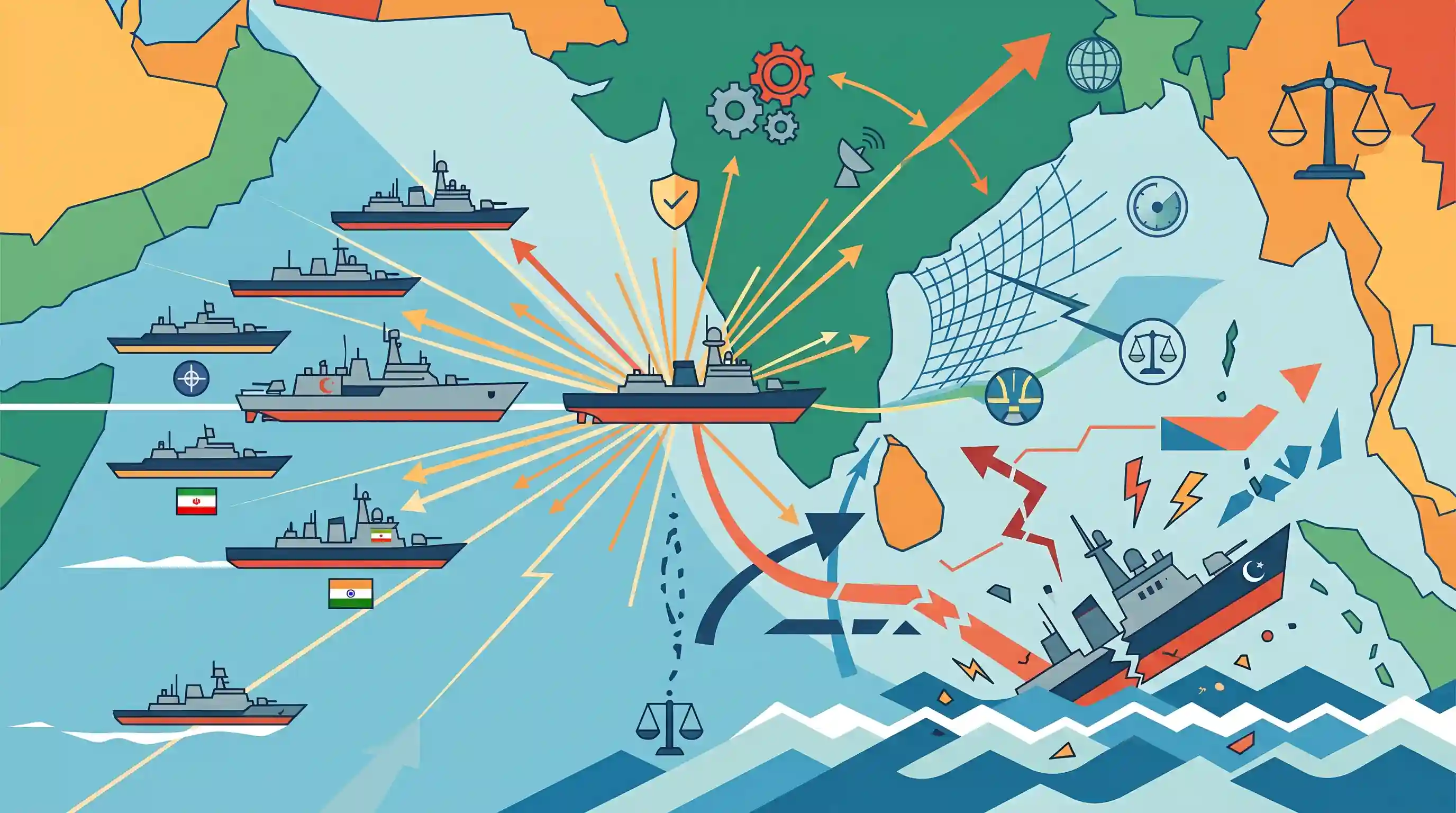
An Iranian warship recently sank near Sri Lanka following its participation in multilateral naval drills hosted by India. The incident highlights both the operational risks associated with long-range naval deployments and the broader geopolitical context of the Indian Ocean Region (IOR). Iran's participation in Indian-hosted exercises underscores New Delhi's strategy of engaging diverse regional players to maintain maritime security and assert its role as a net security provider in the IOR.
Key Points
- An Iranian warship sank near the coast of Sri Lanka while returning or participating in naval activities in the region.
- The vessel had come to Indian waters to participate in multilateral naval drills hosted by India, highlighting Iran's participation in Indian Ocean maritime diplomacy.
- The incident underscores the operational challenges navies face, as well as the growing geopolitical engagement of extra-regional and regional navies in the Indian Ocean.
- India's hosting of such drills reinforces its role as a key security partner and convener in the Indian Ocean Region (IOR).
Important Terms
MILAN Naval Exercise

A biennial multilateral naval exercise hosted by the Indian Navy since 1995, aimed at enhancing interoperability, maritime domain awareness, and professional cooperation among friendly foreign navies.
UPSC context
GS Paper II (IR) & III (Security). Tests India’s maritime diplomacy and its role as a regional net security provider.
Indian Navy
The naval branch of India's armed forces, tasked with safeguarding maritime borders and maintaining stability in the Indian Ocean through strategic patrols, drills, and humanitarian operations.
UPSC context
GS Paper III (Security). Critical for understanding maritime defense strategy and the Indo-Pacific security architecture.
Iranian Navy
The conventional maritime force of Iran, which conducts long-range deployments and participates in international drills like MILAN to project power and engage in regional maritime diplomacy.
UPSC context
GS Paper II (International Relations). Relevant for India-Iran strategic ties and geopolitical shifts in the Indian Ocean.
IRIS Dena
An Iranian Moudge-class frigate that participated in the MILAN 2026 exercise in India; it reportedly sank off the Sri Lankan coast while returning to Iran in March 2026.
UPSC context
GS Paper II/III. Illustrates maritime security risks, operational hazards, and the impact of regional conflicts on Indian Ocean stability.
SAGAR Initiative
India's strategic vision, 'Security and Growth for All in the Region,' emphasizing cooperative maritime security and economic development with its neighbors in the Indian Ocean.
UPSC context
GS Paper II (International Relations). Central framework for India's foreign policy and maritime engagement in the IOR.
Exclusive Economic Zone (EEZ)
A critical maritime zone (up to 200 nautical miles) where a coastal nation has sovereign rights over marine resources, as defined by the UNCLOS.
UPSC context
GS Paper II (International Relations). Relevant for maritime law, sovereignty disputes, and regional search and rescue responsibilities.
Prelims Trap
"Warships enjoy absolute sovereign immunity under UNCLOS and can never be detained or interned by foreign states."
While warships have sovereign immunity, neutral states can and must intern belligerent warships that violate neutrality rules (e.g., overstaying in ports) under international law.
Static Concepts Connected
How does international law govern belligerent warships in neutral waters?
- Innocent Passage: Warships generally enjoy the right of innocent passage through territorial seas under UNCLOS during peacetime.
- Neutrality Rules: Under customary international law and Hague Conventions, belligerent ships must typically leave neutral ports within 24 hours.
- Internment: If a belligerent ship fails to depart, the neutral state has the right and duty to intern the vessel to preserve its neutrality.
What is the MILAN naval exercise?
- Biennial Multilateral: A major biennial multilateral naval exercise hosted by the Indian Navy, initiated in 1995 with just four nations.
- Massive Scale: Currently features dozens of global navies, aiming to enhance interoperability and share maritime operational best practices.
- Net Security Provider: Aligns with India's SAGAR doctrine, showcasing New Delhi's capacity to convene diverse navies for collective IOR security.
Cross-Topic Patterns
India's Strategic Autonomy tightrope
Hosting Iran at MILAN while maintaining a strategic partnership with the US demonstrates India's multi-alignment approach in the IOR, refusing to isolate regional powers despite Western pressure.
IOR Island States as flashpoints
The sinking and UNCLOS internment drag Sri Lanka into US-Iran hostilities, highlighting how small Indian Ocean nations become involuntary arenas for extra-regional great power rivalries.

Expect a multi-statement Prelims question on UNCLOS provisions regarding the sovereign immunity of warships and neutral state rights in 2026.
Linked PYQs · 3
Linked PYQs · 3
- 2024PrelimsGS1
Operations undertaken by the Army towards upliftment of the local population in remote areas to include addressing of their basic needs is called:
- 2024MainsGS2
Discuss the geopolitical and geostrategic importance of Maldives for India with a focus on global trade and energy flows. Further also discuss how this relationship affects India's maritime security and regional stability amidst international competition ?
- 2014MainsGS2
With respect to the South China sea, maritime territorial disputes and rising tension affirm the need for safeguarding maritime security to ensure freedom of navigation and over flight throughout the region. In this context, discuss the bilateral issues between India and China.
