Iran NPT exit threat and global non-proliferation risks
Source:The Hindu ↗
Why It Matters
Iran's potential exit from the NPT is a critical development for global non-proliferation efforts. For India, instability in West Asia and the Persian Gulf threatens energy security, diaspora safety, and regional connectivity projects like the Chabahar Port. Questions on the NPT, IAEA, and the Iran nuclear crisis are mainstays in both Prelims and Mains.
Summary
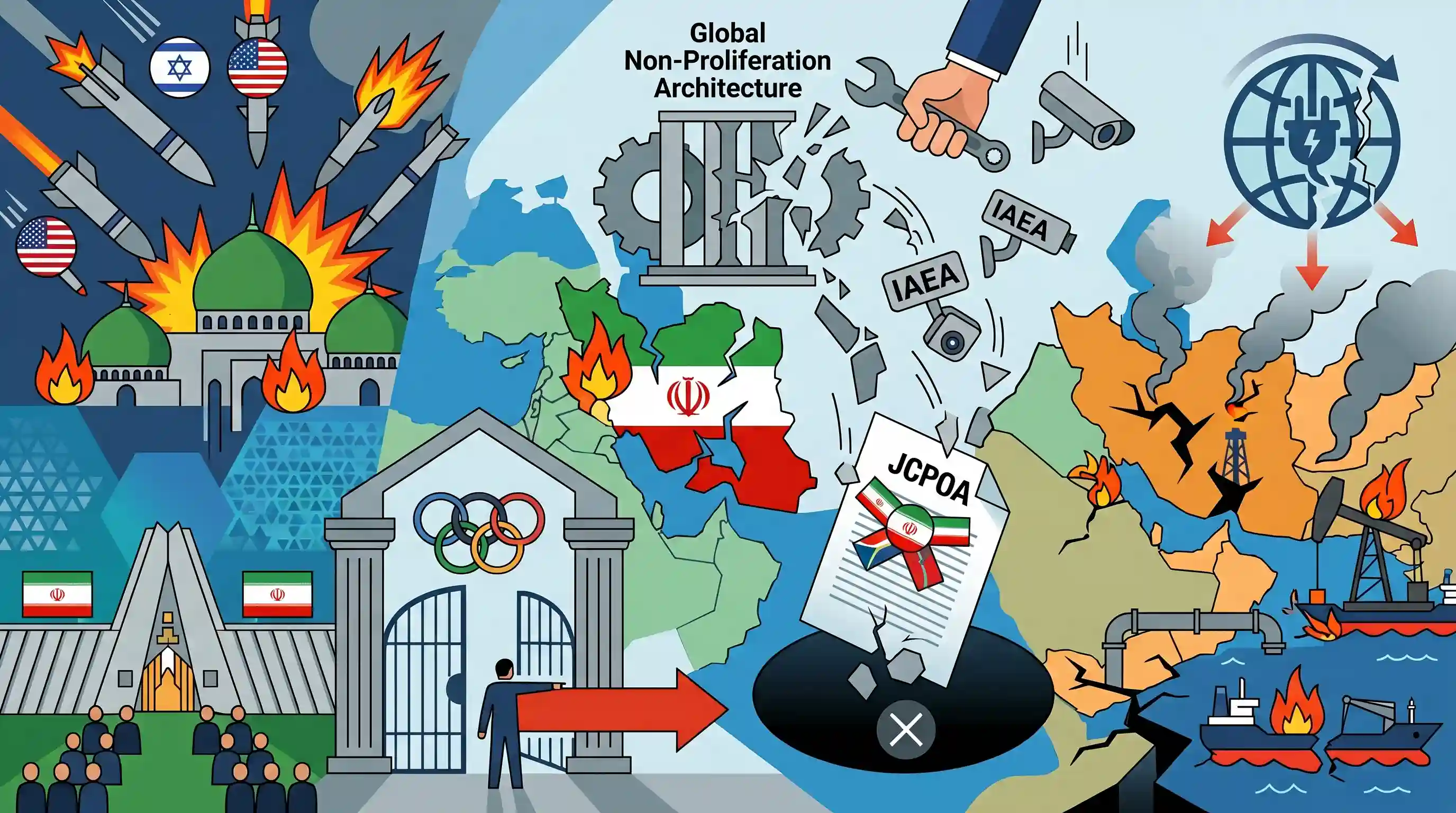
Amidst escalating regional conflict, the Iranian Parliament is considering withdrawing from the Nuclear Non-Proliferation Treaty (NPT) following attacks on Iranian facilities by Israel and the US. Iranian officials argue that hostile nations are denying Iran its rights to peaceful nuclear energy under the treaty. While Iran insists its nuclear ambitions remain peaceful, an exit from the NPT would dismantle international oversight by the IAEA, formally bury the JCPOA, and drastically heighten geopolitical and energy security risks in West Asia.
Key Points
- The Iranian Parliament is evaluating a potential withdrawal from the Nuclear Non-Proliferation Treaty (NPT) following military strikes by Israel and the United States on Iranian facilities.
- Iranian Foreign Ministry spokesperson Esmail Baghaei accused the US and Israel of acting as 'bullying parties' that prevent Iran from benefiting from the peaceful rights guaranteed under the NPT.
- Iran maintains that its nuclear programme is for peaceful purposes, though the threat to exit the NPT raises fears of unchecked nuclear proliferation in West Asia.
- A withdrawal from the NPT would escalate regional tensions, effectively kill any remaining prospects for reviving the JCPOA, and could disrupt global energy trade through the Strait of Hormuz.
Important Terms
Nuclear Non-Proliferation Treaty (NPT)

A 1968 international treaty aiming to prevent nuclear weapons spread, promote peaceful nuclear energy cooperation, and further global disarmament. Iran is a signatory; India is not.
UPSC context
GS Paper II/III: Core of global non-proliferation architecture. India's non-signatory status is a recurring topic in foreign policy and security.
Joint Comprehensive Plan of Action (JCPOA)
The 2015 'Iran Nuclear Deal' between Iran and P5+1 powers, capping Iran's enrichment activities in exchange for lifting international economic sanctions.
UPSC context
GS Paper II: International Agreements. Tests knowledge of West Asian stability and the impact of sanctions on India's energy security.
International Atomic Energy Agency (IAEA)
A UN-affiliated watchdog established in 1957 to promote safe, secure, and peaceful nuclear technologies while verifying that nuclear materials are not diverted for military use.
UPSC context
GS Paper II: Important International Institutions. Relevant for global governance and India's own specific safeguards agreements (e.g., 123 Agreement).
Snapback Mechanism
A provision in UNSC Resolution 2231 allowing JCPOA participants to unilaterally restore pre-2015 UN sanctions if Iran is judged to have breached the nuclear deal.
UPSC context
GS Paper II: International Relations. Tests understanding of diplomatic enforcement tools and the legal complexities of multilateral treaty compliance.
Additional Protocol
A legal instrument granting the IAEA expanded rights of access to information and sites to verify that a state has no undeclared nuclear activities.
UPSC context
GS Paper II: IR/Security. Differentiates standard NPT monitoring from intrusive inspections, critical for analyzing nuclear transparency and trust-building measures.
Prelims Trap
The NPT lacks any legal provisions for withdrawal, making a state's membership permanent.
Article X of the NPT explicitly allows a state to withdraw with a three-month notice if 'extraordinary events' jeopardize its supreme national interests. North Korea used this in 2003.
Static Concepts Connected
Why does India consistently refuse to sign the Nuclear Non-Proliferation Treaty (NPT)?
- Inherently discriminatory: It arbitrarily defines Nuclear Weapon States as only those that tested a device before January 1, 1967, treating India as a non-nuclear state.
- Disarmament failure: The treaty imposes no legally binding, time-bound commitment on the recognized P-5 nations to achieve comprehensive global nuclear disarmament.
- Sovereign deterrence: India views an independent nuclear deterrent as essential for its national security and sovereign strategic autonomy, given its nuclear-armed neighbors.
What is the IAEA 'Additional Protocol'?
- Expanded access: It grants IAEA inspectors enhanced, broader access rights to inspect both declared and undeclared nuclear facilities within a state.
- Short-notice inspections: It allows for short-notice or unannounced inspections to verify that a state is not hiding clandestine nuclear activities.
- Voluntary ratification: It is not an automatic NPT provision; member states must voluntarily negotiate and ratify it with the IAEA.
Cross-Topic Patterns
NPT exit and Chabahar sanctions
Iran's withdrawal from the NPT will likely trigger extreme secondary US sanctions, jeopardizing India's strategic investments and fragile sanction-waivers for the Chabahar port and the INSTC corridor.
Hormuz chokepoint & energy security
Escalating West Asian nuclear tensions threaten the Strait of Hormuz—the vital maritime artery between the Persian Gulf and Gulf of Oman handling much of India's LNG and crude imports.

Expect a multi-statement prelims question mapping NPT, CTBT, and TPNW provisions against India's official signatory status and stance.
Linked PYQs · 4
Linked PYQs · 4
- 2018MainsGS2
In what ways would the ongoing US-Iran Nuclear Pact Controversy affect the national interest of India? How should India respond to this situation?
- 2015PrelimsGS1
Consider the following countries: 1. China 2. France 3. India 4. Israel 5. Pakistan Which among the above are Nuclear Weapons States as recognized by the Treaty on the Non-Proliferation of Nuclear Weapons, commonly known as Nuclear Non-Proliferation Treaty (NPT)?
- 2018PrelimsGS1
What is/are the consequence/consequences of a country becoming the member of the 'Nuclear Suppliers Group'? 1. It will have access to the latest and most efficient nuclear technologies. 2. It automatically becomes a member of "The Treaty on the Non-Proliferation of Nuclear Weapons (NPT)". Which of the statements given above is/are correct?
- 2018PrelimsGS1
In the Indian context, what is the implication of ratifying the 'Additional Protocol' with the 'International Atomic Energy Agency (IAEA)'?
