Iran and United States Nuclear Diplomacy and Negotiations
Source:The Hindu ↗
Why It Matters
The trajectory of U.S.-Iran nuclear negotiations directly impacts the geopolitical stability of West Asia. For India, this relationship is vital as it affects global energy security (oil prices), regional trade dynamics, and strategic investments like the Chabahar Port. It is a recurring theme in UPSC examinations evaluating India's foreign policy maneuvering in the Middle East.
Summary
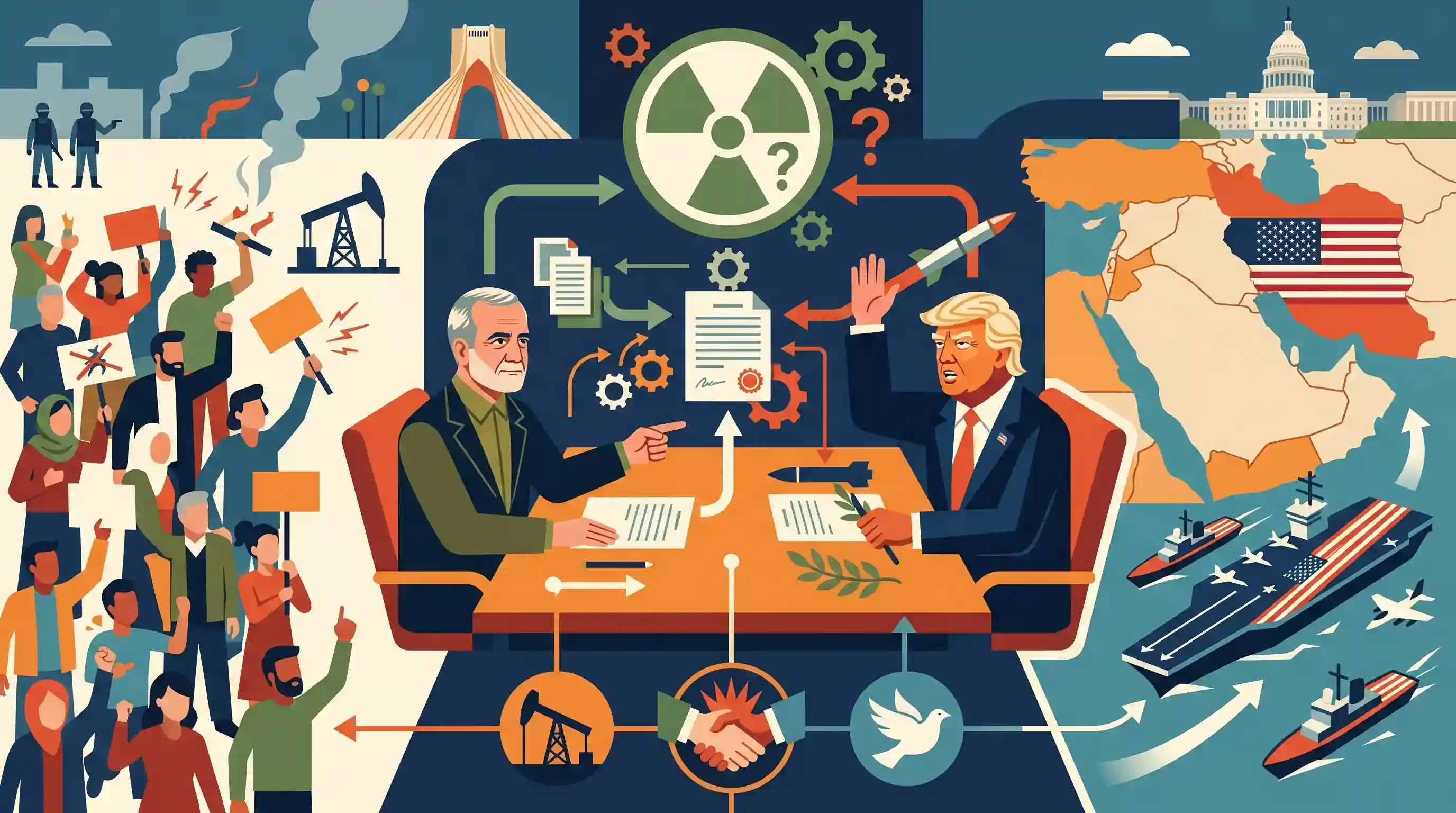
Iranian President Masoud Pezeshkian has ordered the commencement of nuclear negotiations with the United States, aiming to formulate a framework for talks. The decision comes amidst heightened regional tensions, following recent deadly anti-government protests in Iran and the U.S. deploying an aircraft carrier group to West Asia. U.S. President Donald Trump has utilized coercive diplomacy, threatening military action while simultaneously expressing hope for a deal to avert conflict.
Key Points
- Iranian President Masoud Pezeshkian has ordered the start of nuclear talks with the United States to establish a framework for negotiations.
- This development follows a period of heightened tensions, including severe domestic anti-government protests in Iran.
- The U.S., under Donald Trump, has applied coercive diplomacy by threatening military action and deploying an aircraft carrier group to West Asia.
- Resuming these nuclear talks is seen as a crucial step to de-escalate military tensions and avoid a broader conflict in the Middle East.
Important Terms
Joint Comprehensive Plan of Action (JCPOA)

A 2015 agreement between Iran and P5+1 powers (US, UK, France, China, Russia, and Germany) limiting Iran's nuclear program in exchange for lifting economic sanctions.
UPSC context
GS Paper II (International Relations). Tests knowledge of global agreements affecting India’s energy security and regional stability.
Coercive Diplomacy
A diplomatic strategy using threats of force, economic sanctions, or limited military action to compel an adversary to change its policies without resorting to full-scale war.
UPSC context
GS Paper II (IR). Essential for understanding tools of statecraft and strategic behavior of major powers in West Asia.
Masoud Pezeshkian
The President of Iran (elected 2024), recognized for his moderate reformist stance and advocating for diplomatic engagement with the West to secure sanctions relief.
UPSC context
GS Paper II. Relevant for tracking leadership transitions and foreign policy shifts in countries critical to India's interests.
West Asia Geopolitics
The complex political and security dynamics of the Middle East, primarily centered on energy resources, maritime chokepoints, and the influence of regional powers like Iran and Israel.
UPSC context
GS Paper II. Crucial for India’s ‘Look West’ policy, energy security, and the welfare of 9 million Indian expats.
Fars News Agency
A semi-official Iranian news agency frequently linked to the Islamic Revolutionary Guard Corps (IRGC), often used to disseminate official state perspectives and strategic narratives.
UPSC context
GS Paper II. Important for analyzing regional communication channels and identifying official state-backed narratives in West Asian conflicts.
Prelims Trap
The 'snapback' mechanism requires a unanimous vote or consensus by the UN Security Council to reimpose sanctions on Iran.
The snapback mechanism was specifically designed to bypass vetoes. Any single participant state can trigger it to automatically restore pre-2015 UN sanctions, overriding Russia or China.
Static Concepts Connected
What is the IAEA 'Additional Protocol' in nuclear diplomacy?
- Expanded access: Grants IAEA inspectors broadened legal rights to investigate both declared and undeclared nuclear activities and facilities.
- Snap inspections: Allows for short-notice, comprehensive 'snap' inspections across a member state's entire nuclear fuel cycle.
- India's status: India signed an India-specific Additional Protocol in 2009, bringing its civilian nuclear facilities under IAEA safeguards.
Why is the Strait of Hormuz a critical global maritime chokepoint?
- Geographic location: It connects the energy-rich Persian Gulf to the Gulf of Oman and the broader Arabian Sea.
- Bordering nations: It is bounded by Iran to the north and the Musandam Peninsula (Oman) to the south.
- Oil transit: It facilitates the transit of roughly a fifth of global oil consumption; blockades immediately shock global energy markets.
Cross-Topic Patterns
US Secondary Sanctions vs India's Energy
US 'maximum pressure' uses extraterritorial secondary sanctions, previously forcing India to zero-out Iranian oil imports. This directly impacts India's macroeconomic stability, energy diversification, and strategic autonomy.
Chabahar Port and INSTC Viability
Resumed US-Iran talks reduce sanction risks for Indian entities developing Chabahar Port, potentially accelerating the International North-South Transport Corridor's (INSTC) operationalization for Central Asian access.

Expect a 2026 Prelims question linking West Asian maritime chokepoints (Hormuz) with IAEA oversight mechanisms (Additional Protocol).
Linked PYQs · 2
Linked PYQs · 2
- 2018MainsGS2
In what ways would the ongoing US-Iran Nuclear Pact Controversy affect the national interest of India? How should India respond to this situation?
- 2012MainsGS2
How have the US sanctions against Iran affected India's bilateral relations with Iran?
