Iranian Hackers Target Critical Infrastructure Following US Strikes
Source:The Hindu ↗
Why It Matters
Demonstrates the rising prominence of cyber operations as a tool of statecraft and asymmetric warfare. It underscores the vulnerabilities of critical infrastructure and serves as a vital case study for India's own internal security and cyber defence preparedness under GS3.
Summary
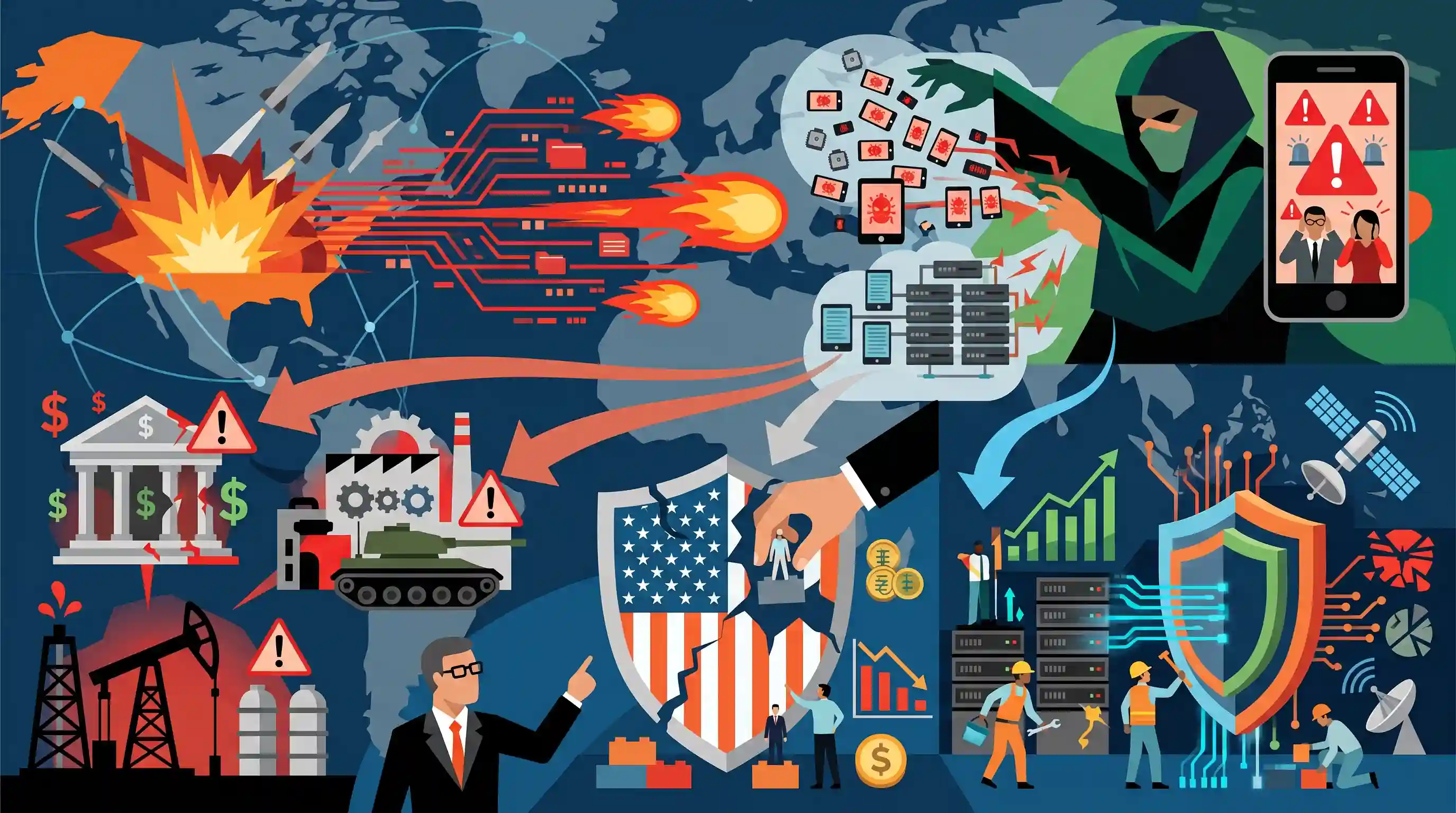
The article discusses the surge in cyberattacks by Iranian-backed hackers targeting U.S. banks, defence contractors, and oil companies following American kinetic strikes on Iranian nuclear facilities. While Iran may lack the advanced technical capabilities of China or Russia, it acts as a "chaos agent" using cost-effective cyber operations—such as DDoS attacks and psychological operations (like fake emergency alerts in Israel)—to exact political and economic tolls. Despite these growing asymmetric threats, the U.S. faces heightened vulnerabilities due to recent budget and staff cuts at critical cybersecurity agencies like CISA and the NSA under the Trump administration. Experts emphasize that the evolving landscape of hybrid conflict requires constant investment in cyber defence to secure critical infrastructure against both state-sponsored and independent hacking groups.
Key Points
- Iranian-backed hackers are targeting U.S. critical infrastructure, including banks, defence contractors, and oil companies, following U.S. strikes on Iranian nuclear facilities.
- These operations are mainly denial-of-service (DDoS) attacks intended to create economic disruption, psychological impact, and collect intelligence, acting as a form of asymmetric warfare.
- Cyber warfare is significantly cheaper than kinetic warfare, but heavily reliant on exploiting vulnerabilities in the target's digital infrastructure.
- The Trump administration has recently reduced funding and staffing for federal cybersecurity agencies (CISA, CIA, NSA), raising concerns about U.S. digital vulnerability.
- The ongoing Israel-Iran conflict highlights the indispensable value of sophisticated cyber espionage and continuous investment in robust digital defences.
Important Terms
CISA (Cybersecurity and Infrastructure Security Agency)

The U.S. federal agency responsible for operational cyber defense and protecting critical infrastructure from physical and digital threats. It coordinates with government and private sectors to enhance national resilience.
UPSC context
GS III: Internal Security; relevant for studying international cyber-defense models and critical infrastructure protection frameworks.
Hybrid Warfare
A strategy blending conventional military force with unconventional tools like cyberattacks, disinformation, and economic coercion to achieve strategic objectives while remaining below the threshold of open war.
UPSC context
GS III: Internal Security; a core concept for analyzing modern threats from state and non-state actors.
Critical Information Infrastructure (CII)
Computer resources whose incapacitation or destruction would have a debilitating impact on national security, economy, or public safety. In India, these are protected under the IT Act, 2000.
UPSC context
GS III: Cybersecurity; essential for questions on digital asset protection and the role of agencies like NCIIPC.
NSA (National Security Agency)
A major U.S. intelligence agency specialized in signals intelligence (SIGINT) and cybersecurity, often working in tandem with military commands for offensive and defensive cyber operations.
UPSC context
GS III: Internal Security; important for understanding global intelligence-military cooperation in cyberspace.
Asymmetric Warfare
Conflict between parties of significantly unequal power, where the weaker side employs unconventional tactics (such as cyber warfare or proxy attacks) to exploit the vulnerabilities of the stronger side.
UPSC context
GS III: Security Challenges; critical for analyzing state-sponsored proxy wars and low-cost, high-impact cyber threats.
DDoS (Distributed Denial of Service)
A cyberattack that attempts to crash a network, server, or service by overwhelming it with a flood of internet traffic from multiple compromised sources.
UPSC context
GS III: Cybersecurity; tests knowledge of common cyberattack mechanisms and infrastructure resilience.
Department of Homeland Security (DHS)
A U.S. cabinet-level department created to coordinate domestic security efforts, encompassing counterterrorism, border security, and cybersecurity (overseeing CISA).
UPSC context
GS III: Internal Security; provides a comparative framework for India's domestic security and disaster management architecture.
Prelims Trap
CERT-In is the nodal agency mandated to secure India's Critical Information Infrastructure (CII).
While CERT-In handles general cybersecurity incidents, NCIIPC (under NTRO) is the specific nodal agency designated under the IT Act to protect Critical Information Infrastructure.
Static Concepts Connected
What is Critical Information Infrastructure (CII) and who protects it in India?
- IT Act 2000: Section 70 of the Act defines CII as computer resources whose destruction or incapacitation would have a debilitating impact on national security, economy, or public health.
- NCIIPC: The National Critical Information Infrastructure Protection Centre (NCIIPC), functioning under the National Technical Research Organisation (NTRO), is the nodal agency.
- Key Sectors: Includes Power/Energy, Banking and Financial Services, Telecom, Transport, Government, and Strategic Public Enterprises.
How do asymmetric cyber attacks function in hybrid warfare?
- DDoS Attacks: Distributed Denial of Service (DDoS) attacks overwhelm target servers with fake traffic, crippling essential digital services affordably and creating economic disruption.
- Plausible Deniability: States employ proxy hacker groups (Advanced Persistent Threats) to launch attacks, enabling them to deny direct involvement and avoid conventional military retaliation.
- Psychological Ops: Cyber actions are increasingly combined with disinformation (e.g., broadcasting fake emergency alerts) to erode public trust in state institutions and trigger panic.
Cross-Topic Patterns
Hybrid warfare via proxy actors
State-sponsored hackers act as digital proxies, mirroring how states historically use non-state armed groups to maintain plausible deniability and achieve strategic goals without triggering direct war.
Cyber-defense capacity constraints
The vulnerability of U.S. critical agencies due to budget cuts parallels India's own administrative challenges in adequately funding, staffing, and retaining talent in specialized cybersecurity bodies like CERT-In and NCIIPC.

Expect a GS3 Mains question exploring the integration of asymmetric cyber warfare, critical infrastructure attacks, and psychological ops.
Linked PYQs · 4
Linked PYQs · 4
- 2017MainsGS3
Discuss the potential threats of Cyber attack and the security framework to prevent it.
- 2020MainsGS3
Discuss different types of cyber crimes and measures required to be taken to fight the menace.
- 2021MainsGS3
Keeping in view India's internal security, analyse the impact of cross-border cyber attacks. Also discuss defensive measures against these sophisticated attacks.
- 2019MainsGS3
What is CyberDome Project? Explain how it can be useful in controlling internet crimes in India.
