West Asia tensions and weak rupee inflate India fertiliser bill
Source:Indian Express ↗
Why It Matters
The issue perfectly highlights the vulnerability of India's macroeconomic stability and agricultural security to global supply chain disruptions. It connects GS2 themes (West Asian geopolitics, Strait of Hormuz) directly with GS3 concerns (fertiliser subsidies, fiscal deficit, exchange rate impacts, and the promotion of sustainable agriculture via nano-fertilisers), making it highly relevant for both Prelims (chemistry of fertilisers, economic indicators) and Mains (policy analysis).
Summary
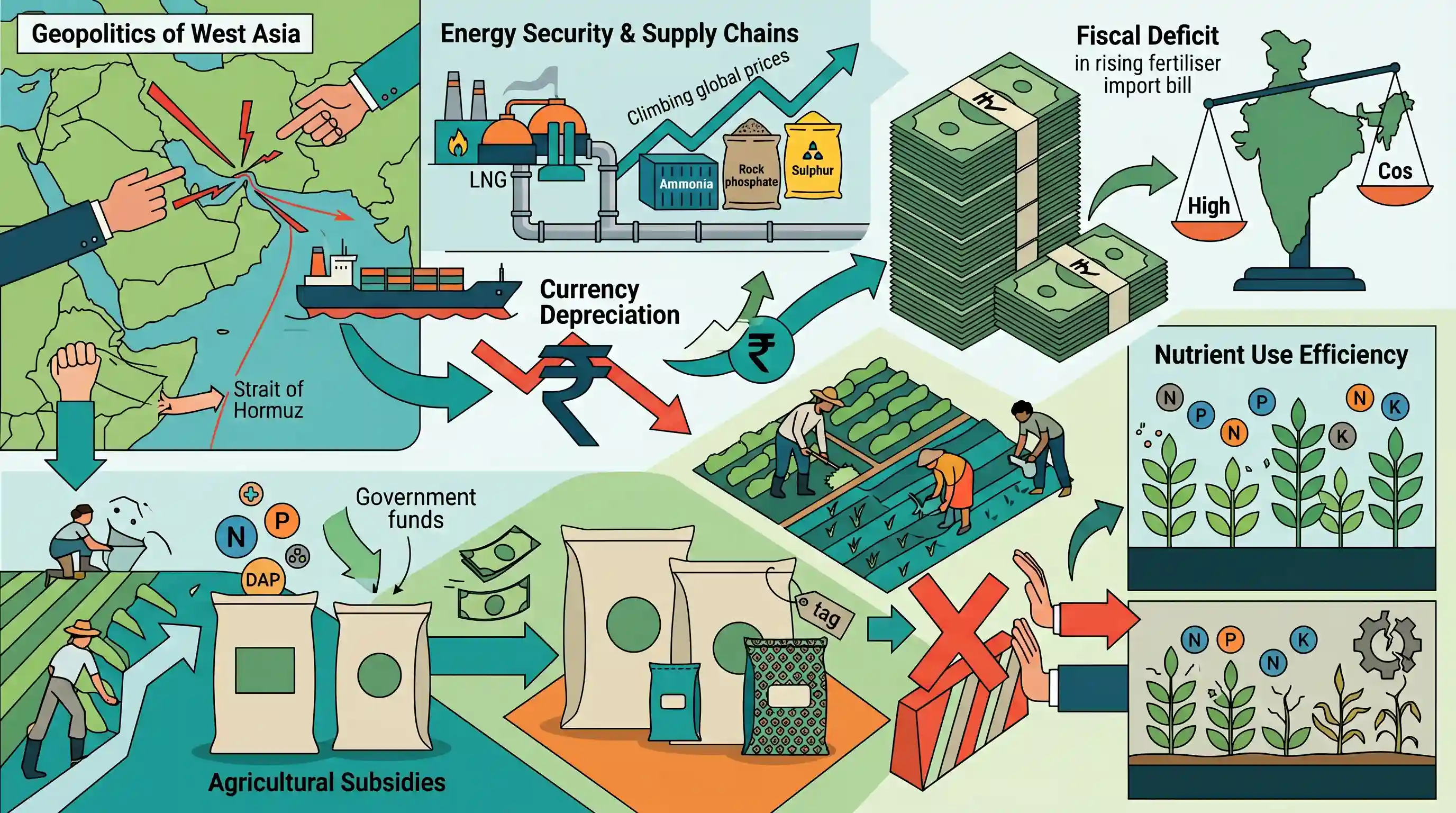
The article analyzes the compounding challenges facing India's agricultural sector and fiscal budget as the fertiliser import bill faces steep increases. This surge is driven by a depreciating rupee and volatile geopolitical tensions in West Asia, particularly involving Iran, which threaten critical maritime choke points like the Strait of Hormuz. Consequently, global prices for essential fertiliser raw materials—such as LNG, ammonia, rock phosphate, and sulphur—are climbing. Concurrently, recent state-level bans on "tagging" (cross-selling non-subsidised specialty and nano-fertilisers with subsidised ones like urea and DAP) have sparked debate, with the industry warning the restriction could undermine the broader push for balanced crop nutrition and improved nutrient use efficiency.
Key Points
- India's fertiliser import bill is expected to face upward pressure due to escalating geopolitical tensions in West Asia (involving Iran and Israel) and a depreciating rupee.
- The potential disruption of shipping routes, particularly the Strait of Hormuz, threatens the supply and increases the cost of crucial raw materials like LNG, ammonia, rock phosphate, and sulphur.
- A depreciating rupee makes dollar-denominated imports of finished fertilisers (like Urea and DAP) and raw materials more expensive, expanding the fiscal burden of agricultural subsidies.
- Several state governments have banned the practice of 'tagging' (forcing farmers to buy non-subsidised nano-fertilisers or micronutrients alongside subsidised bulk fertilisers), a move the industry argues could derail efforts to promote balanced fertilisation and nutrient use efficiency.
Important Terms
Nutrient Based Subsidy (NBS)

A subsidy mechanism for non-urea (P&K) fertilisers where government support is fixed based on the nutrient content (N, P, K, S) rather than the product's weight.
UPSC context
GS Paper 3 (Agriculture/Subsidies); tests understanding of fertiliser pricing reforms and soil health management.
Direct Benefit Transfer (DBT)
A policy where fertiliser subsidies are released to manufacturers only after a retail sale is verified through Aadhaar-authenticated Point of Sale (PoS) devices.
UPSC context
GS Paper 2 & 3 (Governance/Subsidies); focuses on leakage reduction and fiscal transparency in welfare delivery.
Nutrient Use Efficiency (NUE)
The ratio between nutrients absorbed by a crop and the total nutrients applied, highlighting how effectively fertilisers are used to minimize waste and environmental pollution.
UPSC context
GS Paper 3 (Environment/Agriculture); critical for sustainable farming and reducing the fiscal burden of over-fertilisation.
Nano-Fertilisers
Highly efficient, liquid-form fertilisers (like Nano Urea) that deliver nutrients at the nanoscale, improving absorption and significantly reducing the physical volume of fertiliser needed.
UPSC context
GS Paper 3 (Science & Tech/Agriculture); tests awareness of indigenous technological innovations in food security.
Strait of Hormuz
A narrow waterway between Iran and Oman through which approximately 20-30% of global oil, LNG, and critical fertiliser raw materials transit.
UPSC context
GS Paper 2 (International Relations); essential for understanding India’s energy security and maritime trade vulnerabilities.
Fiscal Deficit
The gap between the government’s total expenditure (including massive fertiliser subsidies) and its total non-borrowed receipts, worsened by global price shocks and rupee depreciation.
UPSC context
GS Paper 3 (Indian Economy); relates to the challenge of balancing farmer welfare with budgetary discipline.
Prelims Trap
"Both Urea and DAP are covered under the Nutrient Based Subsidy (NBS) scheme, allowing market forces to determine their retail prices."
Urea is explicitly excluded from the NBS scheme. Its maximum retail price (MRP) is statutorily fixed by the central government. Only P&K fertilisers (like DAP) fall under NBS with decontrolled retail prices.
Static Concepts Connected
What are the key differences in pricing and subsidy mechanisms for Urea vs P&K fertilisers?
- NBS Scheme: Only Phosphatic and Potassic (P&K) fertilisers are covered. A fixed amount of subsidy is provided based on the nutrient content (N, P, K, S).
- Urea Pricing: Urea is heavily subsidized and its retail price is strictly controlled and fixed by the government, ensuring affordability for farmers regardless of global price fluctuations.
- DBT Mechanism: Under the current DBT system, the subsidy is released to companies only after actual sales are registered by the farmer on POS devices at retail outlets.
Why is the Strait of Hormuz a critical global maritime chokepoint?
- Geographical Location: It connects the Persian Gulf to the Gulf of Oman and the Arabian Sea, bordered by Iran to the north and Oman and the UAE to the south.
- Economic Significance: It is the world's most important oil transit chokepoint, handling over 20% of global petroleum liquids consumption and crucial LNG shipments for India's fertiliser sector.
Cross-Topic Patterns
Currency depreciation inflating subsidy bills
A depreciating INR directly inflates the cost of dollar-denominated raw materials like LNG and rock phosphate, forcing the government to either raise farmer prices or absorb the cost, widening the fiscal deficit.
Nano-fertilisers vs. farmer welfare (Tagging)
The state bans on 'tagging' highlight the friction between accelerating agricultural tech adoption (Nano Urea for higher Nutrient Use Efficiency) and protecting marginal farmers from coercive market practices.

Expect a 2026 prelims question linking West Asian maritime chokepoints (Hormuz) to India's fiscal deficit via the fertiliser subsidy bill.
Linked PYQs · 5
Linked PYQs · 5
- 2020PrelimsGS1
With reference to chemical fertilizers in India, consider the following statements : 1. At present, the retail price of chemical fertilizers is market-driven and not administered by the Government. 2. Ammonia, which is an input of urea, is produced from natural gas. 3. Sulphur, which is a raw material for phosphoric acid fertilizer, is a by-product of oil refineries. Which of the statements given above is/are correct?
- 2016PrelimsGS1
Why does the Government of India promote the use of 'Neem-coated Urea' in agriculture?
- 2023MainsGS3
What are the direct and indirect subsidies provided to farm sector in India? Discuss the issues raised by the World Trade Organization (WTO) in relation to agricultural subsidies.
- 2025MainsGS2
"Energy security constitutes the dominant kingpin of India's foreign policy, and is linked with India's overarching influence in Middle Eastern countries.” How would you integrate energy security with India's foreign policy trajectories in the coming years?
- 2017MainsGS2
The question of India's Energy Security constitutes the most important part of India's economic progress. Analyze India's energy policy cooperation with West Asian countries.
