Iran Condemns US Nuclear Strikes and Warns of Retaliation
Source:Indian Express ↗
Why It Matters
Military escalation between the US and Iran over nuclear facilities severely destabilizes the Middle East, threatening global energy security and supply chains passing through the Strait of Hormuz. The event also has deep implications for international law, the relevance of the NPT, and the geopolitical alignments of India in the region.
Summary
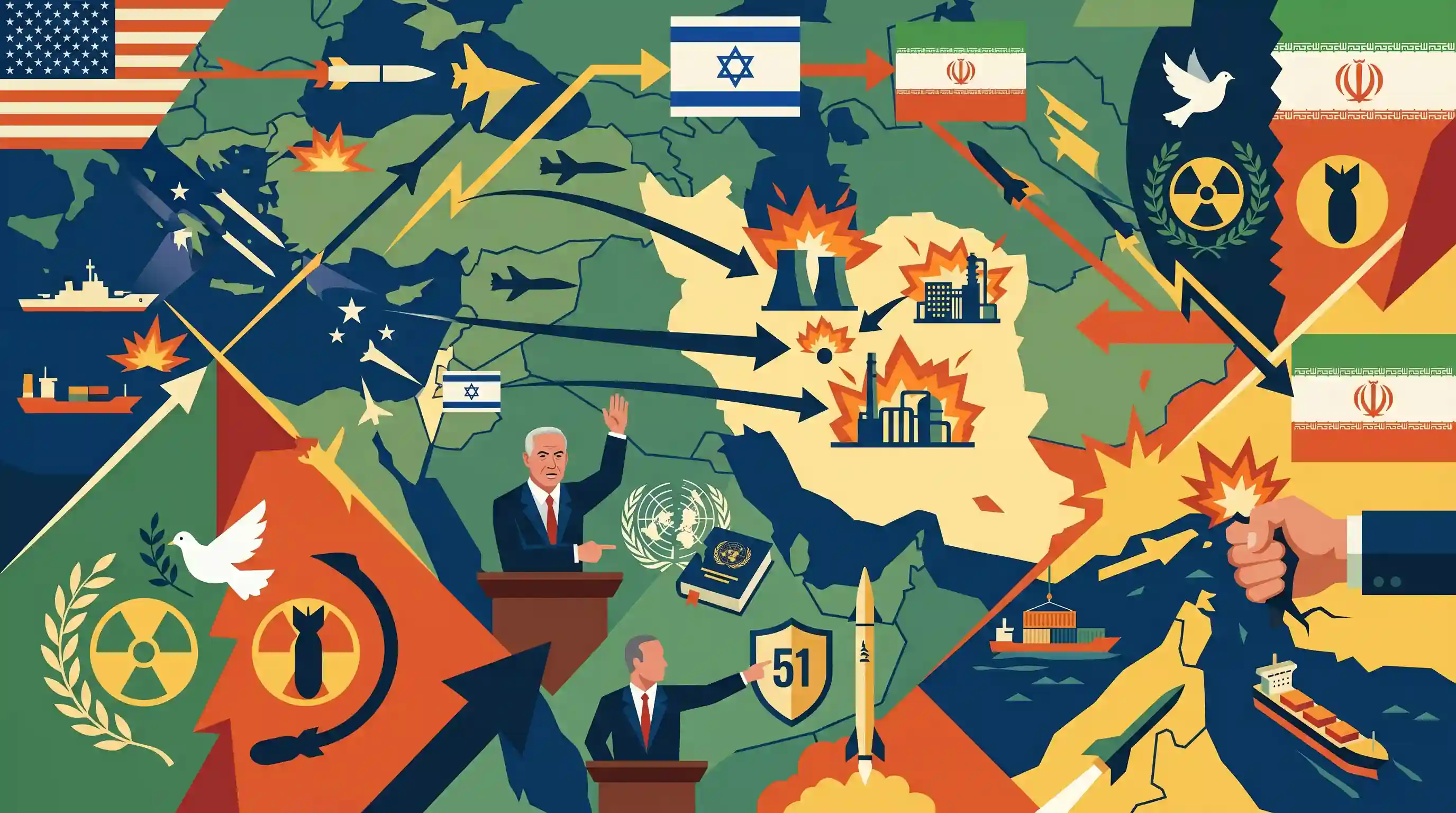
Following US military strikes on Iran’s nuclear facilities in Isfahan, Fordo, and Natanz, Iran’s Foreign Minister Abbas Araghchi condemned the actions as a "criminal" violation of the UN Charter and international law. Iran warned of a "legitimate response" under Article 51 of the UN Charter, raising fears of a broader military conflict. While Iranian authorities assert their nuclear program remains peaceful, the strikes underscore the escalating geopolitical volatility in the Middle East involving the US, Israel, and Iran, and threaten regional energy routes like the Strait of Hormuz.
Key Points
- The US military conducted airstrikes targeting key Iranian nuclear facilities at Isfahan, Fordo, and Natanz, sharply escalating regional tensions.
- Iran's Foreign Minister condemned the attacks as violations of international law, the UN Charter, and the Non-Proliferation Treaty (NPT).
- Invoking Article 51 of the UN Charter, Iran warned of a legitimate response to exercise its right to self-defense against the strikes.
- The strikes exacerbate the already volatile US-Iran-Israel geopolitical triangle and highlight the limitations of E3/EU diplomatic efforts in the region.
Important Terms
Treaty on the Non-Proliferation of Nuclear Weapons (NPT)

A 1970 international treaty aimed at preventing the spread of nuclear weapons, promoting peaceful nuclear energy use, and achieving global disarmament. Iran is a signatory as a non-nuclear-weapon state.
UPSC context
GS-II: International Relations. Essential for understanding global non-proliferation regimes and India's unique stance on the "nuclear haves" vs. "have-nots."
Article 51 (UN Charter)
A provision in the UN Charter that recognizes the inherent right of a member state to individual or collective self-defense if an armed attack occurs.
UPSC context
GS-II: International Organizations. Tests legal foundations of military action, state sovereignty, and the role of the UN Security Council.
Strait of Hormuz
A strategic maritime chokepoint between Iran and Oman connecting the Persian Gulf to the Arabian Sea; it carries roughly 20% of the world’s oil supply.
UPSC context
GS-I: Geography; GS-II: Energy Security. Critical for mapping maritime chokepoints and assessing India's energy import vulnerabilities.
Joint Comprehensive Plan of Action (JCPOA)
The 2015 agreement between Iran and the P5+1 powers (plus Germany/EU) to limit Iran's nuclear enrichment in exchange for the lifting of economic sanctions.
UPSC context
GS-II: Bilateral/Multilateral Agreements. A frequent case study for diplomacy, regional stability in West Asia, and US-Iran relations.
E3/EU
The diplomatic group comprising France, Germany, and the UK, acting alongside the European Union, primarily focused on maintaining the Iran nuclear framework.
UPSC context
GS-II: International Relations. Highlights the role of European powers as mediators and stakeholders in Middle Eastern security.
International Atomic Energy Agency (IAEA)
The United Nations’ nuclear watchdog based in Vienna, tasked with verifying that nuclear material remains in peaceful use through inspections.
UPSC context
GS-II: Statutory, Regulatory and Quasi-judicial Bodies. Tests knowledge of international monitoring, nuclear safeguards, and institutional governance.
Prelims Trap
"Iran, similar to India and Israel, is a non-signatory to the Nuclear Non-Proliferation Treaty (NPT)."
Iran is an NPT signatory. Its geopolitical disputes stem from alleged violations of IAEA safeguard agreements and uranium enrichment limits, not from NPT non-membership.
Static Concepts Connected
Which water bodies and countries border the Strait of Hormuz?
- Water bodies: It acts as a critical chokepoint connecting the Persian Gulf to the Gulf of Oman and the Arabian Sea.
- Bordering nations: It is bounded by Iran to the north and Oman (Musandam Peninsula) and the United Arab Emirates to the south.
- Strategic value: It is the world's most important oil transit chokepoint, facilitating a massive share of global petroleum and India's LNG imports.
What does Article 51 of the UN Charter entail regarding the use of force?
- Right to self-defense: It grants UN member states the inherent right of individual or collective self-defense if an armed attack occurs against them.
- Reporting mandate: Any military measures taken under this article must be immediately reported to the United Nations Security Council.
- Exception to force: It acts as the primary legal exception to Article 2(4) of the UN Charter, which generally prohibits the threat or use of force.
Cross-Topic Patterns
Gulf Instability & India's Economy
Disruptions in the Strait of Hormuz directly spike India's crude import bill, triggering imported inflation and widening the Current Account Deficit, linking Middle East geopolitics to domestic macroeconomic stability.
IAEA Safeguards vs NPT Compliance
UPSC often tests NPT and IAEA safeguard distinctions. Iran's crisis highlights the limits of IAEA inspections when a signatory enriches uranium beyond civilian limits, contrasting with India's specific safeguard agreements.

Expect a 2026 Prelims map-pairing question on Middle East nuclear sites (Natanz, Fordo) alongside strategic chokepoints like the Strait of Hormuz.
Linked PYQs · 3
Linked PYQs · 3
- 2015PrelimsGS1
Consider the following countries: 1. China 2. France 3. India 4. Israel 5. Pakistan Which among the above are Nuclear Weapons States as recognized by the Treaty on the Non-Proliferation of Nuclear Weapons, commonly known as Nuclear Non-Proliferation Treaty (NPT)?
- 2025MainsGS2
"Energy security constitutes the dominant kingpin of India's foreign policy, and is linked with India's overarching influence in Middle Eastern countries.” How would you integrate energy security with India's foreign policy trajectories in the coming years?
- 2018MainsGS2
“India’s relations with Israel have, of late, acquired a depth and diversity, which cannot be rolled back.” Discuss.
