Geopolitical Impact of US Iran Conflict on Global Energy Security
Source:Indian Express ↗
Why It Matters
Disruptions in critical maritime chokepoints like the Strait of Hormuz pose massive threats to global energy security and inflation, heavily impacting energy-dependent nations like India. Furthermore, the accelerating shift in global hegemony from the US towards a Sino-Russian alignment fundamentally alters the strategic environment in which India must navigate its foreign policy.
Summary
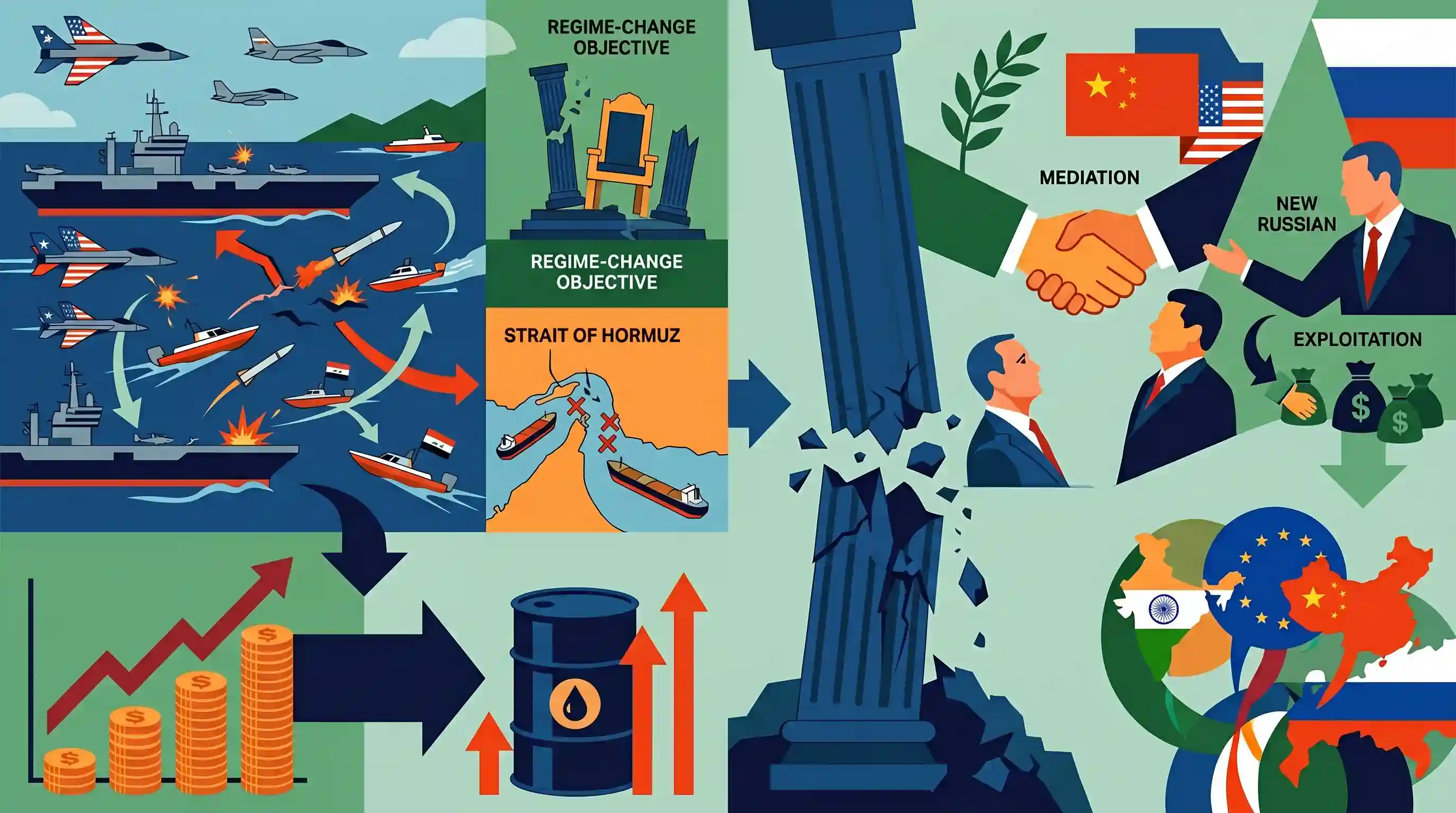
The article analyzes a hypothetical near-future US war against Iran, drawing historical parallels to Britain’s failure in the American War of Independence. It highlights how the US military's technological edge is blunted by logistical challenges, asymmetrical Iranian tactics, and unrealistic regime-change objectives. Beyond military failures and massive domestic economic fallout—such as soaring inflation and $130/barrel oil prices due to disruptions in the Strait of Hormuz—the war carries profound geopolitical implications. By forcing the US to rely on China to mediate an exit, while Russia exploits the distraction, the conflict underscores the waning of unipolar American hegemony and the accelerating transition toward a multipolar world order defined by shifting alliances.
Key Points
- A hypothetical US war on Iran in 2026 demonstrates the limits of military superiority when faced with asymmetrical warfare, poor logistics, and unrealistic objectives like regime change.
- The conflict caused severe disruption at the Strait of Hormuz, driving global crude oil prices to $130 a barrel and causing crippling domestic inflation in the US.
- To exit the quagmire, the US administration was forced to seek mediation from China, highlighting a significant shift in global power dynamics.
- The distraction of the US in the Middle East provided strategic advantages to Russia and China, accelerating the decline of unipolar American hegemony and the rise of a multipolar world order.
Important Terms
Islamic Revolutionary Guard Corps (IRGC)

Iran's elite military branch, separate from the regular army, reporting directly to the Supreme Leader. It manages internal security, external proxy networks (Quds Force), and large segments of the national economy.
UPSC context
GS Paper 2: International Relations; crucial for understanding West Asian security dynamics, proxy warfare, and India-Iran relations.
Strait of Hormuz
The world's most critical oil chokepoint, located between Iran and Oman. It connects the Persian Gulf to the Gulf of Oman and handles roughly one-fifth of global oil consumption.
UPSC context
GS Paper 3: Energy Security; GS Paper 2: Strategic maritime chokepoints and their impact on India’s crude oil imports.
Asymmetric Warfare
Conflict where military capabilities differ significantly, forcing the weaker side to use unconventional tactics—like drones, mines, or proxies—to exploit the superior force's vulnerabilities rather than fighting directly.
UPSC context
GS Paper 3: Internal Security and Defense; focuses on modern warfare trends, including hybrid threats and non-state actors.
Multipolar World Order
A global system where power is distributed among several major poles (e.g., US, China, India, Russia) rather than being concentrated in one or two states.
UPSC context
GS Paper 2: International Relations; tests India’s vision of a balanced global order and its role in "reformed multilateralism."
Unipolar Hegemony
A world order dominated by a single superpower with unmatched military, economic, and political influence, as seen with the United States following the Cold War.
UPSC context
GS Paper 2: IR; analyzes the decline of Western dominance and the emergence of new power centers.
Strategic Autonomy
A country's ability to pursue its national interests and foreign policy independently, without being forced into alliances or dictated by the policies of other major powers.
UPSC context
GS Paper 2: Indian Foreign Policy; central to India's "multi-alignment" strategy amidst US-China-Russia tensions.
Pentagon
The metonym for the United States Department of Defense (DoD), representing the headquarters and leadership of the U.S. military establishment.
UPSC context
GS Paper 2: International Relations; refers to the executive agency responsible for U.S. global military strategy and alliances.
Prelims Trap
The Strait of Hormuz connects the Red Sea to the Gulf of Aden, serving as a critical chokepoint for global oil transit.
This describes the Bab-el-Mandeb strait. The Strait of Hormuz connects the Persian Gulf to the Gulf of Oman and the Arabian Sea.
Static Concepts Connected
What is the geographic and economic significance of the Strait of Hormuz?
- Location: Connects the Persian Gulf to the Gulf of Oman and the Arabian Sea; bordered by Iran to the north and Oman/UAE to the south.
- Transit volume: It is the world's most critical oil chokepoint, handling roughly 20% of global oil consumption and a significant portion of global LNG trade.
- Bypass routes: Saudi Arabia's East-West pipeline and the UAE's Habshan-Fujairah pipeline are the only major operational routes that can partially bypass the strait.
What characterizes Asymmetric Warfare in modern geopolitics?
- Definition: Conflicts where opposing forces possess vastly unequal military resources and the weaker party employs unconventional tactics to exploit the stronger party's vulnerabilities.
- Tactics: Relies on low-cost, high-impact strategies like proxy militias, swarm drone attacks, fast attack craft, sea mines, and cyber warfare.
- Strategic impact: Neutralizes the technological and conventional superiority of larger militaries, often dragging them into prolonged, logistically draining wars of attrition.
Cross-Topic Patterns
Energy Security + RBI Monetary Policy
Supply shocks at the Strait of Hormuz directly widen India's Current Account Deficit and fuel imported inflation, complicating the RBI's interest rate and monetary policy decisions.
China's Evolving Middle East Footprint
The scenario reflects a real-world trend: China's brokering of the Saudi-Iran détente marked its shift from a purely economic actor to a geopolitical and diplomatic heavyweight in the Middle East.

Expect a Prelims pair-matching question on Middle East chokepoints (Hormuz, Bab-el-Mandeb, Bosphorus) and bordering nations in 2026.
Linked PYQs · 4
Linked PYQs · 4
- 2025MainsGS2
"Energy security constitutes the dominant kingpin of India's foreign policy, and is linked with India's overarching influence in Middle Eastern countries.” How would you integrate energy security with India's foreign policy trajectories in the coming years?
- 2021MainsGS2
“The USA is facing an existential threat in the form of a China, that is much more challenging than the erstwhile Soviet Union.” Explain.
- 2025MainsGS2
"The reform process in the United Nations remains unresolved, because of the delicate imbalance of East and West and entanglement of the USA vs. Russo-Chinese alliance.” Examine and critically evaluate the East-West policy confrontations in this regard.
- 2023PrelimsGS1
Consider the following pairs: Area of conflict mentioned in news Country where it is located 1. Donbas : Syria 2. Kachin : Ethiopia 3. Tigray : North Yemen How many of the above pairs are correctly matched?
