Systemic Crisis and Domestic Pressures Confronting Iranian Regime
Source:Indian Express ↗
Why It Matters
This article offers a deep analytical framework to understand Iran's domestic and foreign policy crises. It bridges World History (evolution and decay of revolutionary regimes) with contemporary International Relations (US-Iran relations, Middle East conflict, and the impact of economic sanctions), which are vital for answering analytical questions in GS Papers 1 and 2.
Summary
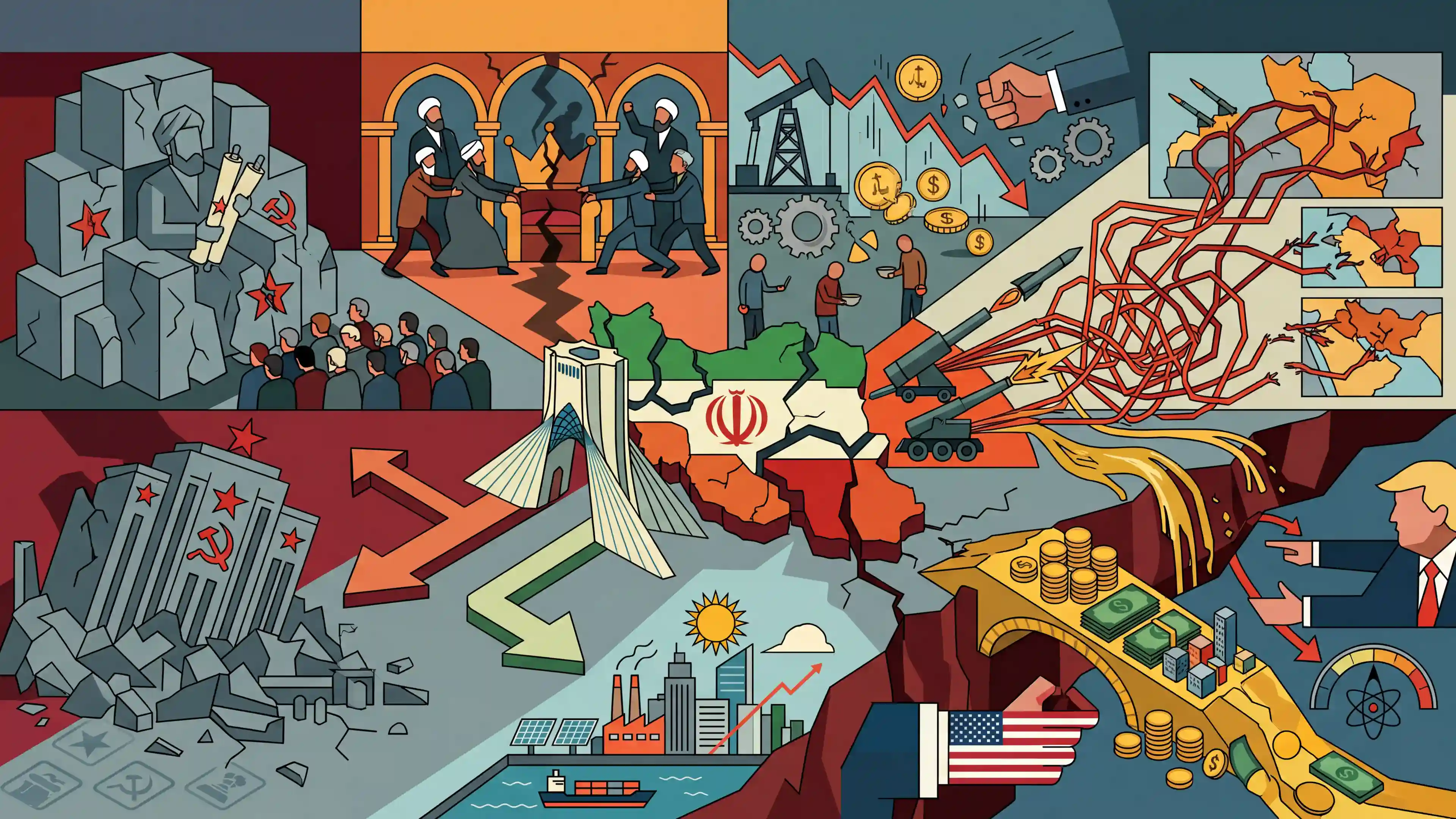
C Raja Mohan analyzes the systemic crisis confronting Iran's revolutionary regime, mapping its trajectory against the historical unraveling of similar ideological states. He identifies four existential threats to such regimes: ideological ossification, elite fragmentation, economic collapse, and exhausting foreign wars. Applying this framework to Tehran, the article highlights Iran's severe economic distress exacerbated by international sanctions and massive investments in regional proxy networks at the expense of domestic development. Internal political divisions and the looming succession of the Supreme Leader further destabilize the state. With escalating military conflicts involving Israel and the US, Iran stands at a crossroads. It must either double down on its revolutionary dogma—risking a collapse akin to the Soviet Union—or embrace a pragmatic shift, as China did under Deng Xiaoping. The author suggests that a potential "grand bargain" from the US under Donald Trump, offering economic relief in exchange for nuclear restraint and reduced proxy support, could force Tehran into making critical concessions.
Key Points
- Revolutionary regimes historically erode through four primary pathways: ideological rigidity, internal elite fragmentation, economic decay, and external conflicts or wars.
- Iran's regime faces severe economic decay driven by crippling international sanctions and the extensive diversion of state resources to fund an external "Axis of Resistance" proxy network.
- Internal elite fractures are deepening in Tehran between hardline 'principalists', pragmatic 'reconcilers', and 'reformers', compounded by the looming succession crisis surrounding the 85-year-old Supreme Leader.
- Escalating direct confrontations with Israel and the US constitute a critical vulnerability, testing the limits of Iran's regional military posture.
- To avoid a Soviet-style collapse, Iran must choose between rigid adherence to its revolutionary dogma or adopting pragmatic reforms similar to China's pivot under Deng Xiaoping.
- The upcoming US administration under Donald Trump may offer a "grand bargain," conditioning economic relief on Iran curbing its nuclear ambitions and dismantling its regional proxy infrastructure.
Important Terms
Islamic Republic of Iran

The theocratic-republican system established in 1979, where governance is split between elected bodies and unelected clerical institutions overseen by a Supreme Leader.
UPSC context
GS Paper II (International Relations). Essential for understanding India's strategic ties, energy security, and the regional 'West Asia' policy.
Supreme Leader (Rahbar)
The highest religious and political authority in Iran, holding ultimate command over the military, judiciary, and state media, and directing the country's general policy.
UPSC context
GS Paper II (International Relations). Critical for analyzing Iranian foreign policy and the current challenges of leadership succession in Tehran.
Permanent Revolution
An ideological doctrine where a state prioritizes revolutionary expansion and ideological purity over national stability, often leading to isolation and prolonged regional conflict.
UPSC context
GS Paper I (World History) and GS II (International Relations). Tests knowledge of ideological state-building and its impact on modern geopolitics.
Axis of Resistance
Tehran's regional network of state and non-state allies (e.g., Hezbollah, Houthis, Hamas) used to project power and deter adversaries like Israel and the US.
UPSC context
GS Paper II (Regional Geopolitics) and GS III (Security). Significant for maritime security in the Red Sea and regional stability.
Grand Bargain
A proposed comprehensive diplomatic settlement between the US and Iran to resolve long-standing disputes regarding nuclear enrichment, regional proxies, and economic sanctions.
UPSC context
GS Paper II (International Relations). A recurring theme in US-Iran diplomacy that affects global energy markets and India's trade interests.
Velayat-e Faqih
The constitutional principle of 'Guardianship of the Islamic Jurist,' which grants a senior cleric (the Supreme Leader) absolute authority over the state.
UPSC context
GS Paper II (International Relations/Governance). Understanding the unique clerical-political framework that differentiates Iran from other Middle Eastern republics.
Prelims Trap
"The 'Axis of Resistance' is a formal, legally binding military alliance between Iran and Middle Eastern states."
The Axis is an informal, decentralized network of proxy militias (Hamas, Hezbollah, Houthis) funded by Iran, not a formalized, legally binding mutual defense treaty.
Static Concepts Connected
How do US sanctions on Iran impact India's connectivity projects?
- Chabahar Port: India developed the Shahid Beheshti terminal to bypass Pakistan, providing a direct maritime-to-land gateway to Afghanistan and Central Asia.
- INSTC Linkage: It acts as a crucial node for the International North-South Transport Corridor (INSTC), aiming to connect the Indian Ocean region to Russia and Europe.
- Sanctions Impact: Though legally exempted, secondary US sanctions create a "chilling effect," deterring international private shipping, insurance, and banking entities from operating there.
What was the basic framework of the Joint Comprehensive Plan of Action (JCPOA)?
- The Agreement: A 2015 nuclear agreement signed between Iran and the P5+1 (US, UK, France, Russia, China + Germany).
- The Core Bargain: Iran agreed to significantly limit its nuclear enrichment program and allow robust IAEA inspections in exchange for the lifting of crippling economic sanctions.
- Current Status: The US unilaterally withdrew in 2018, reimposing sanctions, leading Iran to gradually abandon its enrichment constraints.
Cross-Topic Patterns
Iran's crisis & Cold War parallels
The article maps Iran's trajectory against the USSR's collapse and China's 1970s reforms. UPSC Mains frequently links contemporary geopolitical crises to these 20th-century World History models of state collapse and economic pivot.
Extraterritorial sanctions vs. Strategic autonomy
US secondary sanctions on Iran continually test India’s strategic autonomy. Aspirants should map how US domestic laws (IFCA, CAATSA) force India to navigate complex payment mechanisms and protect key connectivity assets.

Iran’s proxy wars and US sanctions will likely feature as a 2026 Mains question evaluating risks to India's INSTC and Chabahar investments.
Linked PYQs · 4
Linked PYQs · 4
- 2012MainsGS2
How have the US sanctions against Iran affected India's bilateral relations with Iran?
- 2025MainsGS2
"Energy security constitutes the dominant kingpin of India's foreign policy, and is linked with India's overarching influence in Middle Eastern countries.” How would you integrate energy security with India's foreign policy trajectories in the coming years?
- 2025MainsGS1
The French Revolution has enduring relevance to the contemporary world. Explain.
- 2019MainsGS1
Explain how the foundations of the modern world were, laid by the American and French Revolutions.
