West Asia Geopolitics and Domestic Energy Security Implications
Source:Indian Express ↗
Why It Matters
Understanding the linkage between foreign policy and domestic welfare is a recurrent theme in UPSC. The article highlights how global conflicts (like an Iran war) translate into tangible domestic challenges (like an LPG crisis), crucial for answering questions on energy security, US-Iran-India dynamics, and the economic impacts of geopolitical instability.
Summary
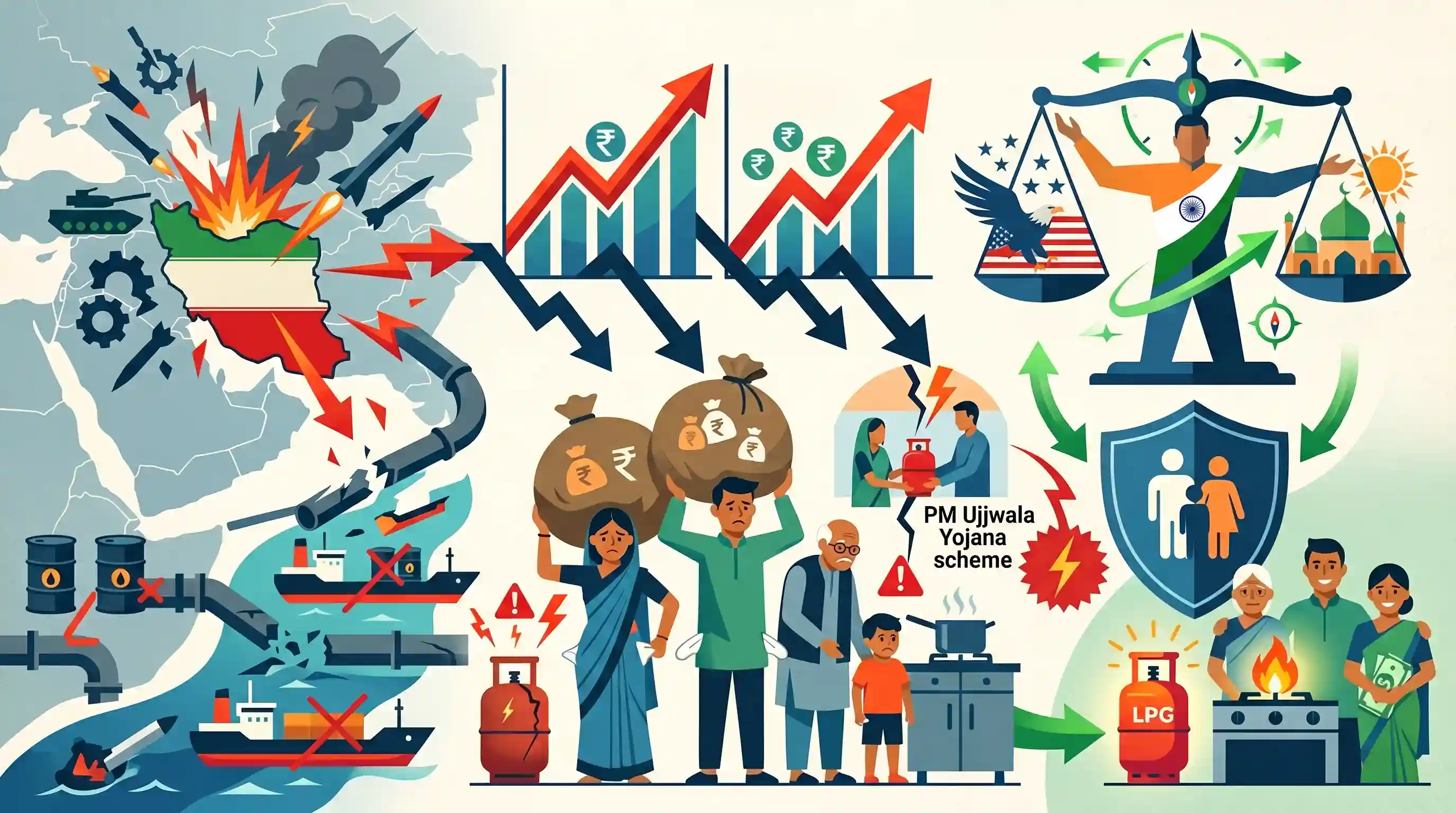
The article discusses the direct impact of India's foreign policy and global geopolitical events on its citizens, contextualized by the Iran war and the resulting LPG crisis. As conflict in the Middle East disrupts energy supply chains, the resulting spikes in fuel prices and inflation heavily burden Indian households, threatening the sustainability of domestic initiatives like the PM Ujjwala Yojana. The piece underscores the need for a citizen-centric approach to foreign policy, emphasizing that strategic maneuvers by the Indian leadership, particularly in balancing relations between the US and Iran, must ultimately safeguard domestic energy security and economic stability.
Key Points
- The ongoing conflict in Iran has triggered a global energy supply shock, notably causing an LPG crisis that directly impacts India.
- India's foreign policy outcomes are not just geopolitical but have immediate domestic economic repercussions, such as inflation and fuel shortages.
- The LPG crisis highlights the vulnerability of domestic welfare programs like PM Ujjwala Yojana to Middle Eastern geopolitical instability.
- Navigating the US-Iran dynamics and managing relations with global leaders remains a critical test for India to ensure energy security and shield its citizens from external shocks.
Important Terms
PM Ujjwala Yojana (PMUY)

Flagship scheme launched in 2016 providing deposit-free LPG connections to women from below-poverty-line households to ensure clean cooking fuel and reduce indoor air pollution.
UPSC context
GS Paper 2 (Welfare Schemes) and GS Paper 3 (Energy). Tests knowledge of social empowerment and energy access.
Energy Security
The uninterrupted availability of energy sources at an affordable price, encompassing physical availability, economic accessibility, and environmental sustainability.
UPSC context
GS Paper 3 (Infrastructure/Energy). Critical for discussions on India's import dependence and economic stability.
Strategic Autonomy
A foreign policy principle allowing a nation to make independent decisions based on national interest without being constrained by external pressures or permanent military alliances.
UPSC context
GS Paper 2 (International Relations). Central to India's balancing act between global powers like the US, Russia, and Iran.
Strait of Hormuz
A vital maritime chokepoint between the Persian Gulf and the Gulf of Oman through which approximately 20% of global oil and significant Indian LPG imports transit.
UPSC context
GS Paper 1 (Geography) and GS Paper 2 (IR). Important for mapping and maritime security questions.
Multi-alignment
The contemporary evolution of India's foreign policy where it engages with multiple global powers simultaneously based on specific issues rather than joining formal blocs.
UPSC context
GS Paper 2 (International Relations). Tests understanding of the shift from Non-Alignment to pragmatic engagement.
Current Account Deficit (CAD)
An economic indicator representing the shortfall between a country's total exports and imports; spikes in global energy prices typically widen this deficit for India.
UPSC context
GS Paper 3 (Economy). Relevant for questions on external sector stability and inflation.
Essential Commodities Act
A 1955 law enabling the government to regulate the production, supply, and distribution of certain commodities to prevent hoarding and ensure fair pricing during crises.
UPSC context
GS Paper 2 (Governance) and GS Paper 3 (Food/Energy Security). Tests knowledge of administrative measures during supply disruptions.
Prelims Trap
India's massive oil refining capacity makes it self-sufficient in LPG production.
Despite exporting refined petroleum products, India imports ~60% of its domestic LPG requirement. Aspirants often confuse crude refining surplus with LPG self-sufficiency.
Static Concepts Connected
How do global energy shocks trigger "imported inflation" in India?
- Direct cost push: Elevated global crude and LPG prices immediately increase domestic transport, manufacturing, and retail fuel costs.
- Currency depreciation: A bloated import bill widens the Current Account Deficit, depreciating the Rupee and compounding import costs.
- Fiscal strain: The government must absorb price shocks through increased subsidies (like PMUY), widening the fiscal deficit and reducing capital expenditure.
How does India balance Strategic Autonomy with energy security imperatives?
- Supplier diversification: Shifting dependency away from the volatile Middle East by sourcing oil and gas from Russia, Africa, and the Americas.
- Diplomatic tightrope: Maintaining working relations with adversaries (e.g., US and Iran) simultaneously to protect national economic interests.
- Alternative payments: Utilizing mechanisms like Rupee-Dirham or Rupee-Ruble trade settlements to bypass Western sanctions and secure affordable energy.
Cross-Topic Patterns
Geopolitics hitting domestic welfare
The PM Ujjwala Yojana's success relies heavily on global supply chains. Middle Eastern conflicts threaten affordability, linking IR directly to Social Justice and rural welfare outcomes.
Twin Deficit risks from energy shocks
Spiking global energy prices simultaneously widen the Current Account Deficit via a bloated import bill and the Fiscal Deficit through rising fuel subsidy burdens.

Expect a 2026 Mains question linking Middle East instability directly to the fiscal sustainability of India's domestic welfare schemes.
Linked PYQs · 4
Linked PYQs · 4
- 2025MainsGS2
"Energy security constitutes the dominant kingpin of India's foreign policy, and is linked with India's overarching influence in Middle Eastern countries.” How would you integrate energy security with India's foreign policy trajectories in the coming years?
- 2018MainsGS2
In what ways would the ongoing US-Iran Nuclear Pact Controversy affect the national interest of India? How should India respond to this situation?
- 2017MainsGS2
The question of India's Energy Security constitutes the most important part of India's economic progress. Analyze India's energy policy cooperation with West Asian countries.
- 2024MainsGS3
What are the causes of persistent high food inflation in India? Comment on the effectiveness of the monetary policy of the RBI to control this type of inflation.
