Macroeconomic implications of West Asian conflicts for India
Source:Indian Express ↗
Why It Matters
Understanding the macroeconomic ripple effects of global oil shocks is crucial for UPSC aspirants, as it integrates core GS3 topics (inflation, CAD, energy security) with GS2 geopolitics (West Asia). This allows for multidimensional analysis in Mains answers.
Summary
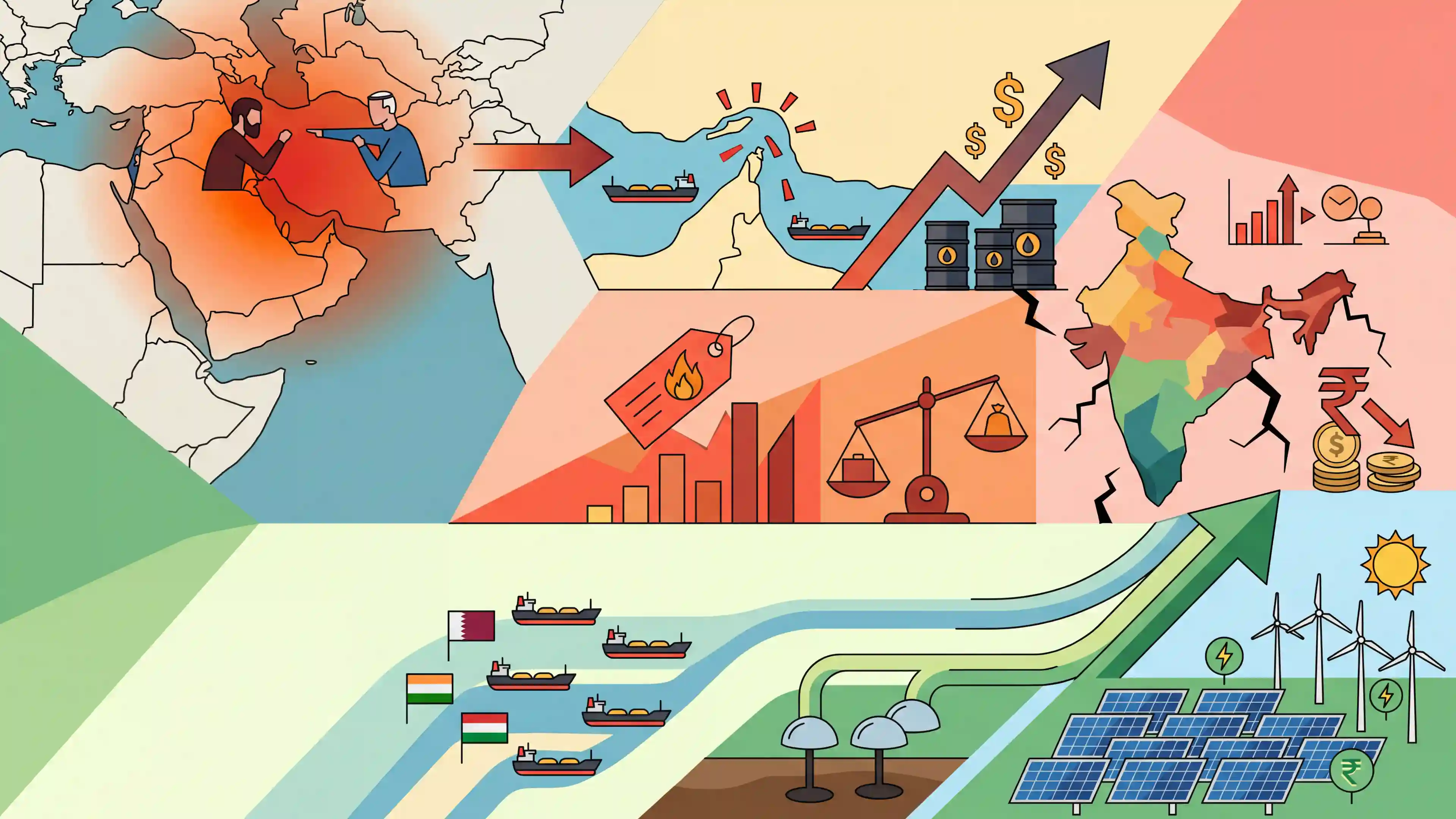
The potential for a wider conflict between Iran and Israel in West Asia carries significant economic risks for India, primarily through the threat of a global oil shock. Because India imports the vast majority of its crude oil, any disruption to supply routes like the Strait of Hormuz or a resultant spike in crude prices could severely impact macroeconomic stability. Drawing lessons from past oil shocks in 1973, 1979, and 1990, the situation underscores the risk of imported inflation, a widening Current Account Deficit (CAD), and currency depreciation. The crisis reinforces the urgent need for India to ensure energy security by diversifying its supplier base, building robust Strategic Petroleum Reserves (SPR), and aggressively pivoting toward renewable energy sources to reduce import dependency.
Key Points
- Escalating geopolitical tensions between Iran and Israel threaten vital global energy supply routes in West Asia, raising fears of a crude oil price spike.
- India's heavy reliance on imported crude oil makes it highly vulnerable to external price shocks, which can widen the Current Account Deficit (CAD) and put downward pressure on the rupee.
- Historical oil shocks (such as in 1973, 1979, and 1990) demonstrate that sudden increases in fuel prices feed into domestic transportation costs, driving up generalized inflation.
- To mitigate such risks, India needs a multi-pronged strategy: diversifying oil import sources, expanding Strategic Petroleum Reserves (SPR), and accelerating the transition to renewable energy.
Important Terms
Strategic Petroleum Reserves (SPR)

Emergency crude oil stockpiles stored in underground rock caverns to ensure energy security during supply disruptions. India's current Phase I capacity is 5.33 MMT, providing ~9.5 days of cover.
UPSC context
GS Paper III (Energy Security); tests knowledge of India's infrastructure, energy autonomy, and the role of ISPRL.
OPEC
An intergovernmental organization of oil-exporting nations that coordinates production policies to stabilize global oil prices. It currently includes members like Saudi Arabia, Iran, and Iraq.
UPSC context
GS Paper II (International Relations); tests understanding of global cartels and their influence on India's energy economy.
Current Account Deficit (CAD)
A measurement of a country's trade where the value of imported goods and services exceeds the value of those it exports. In India, it is highly sensitive to oil prices.
UPSC context
GS Paper III (Indian Economy); critical for understanding Balance of Payments (BoP) and rupee volatility.
Strait of Hormuz
A critical maritime chokepoint between Iran and Oman/UAE through which roughly one-fifth of global oil and nearly half of India's crude imports transit.
UPSC context
GS Paper II & III (Geography/Security); tests awareness of strategic maritime routes and energy supply chain risks.
Imported Inflation
General price rise in an economy caused by the increased cost of imported essential commodities like crude oil or due to currency depreciation.
UPSC context
GS Paper III (Economy); tests knowledge of cost-push inflation and external shocks on domestic price stability.
Prelims Trap
As a full member of the IEA, India maintains Strategic Petroleum Reserves equivalent to 90 days of net imports.
India is only an Associate Member of the IEA. Its dedicated Phase-I SPR capacity covers just 9.5 days, falling short of the 90-day mandate.
Static Concepts Connected
How does a crude oil shock impact India's macroeconomic stability?
- Current Account Deficit: Higher import bills for crude oil widen the CAD, leading to increased demand for dollars and rupee depreciation.
- Imported Inflation: A fuel price surge triggers cost-push inflation, raising transportation logistics and manufacturing input costs across sectors.
- Fiscal Burden: Forces the government to either absorb the shock via subsidies or cut excise duties, significantly squeezing fiscal space.
What is the status of India's Strategic Petroleum Reserves (SPR)?
- Phase-I Locations: Visakhapatnam (AP), Mangaluru (Karnataka), and Padur (Karnataka); built in underground, unlined rock caverns.
- Current Capacity: Total Phase-I capacity is 5.33 MMT, meeting approximately 9.5 days of India's national crude oil requirement.
- Managing Body: Operated by Indian Strategic Petroleum Reserves Limited (ISPRL), under the Ministry of Petroleum and Natural Gas.
Cross-Topic Patterns
Maritime Chokepoints Map
Disruptions in the Strait of Hormuz often feature alongside Bab-el-Mandeb and the Strait of Malacca in Prelims map-based questions on energy security.
Inflation vs. Growth Dilemma
Oil shocks present a classic dilemma for the RBI's Monetary Policy Committee: hike rates to combat imported inflation, or hold them to protect economic growth.
Renewables as Macro-Stabilizers
India's National Green Hydrogen Mission and EV transition are not merely climate initiatives; they act as structural macroeconomic shields against chronic CAD vulnerabilities.

A blended Prelims question on SPR cavern locations, IEA associate membership criteria, and Strait of Hormuz mapping is highly probable.
Linked PYQs · 4
Linked PYQs · 4
- 2025MainsGS2
"Energy security constitutes the dominant kingpin of India's foreign policy, and is linked with India's overarching influence in Middle Eastern countries.” How would you integrate energy security with India's foreign policy trajectories in the coming years?
- 2017MainsGS2
The question of India's Energy Security constitutes the most important part of India's economic progress. Analyze India's energy policy cooperation with West Asian countries.
- 2024PrelimsGS1
Consider the following statements : Statement-I : Sumed pipeline is a strategic route for Persian Gulf oil and natural gas shipments to Europe. Statement-II : Sumed pipeline connects the Red Sea with the Mediterranean Sea. Which one of the following is correct in respect of the above statements?
- 2024PrelimsGS1
Consider the following statements : Statement-I : Recently, Venezuela has achieved a rapid recovery from its economic crisis and succeeded in preventing its people from fleeing/emigrating to other countries. Statement-II : Venezuela has the world's largest oil reserves. Which one of the following is correct in respect of the above statements?
