West Asia Conflict Impact on Agricultural Input Industries
Source:The Hindu ↗
Why It Matters
This article highlights the vulnerability of domestic agriculture to global geopolitical shocks. It connects international relations (West Asia conflict) with core GS3 themes such as agricultural inputs (pesticides), food security (Kharif season yield), and the economic stability of MSMEs, underscoring the need for robust supply chains and regulatory vigilance against counterfeit products.
Summary
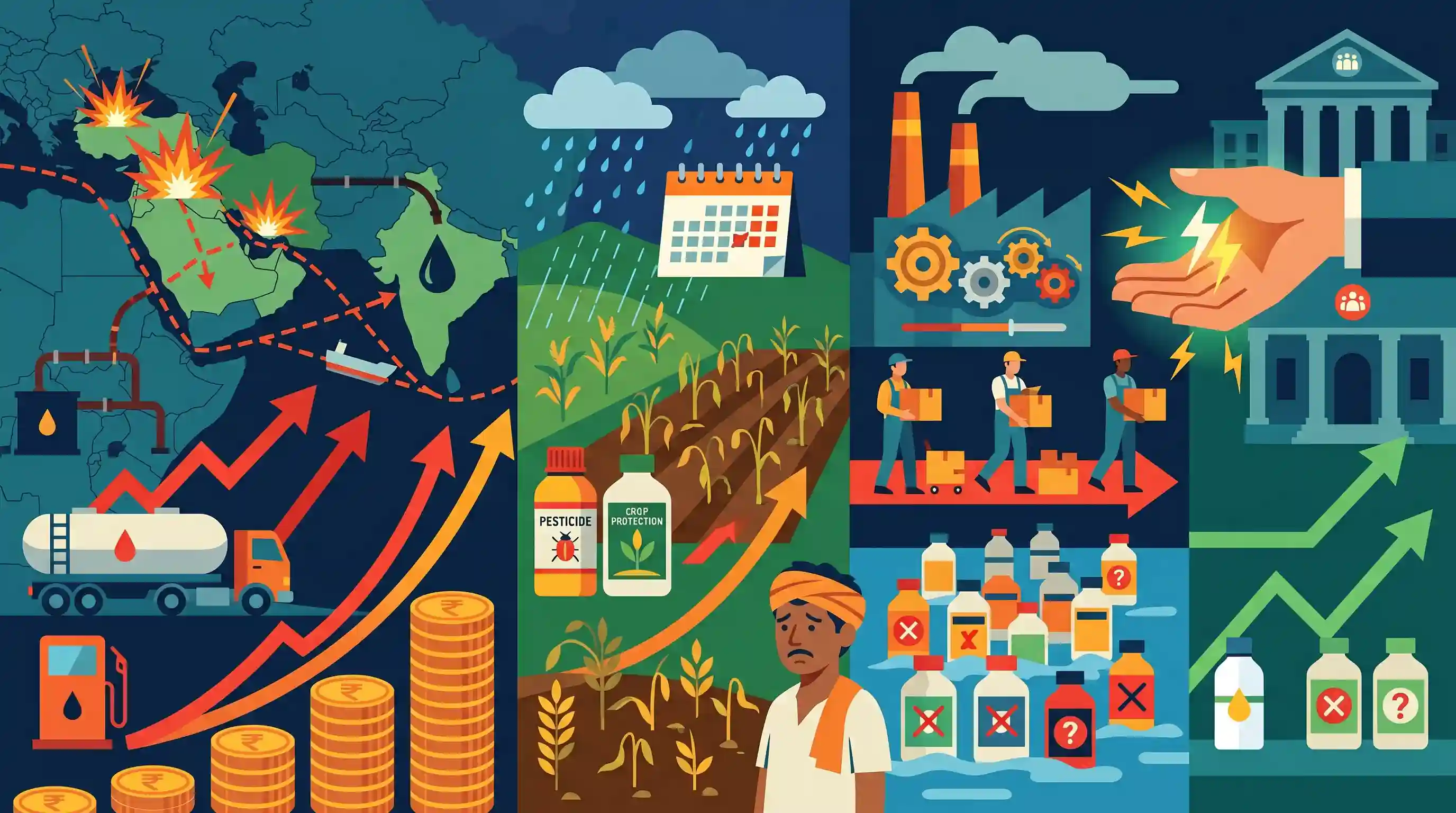
The ongoing conflict in West Asia is causing severe supply chain disruptions and escalating freight and fuel costs, heavily impacting India's pesticide and crop protection industry. Industry body CropLife India anticipates a 20-25% increase in input costs, which threatens agricultural productivity during the upcoming Kharif season. The disruption is expected to reduce manufacturing capacity utilization, affecting MSME employment, and heightening the risk of counterfeit and substandard agrochemicals flooding the market. The industry has sought government intervention and energy incentives to stabilize local production.
Key Points
- Geopolitical conflicts in West Asia and resultant supply chain disruptions are projected to increase crop protection chemical costs in India by 20-25%.
- The impending Kharif season faces risks of reduced agricultural yield and quality due to potential shortages of vital pesticides.
- Supply gaps and price volatility could trigger a dangerous influx of illicit, counterfeit, and substandard agrochemicals into the market.
- The crisis threatens MSME employment and industry earnings due to lower capacity utilization across technical and formulation plants, prompting calls for government support.
Important Terms
MSMEs (Micro, Small, and Medium Enterprises)

Small-scale business units classified by investment and turnover. They are 'engines of growth,' contributing ~30% to India's GDP and providing significant employment in manufacturing and services.
UPSC context
GS Paper 3: Indian Economy. Key for discussions on industrial growth, employment generation, and supply chain resilience.
Kharif Season
India's monsoon cropping season (June–October). Key crops include rice, maize, and cotton. It is highly dependent on the southwest monsoon and critical for national food security.
UPSC context
GS Paper 1 (Geography) & GS Paper 3 (Agriculture). Tests knowledge of cropping patterns and monsoon dependence.
CropLife India
A non-profit association of R&D-driven crop science companies in India. It advocates for sustainable agriculture, food security, and the responsible use of genuine crop protection products.
UPSC context
GS Paper 3: Agriculture. Relevant for topics involving agri-input industry, pesticide regulation, and private sector roles in agriculture.
Spurious Agrochemicals
Low-quality or fake agri-inputs lacking official registration or proper active ingredients. They cause significant crop loss, damage soil health, and reduce farmer income.
UPSC context
GS Paper 3: Agriculture. Important for issues regarding food security, farmer distress, and regulatory challenges in agri-inputs.
West Asia Geopolitical Impact
The economic consequences of regional instability, such as oil price volatility, supply chain bottlenecks (e.g., Strait of Hormuz), and increased freight costs affecting global trade.
UPSC context
GS Paper 2 (International Relations) & GS Paper 3 (Economy). Tests understanding of how external conflicts affect India’s energy security and trade.
Prelims Trap
India is self-sufficient in pesticide manufacturing and relies entirely on domestically sourced active ingredients.
While India is a top exporter of formulated generic pesticides, it relies heavily on imports for Active Pharmaceutical Ingredients (technical-grade materials), exposing it to global supply shocks.
Static Concepts Connected
How is the pesticide sector currently regulated in India?
- Nodal Act: It is primarily regulated by the Insecticides Act, 1968, and Insecticides Rules, 1971, administered by the Ministry of Agriculture and Farmers Welfare.
- Registration Body: The Central Insecticides Board and Registration Committee (CIBRC) evaluates safety and efficacy, mandating registration before import, manufacture, or sale.
- Pending Reforms: The proposed Pesticides Management Bill seeks to replace the 1968 Act to better regulate the supply chain and strictly penalize spurious/counterfeit pesticides.
Which common chemical agents frequently appear in UPSC pesticide questions?
- Organophosphates: Chemicals like Malathion, Methyl Parathion, and Triazophos. They are highly toxic and frequently face bans or heavy restrictions due to severe ecological persistence.
- Carbamates: Carbofuran is a broad-spectrum systemic insecticide and nematicide whose usage is heavily restricted in India due to high toxicity to birds and mammals.
Cross-Topic Patterns
Geopolitics spilling into Food Inflation
Maritime chokepoint disruptions (Red Sea/Bab-el-Mandeb) don't just delay oil; they spike freight for bulk agricultural inputs like fertilizers and APIs, directly threatening Kharif yields and CPI food inflation.
Spurious Agro-inputs & Soil Ecology
Price volatility in genuine crop protection chemicals drives farmers to counterfeit alternatives, accelerating soil degradation, disrupting local soil microbiomes, and causing severe bioaccumulation in water bodies.

Red Sea chokepoint disruptions + fertilizer/pesticide API import dependency likely to feature in 2026 as a linked economy-geography question.
Linked PYQs · 3
Linked PYQs · 3
- 2024MainsGS2
‘The West is fostering India as an alternative to reduce dependence on China's supply chain and as a strategic ally to counter China's political and economic dominance.’ Explain this statement with examples.
- 2019PrelimsGS1
In India, the use of carbofuran, methyl parathion, phorate and triazophos is viewed with apprehension. These chemicals are used as
- 2017MainsGS3
What are the major reasons for declining rice and wheat yield in the cropping system? How crop diversification is helpful to stabilise the yield of the crops in the system?
