Middle East Conflict Disrupts Global Electronics Supply Chain
Source:The Hindu ↗
Why It Matters
Highlights the vulnerability of global electronics and semiconductor supply chains to geopolitical conflicts, especially the concentration of critical raw materials (like PPE resin) in volatile regions like the Middle East.
Summary
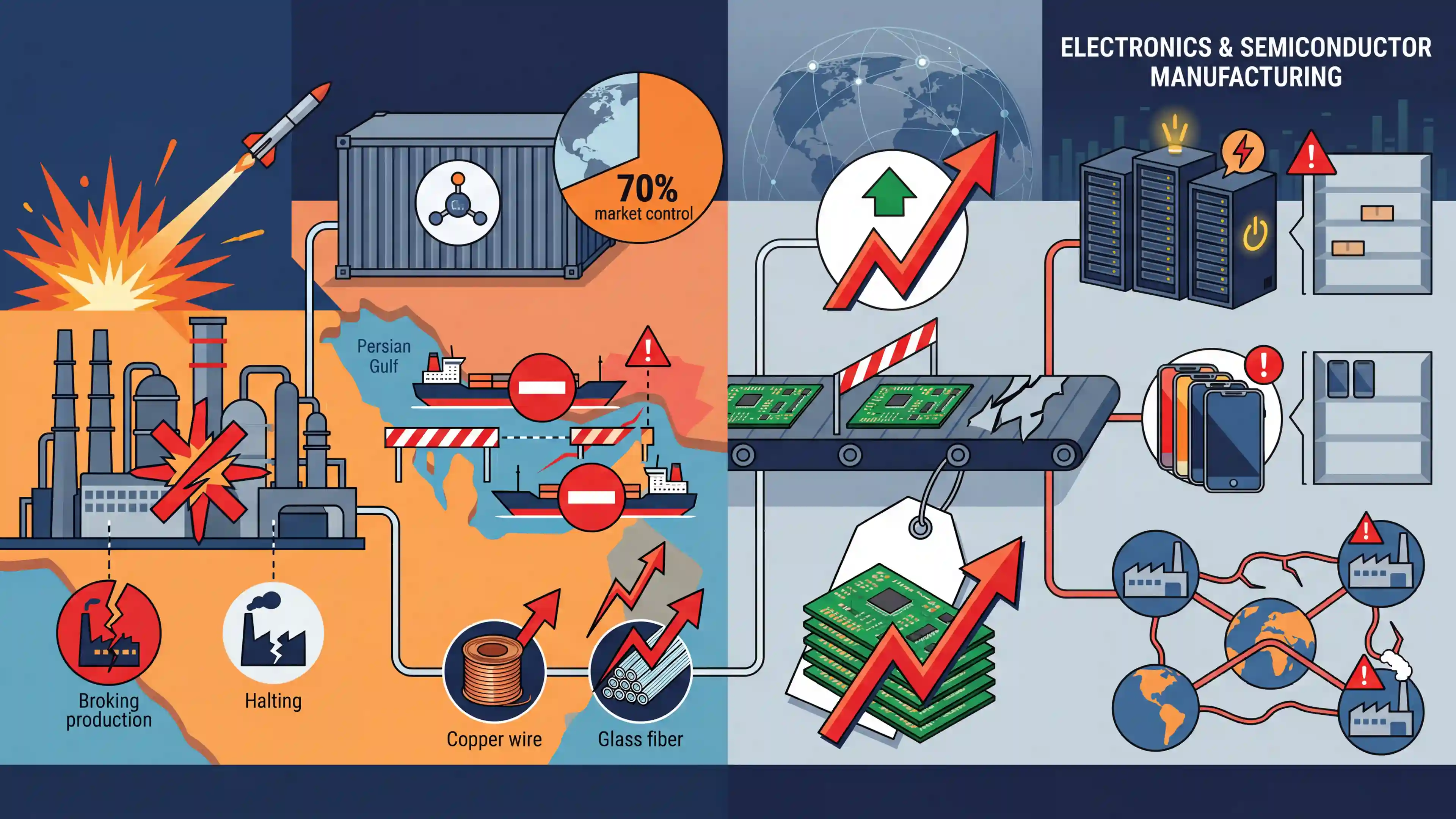
The escalating conflict in the Middle East has severely disrupted the global electronics supply chain, particularly for printed circuit boards (PCBs) used in AI servers and smartphones. An Iranian strike on Saudi Arabia's Jubail petrochemical complex halted the production of high-purity polyphenylene ether (PPE) resin by SABIC, which supplies 70% of the global market. Combined with shipping disruptions in the Persian Gulf and surging raw material costs (such as copper and glass fiber), PCB prices have spiked by up to 40%. This geopolitical bottleneck threatens tech hardware manufacturers worldwide who are already struggling to meet the soaring demand for AI infrastructure.
Key Points
- The ongoing conflict in the Middle East has disrupted the global supply of crucial raw materials like polyphenylene ether (PPE) resin, glass fiber, and copper foil.
- An Iranian strike on Saudi Arabia's Jubail petrochemical complex halted SABIC's production of high-purity PPE resin, which accounts for 70% of global supply.
- The geopolitical crisis has severely disrupted shipping routes in and out of the Persian Gulf, compounding supply chain challenges.
- Prices of printed circuit boards (PCBs) have surged up to 40% due to raw material shortages and soaring demand for AI servers.
- Rising costs and supply constraints are squeezing margins for global tech hardware manufacturers, particularly those producing AI infrastructure and smartphones.
Important Terms
SABIC

A Saudi Arabian multinational chemical manufacturing company, ranked among the world’s largest petrochemical producers. It is a dominant global supplier of resins essential for advanced electronics.
UPSC context
GS Paper II & III; crucial for studying India-Saudi bilateral trade, global energy security, and industrial raw material supply chains.
Printed Circuit Board (PCB)
A foundational electronic component providing the base for connecting parts in devices. It is vital for smartphones, AI servers, and 5G infrastructure.
UPSC context
GS Paper III; relevant to manufacturing, 'Make in India', and the PLI scheme for electronics.
Jubail Petrochemical Complex
The world’s largest industrial development project, located in Saudi Arabia. It is a strategic hub for global petrochemical production and non-oil exports.
UPSC context
GS Paper I; tests understanding of industrial geography and location factors of major global industries.
Polyphenylene Ether (PPE) resin
A high-performance resin used as an insulator in circuit boards. It maintains stability under high heat, making it essential for AI and high-voltage electronics.
UPSC context
GS Paper III; highlights supply chain vulnerabilities and India’s dependence on specialized imported raw materials.
Strait of Hormuz
A critical maritime chokepoint between the Persian Gulf and the Gulf of Oman, essential for global oil transport and maritime trade security.
UPSC context
GS Paper I & II; vital for studying international relations, maritime security, and energy logistics.
Prelims Trap
"Saudi Arabia's Jubail complex is primarily an electronics and PCB assembly hub."
Jubail is actually the world's largest petrochemical industrial hub. The trap confuses downstream tech assembly (Asia) with upstream chemical inputs (Middle East).
Static Concepts Connected
What factors drive the agglomeration of petrochemical industries in the Persian Gulf?
- Raw Material: Proximity to abundant, cheap crude oil and natural gas that serve as primary feedstock.
- Cheap Energy: Energy-intensive refining processes benefit from massive, heavily subsidized local power generation.
- Export Infrastructure: Purpose-built coastal industrial cities (like Jubail) feature integrated port facilities for seamless global export.
Why is the Strait of Hormuz structurally vulnerable to geopolitical disruption?
- Strategic Geography: It is a narrow 21-mile-wide waterway between Iran and Oman connecting the Persian Gulf to the open ocean.
- High Volume: It handles approximately 25% of global seaborne oil and 20% of global LNG exports.
- No Alternatives: There are extremely limited pipeline bypass routes capable of handling equivalent export volumes if the strait closes.
Cross-Topic Patterns
Upstream Petrochemicals to Downstream Tech
UPSC tests supply chain resilience. Disruption of PPE resins in Saudi Arabia exposes how AI and 5G hardware production is fundamentally tethered to Middle Eastern fossil-fuel derivatives.
Maritime Chokepoints & Imported Inflation
Persian Gulf disruptions cascade from raw material shortages to higher freight costs, fueling imported structural inflation in high-tech hardware (servers, smartphones) for tech-consuming nations like India.

Expect a 2026 prelims map question linking Middle Eastern industrial ports (Jubail) to corresponding trade chokepoints (Hormuz).
Linked PYQs · 3
Linked PYQs · 3
- 2025MainsGS3
India aims to become a semiconductor manufacturing hub. What are the challenges faced by the semiconductor industry in India? Mention the salient features of the India Semiconductor Mission.
- 2018MainsGS2
In what ways would the ongoing US-Iran Nuclear Pact Controversy affect the national interest of India? How should India respond to this situation?
- 2017MainsGS1
Petroleum refineries are not necessarily located nearer to crude oil producing areas, particularly in many of the developing countries. Explain its implications.
