Iran Diplomatic Balance and Regional Deterrence Strategy
Source:The Hindu ↗
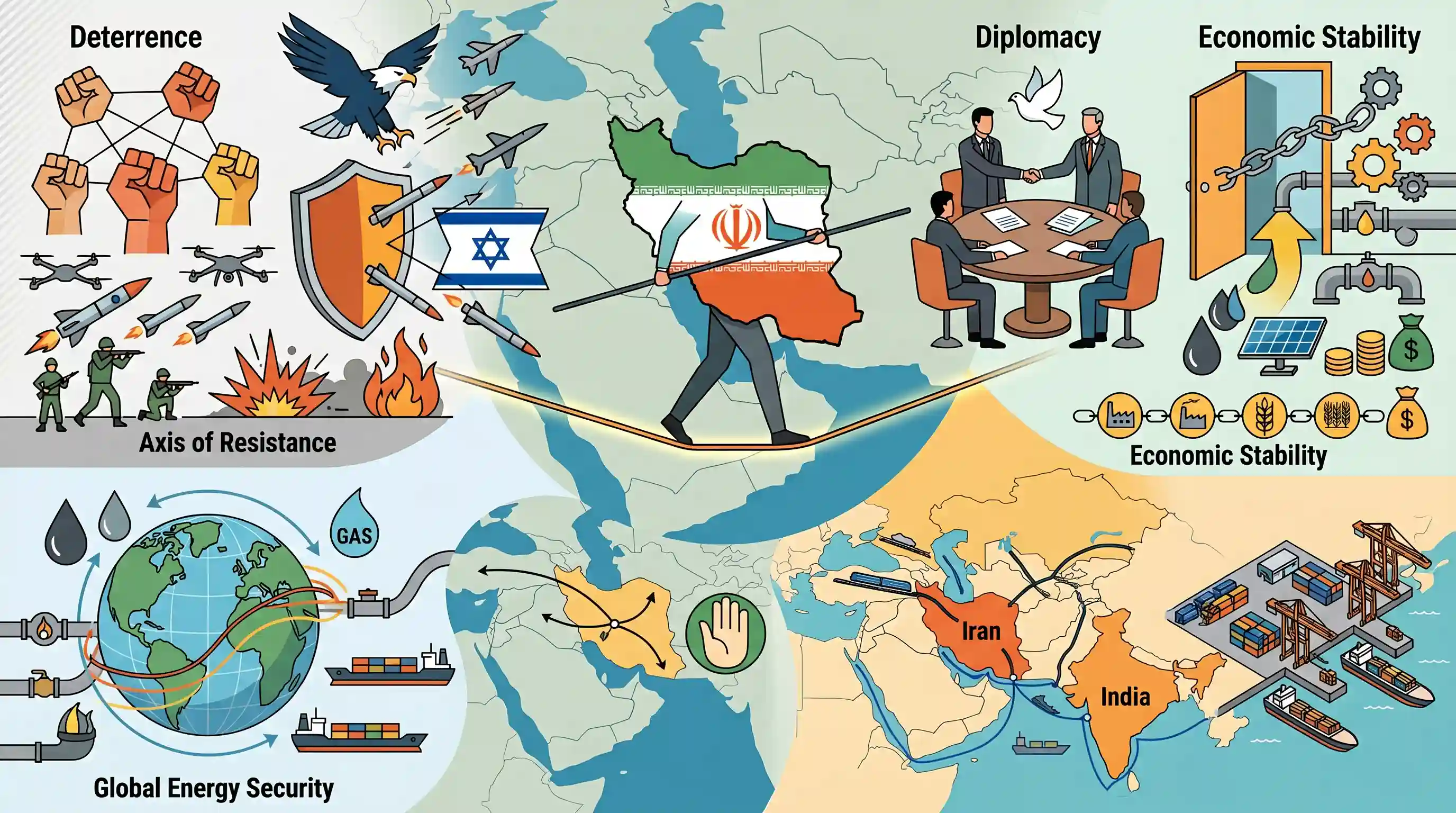
Why It Matters
Iran's actions directly influence the stability of West Asia, a region vital to India's energy security, diaspora, and strategic connectivity projects (INSTC, Chabahar). Understanding Iran's dual strategy helps candidates analyse Middle Eastern conflicts and their cascading effects on India's foreign policy.
Summary
Iran's current geopolitical strategy involves walking a tightrope between deterrence and diplomacy. While heavily relying on its 'Axis of Resistance' network to counter Israeli and US military pressure, Tehran is simultaneously trying to keep diplomatic channels alive to secure much-needed sanctions relief and economic stability. This balancing act aims to project strength and protect its strategic interests without triggering a full-scale regional conflict. The outcome of this strategy is critical for the Middle East's stability and holds significant implications for global energy security and India's strategic projects like the INSTC and Chabahar port.
Key Points
- Iran is navigating a delicate balance between maintaining regional deterrence through its 'Axis of Resistance' and pursuing diplomacy to ease economic sanctions.
- Its deterrence strategy relies on proxy groups like Hezbollah, Hamas, and the Houthis to counter Israeli and US influence without triggering a direct conventional war.
- Diplomatically, Iran seeks to keep channels open for renegotiating the nuclear deal (JCPOA) and maintaining its China-brokered reconciliation with Arab neighbours like Saudi Arabia.
- An escalation in the Iran-Israel conflict threatens global energy supply chains passing through the Strait of Hormuz and risks destabilising the broader Middle East.
- For India, Iran's geopolitical stability is crucial to protect strategic infrastructure investments like the Chabahar port, ensure the viability of the INSTC, and secure its energy imports from West Asia.
Important Terms
International North-South Transport Corridor (INSTC)

A 7,200 km-long multimodal network connecting India to Russia and Europe via Iran. It bypasses Pakistan, reducing transit time and costs compared to the traditional Suez Canal route.
UPSC context
GS Paper II: Regional connectivity and trade agreements involving India and their strategic significance.
Joint Comprehensive Plan of Action (JCPOA)
The 2015 landmark agreement between Iran and world powers (P5+1) to limit Iran's nuclear activities in exchange for sanctions relief. It faced significant decline after US withdrawal in 2018.
UPSC context
GS Paper II: Global groupings and policies of developed countries affecting India's energy security.
Axis of Resistance
An informal Iran-led coalition of state and non-state actors (including Hezbollah, Hamas, and Houthis) designed to counter Western and Israeli influence in West Asia through asymmetric warfare.
UPSC context
GS Paper II: West Asia geopolitics and its impact on regional stability and Indian interests.
Houthis
A Yemen-based Zaydi Shia militant group (Ansar Allah) aligned with Iran. They control northern Yemen and significantly influence maritime security in the Red Sea and Bab-el-Mandeb strait.
UPSC context
GS Paper III: Security challenges in maritime trade routes and role of non-state actors.
Hezbollah
A powerful Lebanese Shia political and military organization supported by Iran. It acts as a primary regional deterrent and a key state-within-a-state in Lebanon.
UPSC context
GS Paper II: Impact of external state and non-state actors on global and regional security.
Hamas
A Palestinian Sunni militant and political organization governing the Gaza Strip. It is a key member of the Axis of Resistance in its confrontation with Israel.
UPSC context
GS Paper II: International conflicts and their implications for India's foreign policy and regional connectivity.
Prelims Trap
"The Strait of Hormuz is a critical chokepoint connecting the Persian Gulf directly to the Red Sea."
UPSC frequently swaps West Asian water bodies. The Strait of Hormuz connects the Persian Gulf to the Gulf of Oman, whereas the Bab-el-Mandeb strait links the Red Sea to the Gulf of Aden.
Static Concepts Connected
What is the strategic utility of the INSTC and Chabahar Port for India?
- Bypassing Pakistan: Grants direct maritime and land access to Afghanistan and resource-rich Central Asia without relying on overland Pakistani transit routes.
- INSTC framework: A 7,200-km multi-modal (ship, rail, road) transport network linking Mumbai, Bandar Abbas (Iran), Baku (Azerbaijan), and Astrakhan (Russia).
- Strategic counterweight: Positions India to proactively counter China's Belt and Road Initiative (BRI) and its strategic presence at Pakistan's Gwadar Port.
Who are the P5+1 countries in the context of the JCPOA?
- The P5: The five permanent, veto-wielding members of the United Nations Security Council: China, France, Russia, the United Kingdom, and the United States.
- The +1: Germany, which is a major economic partner to Iran and played a pivotal role in the diplomatic negotiations leading up to the 2015 agreement.
- Core objective: Limiting Iran's uranium enrichment strictly to civilian uses and permitting IAEA inspections in exchange for lifting crippling global economic sanctions.
Cross-Topic Patterns
Energy security & strategic petroleum reserves
Disruptions in the Strait of Hormuz directly test India's Strategic Petroleum Reserves (SPR) policy and act as a major catalyst for India's push towards non-fossil fuel energy independence.
Asymmetric warfare & non-state actors
Iran's reliance on proxy groups like the Houthis demonstrates how non-state actors now dictate international maritime security (e.g., Red Sea shipping attacks) and bypass conventional deterrence.

Expect a map-based Prelims question pairing West Asian chokepoints (Hormuz, Bab-el-Mandeb) with bordering nations or proxy actor zones.
Linked PYQs · 4
Linked PYQs · 4
- 2025MainsGS2
"Energy security constitutes the dominant kingpin of India's foreign policy, and is linked with India's overarching influence in Middle Eastern countries.” How would you integrate energy security with India's foreign policy trajectories in the coming years?
- 2017MainsGS2
The question of India's Energy Security constitutes the most important part of India's economic progress. Analyze India's energy policy cooperation with West Asian countries.
- 2022PrelimsGS1
The term "Levant" often heard in the news roughly corresponds to which of the following regions?
- 2025PrelimsGS1
India is one of the founding members of the International North-South Transport Corridor (INSTC), a multimodal transportation corridor, which will connect
