Iran declares Strait of Hormuz closed threatening global oil supply
Source:The Hindu ↗
Why It Matters
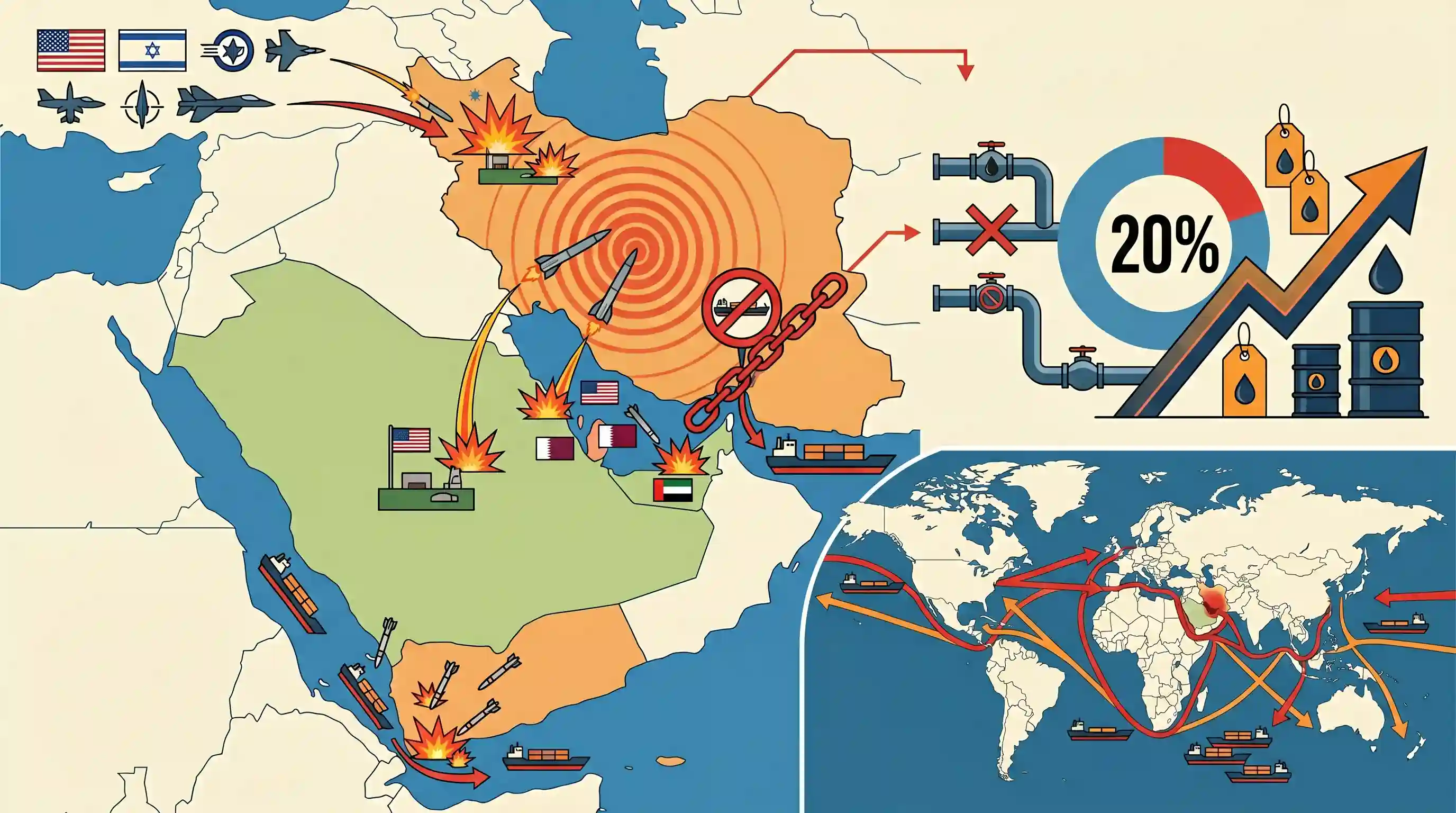
The Strait of Hormuz is the world's most critical oil transit chokepoint. Its closure threatens severe global economic repercussions, sharply escalating crude oil prices and challenging India's energy security given its dependence on Gulf imports. It highlights the widening scope of Middle Eastern conflicts affecting critical maritime trade routes.
Summary
Following U.S. and Israeli strikes targeting its leadership in early 2026, Iran explicitly declared the critical Strait of Hormuz closed, vowing to attack any passing ships. This major geopolitical escalation threatens to choke off 20% of the world's daily oil supply and drastically increase crude oil prices, compounding existing shipping disruptions caused by Houthi militant attacks in the Red Sea. In addition to the blockade, Iran launched retaliatory missile strikes against several neighboring Gulf nations hosting U.S. military bases.
Key Points
- Iran\'s Revolutionary Guards declared the Strait of Hormuz closed and threatened to set ablaze any navigating vessels in response to U.S. and Israeli strikes aimed at its leadership.
- Tehran launched retaliatory missile strikes against regional Gulf neighbors—including Qatar, Kuwait, Bahrain, the UAE, Saudi Arabia, and Oman—due to their hosting of U.S. military bases.
- The Strait of Hormuz is a critical global chokepoint linking the Persian Gulf to the Gulf of Oman, facilitating roughly 20% of the world\'s daily oil consumption.
- The blockade threatens to severely choke global oil flows and drive crude prices up sharply.
- This crisis exacerbates existing maritime shipping disruptions caused by ongoing attacks by Iran-aligned Houthi militants in the Red Sea and Gulf of Aden.
Important Terms
Strait of Hormuz

A narrow waterway connecting the Persian Gulf and the Gulf of Oman; the world's most critical oil transit route, handling approximately 20% of global daily consumption.
UPSC context
GS Paper-I (Geography) and GS Paper-II (International Relations). Tests knowledge of global energy arteries and India's strategic dependency on West Asian oil.
Revolutionary Guards (IRGC)
An elite branch of Iran’s Armed Forces, independent of the regular army, reporting directly to the Supreme Leader and tasked with protecting the country's Islamic revolutionary system.
UPSC context
GS Paper-II (International Relations). Key for analyzing Iran's regional influence, proxy networks, and geopolitical tensions in the Middle East.
Houthi Militants
An Iran-backed Zaydi Shia movement in Yemen (Ansar Allah) that controls northern Yemen; currently a major actor in regional conflicts and Red Sea maritime disruptions.
UPSC context
GS Paper-II (International Relations) and GS Paper-III (Internal Security). Crucial for understanding maritime security, global trade disruption, and regional proxy wars.
Maritime Choke Points
Strategic narrow passages (straits or canals) along global shipping routes that are vital for trade but highly vulnerable to blockades or military disruptions.
UPSC context
GS Paper-I (World Geography) and GS Paper-III (Economy). Essential for studying global supply chain vulnerabilities and the importance of secure Sea Lines of Communication.
Energy Security
The uninterrupted availability of energy sources at an affordable price; a primary strategic concern for oil-importing nations facing geopolitical supply disruptions.
UPSC context
GS Paper-III (Economic Development/Infrastructure). Tests awareness of India's vulnerability to global oil price shocks and the need for strategic reserves.
Bab el-Mandeb
A strategic strait connecting the Red Sea to the Gulf of Aden; it serves as a vital maritime link between the Mediterranean Sea and the Indian Ocean.
UPSC context
GS Paper-I (World Geography). Important for mapping global trade routes and understanding the geography of maritime security threats in West Asia.
Prelims Trap
"The Strait of Hormuz is bordered by Iran to the north and Saudi Arabia to the south."
Aspirants wrongly assume Saudi Arabia borders the strait due to its oil dominance. The southern coast is actually controlled by Oman (Musandam exclave) and the UAE.
Static Concepts Connected
What are the key maritime chokepoints in West Asia?
- Strait of Hormuz: Connects the Persian Gulf to the Gulf of Oman and Arabian Sea. Bordered by Iran, Oman, and UAE.
- Bab-el-Mandeb: Connects the Red Sea to the Gulf of Aden. Bordered by Yemen, Djibouti, and Eritrea.
- Suez Canal: Artificial waterway connecting the Mediterranean Sea to the Red Sea, bypassing the African continent.
How do global crude oil spikes impact India's macroeconomic indicators?
- Current Account Deficit: Widens the CAD as the import bill for crude inflates, bleeding foreign exchange reserves.
- Imported Inflation: Drives up domestic fuel and logistics costs, cascading into higher retail (CPI) and wholesale (WPI) inflation.
- Rupee Depreciation: Higher dollar demand to fund expensive oil imports puts downward pressure on the Indian Rupee.
Cross-Topic Patterns
Energy Security + Strategic Petroleum Reserves
Blockades in Hormuz directly test India's energy resilience, renewing focus on expanding Strategic Petroleum Reserve (ISPRL) capacities in Chandikhol and Padur to hedge against severe supply shocks.
West Asian map + US Military Bases
Iran's targeting of US host nations elevates the geography of military installations—like Al Udeid in Qatar and the 5th Fleet in Bahrain—for "Base-Country" match-the-following Prelims questions.

Expect a composite Prelims question merging West Asian map locations (Hormuz/Oman) with macroeconomic statements on India's CAD impacts.
Linked PYQs · 3
Linked PYQs · 3
- 2025MainsGS2
"Energy security constitutes the dominant kingpin of India's foreign policy, and is linked with India's overarching influence in Middle Eastern countries.” How would you integrate energy security with India's foreign policy trajectories in the coming years?
- 2017MainsGS2
The question of India's Energy Security constitutes the most important part of India's economic progress. Analyze India's energy policy cooperation with West Asian countries.
- 2024PrelimsGS1
Consider the following statements : Statement-I : Sumed pipeline is a strategic route for Persian Gulf oil and natural gas shipments to Europe. Statement-II : Sumed pipeline connects the Red Sea with the Mediterranean Sea. Which one of the following is correct in respect of the above statements?
