Escalating US Iran Conflict Risks Global Crude Oil Supply
Source:The Hindu ↗
Why It Matters
The conflict fundamentally alters Middle Eastern geopolitics and threatens global energy security. The potential closure of the Strait of Hormuz poses severe risks to India's macroeconomic stability due to its heavy reliance on imported crude oil, impacting inflation, Current Account Deficit, and broader economic growth.
Summary
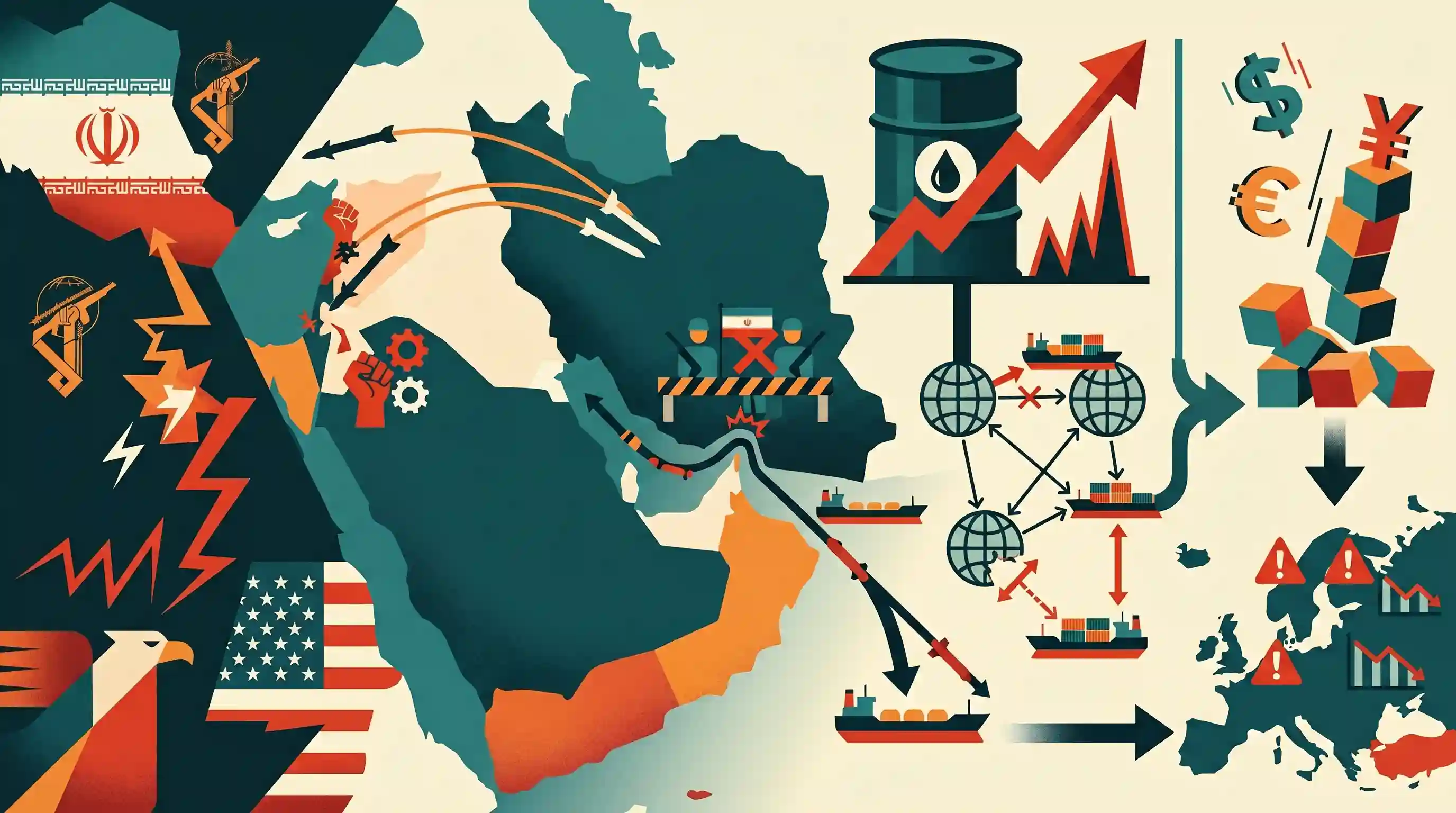
Tensions in the Middle East have escalated drastically after Iran vowed "crushing" retaliation against the U.S. and Israel. This follows U.S. President-elect Donald Trump's threats to bomb Iran "back to the Stone Ages" if it proceeds with attacks on Israel. The ongoing conflict has seen direct missile strikes by Iran on Tel Aviv and continued proxy engagement via Hezbollah in Lebanon. Crucially, the Islamic Revolutionary Guard Corps (IRGC) has threatened to close the Strait of Hormuz, a vital maritime chokepoint for global energy supplies. This threat has already triggered a spike in global crude oil prices, raising concerns over global energy security, supply chain disruptions, and the macroeconomic stability of oil-importing nations.
Key Points
- Iran has threatened "crushing" retaliatory attacks on U.S. and Israeli targets following U.S. President-elect Donald Trump's vow to bomb Iran "back to the Stone Ages".
- The escalation involves multiple fronts, with Iran firing ballistic missiles at Tel Aviv and Hezbollah launching drones into northern Israel.
- Iran's Revolutionary Guards threatened to shut down the Strait of Hormuz, a critical global shipping chokepoint where one-fifth of the world's oil passes.
- Fears of disruptions to oil shipments through the Strait of Hormuz have already caused global oil prices to spike, risking broader economic consequences.
- The widening conflict destabilises the Middle East further, drawing direct confrontations between major regional powers and their proxies.
Important Terms
Strait of Hormuz

A narrow waterway between Iran and Oman/UAE connecting the Persian Gulf and Gulf of Oman; handles ~20% of global oil trade and 20% of LNG.
UPSC context
GS Paper 2 (IR) and Paper 3 (Energy Security). Vital for India’s energy security as it imports ~60% of oil from the Gulf.
Islamic Revolutionary Guard Corps (IRGC)
An elite branch of Iran's military, independent of the regular army, reporting to the Supreme Leader; it oversees the ballistic missile program and regional proxies.
UPSC context
GS Paper 2 (IR). Tests understanding of Iran's internal power structure and its external influence through the Quds Force.
Energy Security
The state of having uninterrupted availability of energy sources at an affordable price; critical for maintaining economic growth and national stability.
UPSC context
GS Paper 3 (Economy/Infrastructure). Focuses on India's vulnerability to global supply shocks and the need for diversification and strategic reserves.
Proxy War
A conflict where two or more rival powers indirectly confront each other by supporting third parties (states or militias) to avoid direct military confrontation.
UPSC context
GS Paper 2 (IR). Essential for analyzing Middle East dynamics, including the Saudi-Iran rivalry and Iran-Israel shadow conflict.
Hezbollah
A Shia Islamist political party and militant group in Lebanon, funded by Iran; serves as a primary regional proxy against Israel and Western influence.
UPSC context
GS Paper 2 (IR). Tests knowledge of non-state actors and their role in regional instability and the "Axis of Resistance."
Maritime Chokepoint
A narrow geographical feature, like a strait or canal, whose blockage can significantly disrupt global trade and transit, particularly energy supplies.
UPSC context
GS Paper 1 (Geography) and Paper 2 (IR). Important for understanding maritime security and the strategic significance of locations like Hormuz, Malacca, and Suez.
Prelims Trap
"The Strait of Hormuz connects the Persian Gulf directly to the Red Sea."
The Strait of Hormuz connects the Persian Gulf to the Gulf of Oman. It is the Bab el-Mandeb strait that connects the Red Sea to the Gulf of Aden.
Static Concepts Connected
What are the key maritime chokepoints in the Middle East?
- Strait of Hormuz: Connects the Persian Gulf to the Gulf of Oman. Bordered by Iran to the north and Oman/UAE to the south.
- Bab el-Mandeb: Connects the Red Sea to the Gulf of Aden. Bordered by Yemen on the Arabian Peninsula, and Djibouti/Eritrea in Africa.
- Suez Canal: An artificial sea-level waterway in Egypt connecting the Mediterranean Sea to the Red Sea, enabling direct Europe-Asia shipping.
How do global crude oil price spikes affect India's macroeconomic stability?
- Current Account Deficit: Since India imports over 85% of its crude oil, higher prices drastically increase the import bill, widening the CAD.
- Imported Inflation: Increased global oil prices lead to higher domestic fuel and freight costs, feeding directly into wholesale and consumer price inflation.
- Rupee Depreciation: A larger import bill increases the demand for US dollars, putting severe downward pressure on the Indian Rupee.
Cross-Topic Patterns
Chabahar bypassing Hormuz volatility
India's investment in Chabahar on the Gulf of Oman provides a strategic alternative to the volatile Strait of Hormuz, safeguarding transit to Central Asia via the INSTC.
I2U2 dynamics amidst proxy warfare
The escalation severely tests India's diplomatic balancing act, maintaining strategic ties via I2U2 (India, Israel, UAE, US) while protecting its historical energy and connectivity interests with Iran.

Map pairings of Middle-East straits (Hormuz, Bab el-Mandeb) and a Mains question on energy security vs strategic autonomy are highly likely.
Linked PYQs · 3
Linked PYQs · 3
- 2025MainsGS2
"Energy security constitutes the dominant kingpin of India's foreign policy, and is linked with India's overarching influence in Middle Eastern countries.” How would you integrate energy security with India's foreign policy trajectories in the coming years?
- 2024PrelimsGS1
Consider the following statements : Statement-I : Sumed pipeline is a strategic route for Persian Gulf oil and natural gas shipments to Europe. Statement-II : Sumed pipeline connects the Red Sea with the Mediterranean Sea. Which one of the following is correct in respect of the above statements?
- 2018MainsGS2
“India’s relations with Israel have, of late, acquired a depth and diversity, which cannot be rolled back.” Discuss.
