Iran Israel Ceasefire Fragility and West Asian Security
Source:The Hindu ↗
Why It Matters
The volatile security situation in West Asia directly impacts India's strategic interests, particularly concerning energy security, the welfare of the Indian diaspora, and trade networks. Evolving dynamics, such as the fragile Iran-Israel ceasefire and ongoing Iran-Saudi diplomacy, are crucial for understanding the shifting balance of power in the Middle East.
Summary
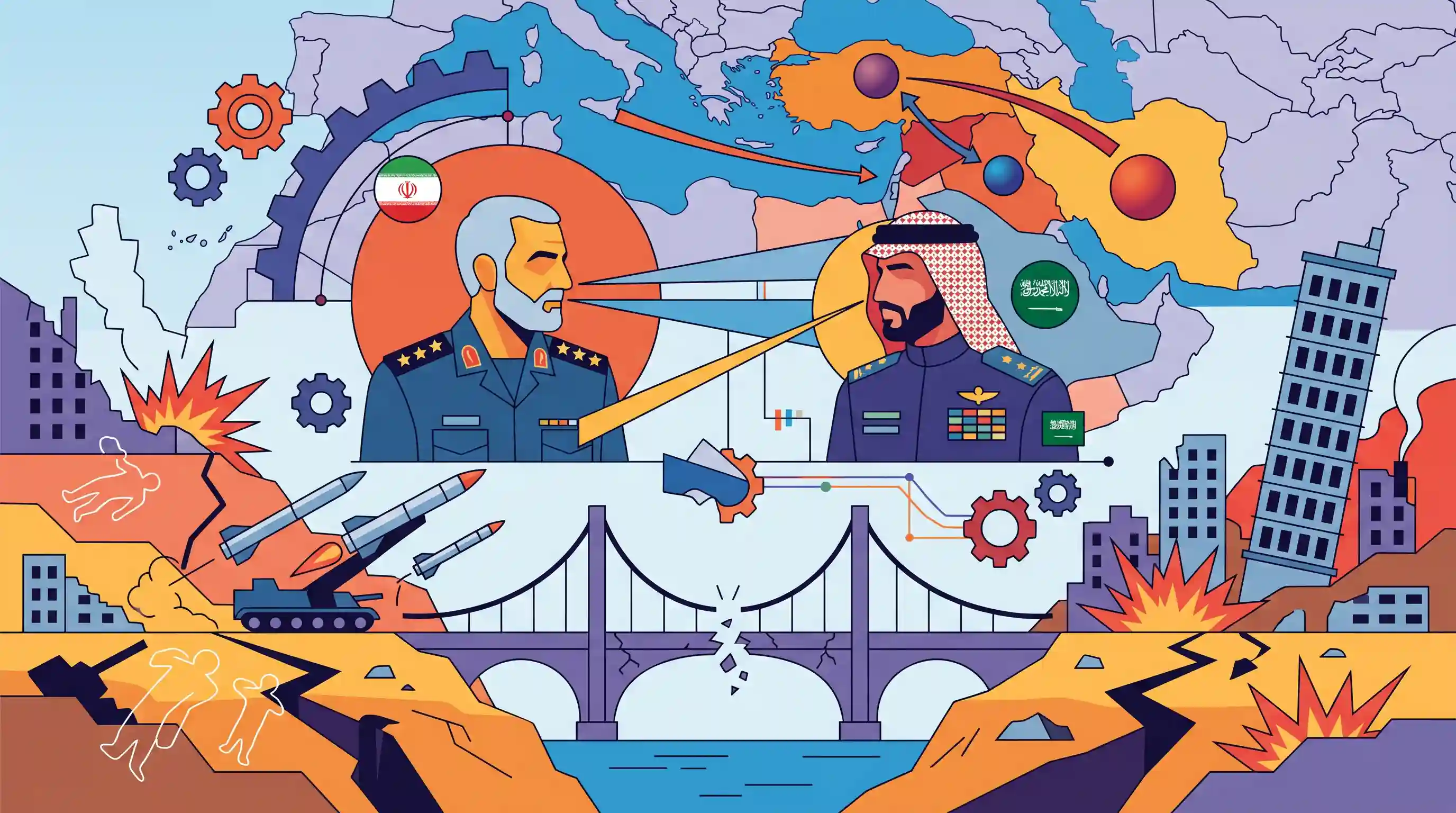
Iran has voiced strong skepticism regarding the durability of its recent ceasefire with Israel. In a communication between the Iranian Armed Forces Chief of Staff and the Saudi Defence Minister, Iran reiterated its stance that any breach of the ceasefire by Israel would trigger a strong military response. This development underscores the fragile security architecture in West Asia following direct military engagements that caused significant casualties. Notably, the high-level dialogue between Iran and Saudi Arabia highlights the ongoing geopolitical realignments in the Middle East, as regional powers attempt to navigate the volatile landscape.
Key Points
- Iran's Armed Forces Chief of Staff conveyed doubts about the durability of the recent ceasefire with Israel to Saudi Arabia's Defence Minister.
- Iran warned of a "strong response" should Israel violate the terms of the ceasefire.
- The recent direct military engagements resulted in approximately 60 Iranian casualties from Israeli strikes.
- The high-level defense communication between Iran and Saudi Arabia underscores the ongoing regional diplomatic realignments aimed at managing the broader fallout of the West Asian conflict.
Important Terms
West Asia Geopolitics

The complex interplay of power, religion, and energy interests in the Middle East. It involves rivalries between regional powers (Iran vs. Saudi Arabia) and the influence of global actors.
UPSC context
GS Paper II (IR). Tests understanding of India's 'Extended Neighbourhood' policy and regional stability's impact on energy security.
Iranian Armed Forces
The unified military of Iran consisting of the regular army (Artesh), the Islamic Revolutionary Guard Corps (IRGC), and the Law Enforcement Command, coordinated by a central General Staff.
UPSC context
GS Paper II (IR). Understanding the dual-military structure (ideological vs. conventional) is crucial for analyzing Iran's regional security posture.
Strait of Hormuz
The world's most critical maritime chokepoint between the Persian Gulf and Gulf of Oman. It carries approximately 20-30% of the world's total oil consumption.
UPSC context
GS Paper I (Geography) and GS Paper III (Security). Tests knowledge of global energy supply chains and maritime security.
Regional Security Architecture
The framework of alliances, treaties, and diplomatic norms (e.g., the 2023 Saudi-Iran normalization) intended to maintain stability and prevent large-scale conflict among Middle Eastern states.
UPSC context
GS Paper II (IR). Focuses on conflict resolution and the role of third-party mediators (like China) in regional stability.
Strategic Autonomy
A core tenet of India’s foreign policy, emphasizing the ability to make independent decisions based on national interest without being tied to permanent military blocs.
UPSC context
GS Paper II (IR). Tested in the context of India's balancing act between the US, Israel, and Iran.
Axis of Resistance
An Iranian-led political and military coalition including Hezbollah, Hamas, and the Houthis, aimed at countering Western and Israeli influence in West Asia.
UPSC context
GS Paper II (IR). Relevant for questions regarding proxy warfare and non-state actors in the Middle East.
Tasnim News Agency
A semi-official Iranian news agency with close ties to the IRGC. It is a primary source for Iran's official military and security narratives.
UPSC context
GS Paper II (IR). Relevant for identifying official state-sponsored narratives and disinformation in regional security reporting.
Prelims Trap
The recent diplomatic restoration between Iran and Saudi Arabia was brokered by the US under the Abraham Accords.
The 2023 Iran-Saudi rapprochement was brokered by China, not the US. The Abraham Accords (US-brokered) normalized relations between Israel and select Arab states like the UAE.
Static Concepts Connected
What is India's 'De-hyphenation' policy in West Asia?
- Independent relations: Managing strategic ties with mutually antagonistic states independently, without letting one relationship dictate or constrain the other.
- Strategic balancing: Allows India to maintain robust defense and agriculture ties with Israel while simultaneously developing the Chabahar Port with Iran.
Why is the Strait of Hormuz a critical maritime chokepoint?
- Geographical position: It connects the Persian Gulf to the Gulf of Oman and the Arabian Sea, flanked by Iran to the north and Oman to the south.
- Energy transit: It is the world's most vital oil chokepoint; roughly 20% of global oil flows through it, which critically underpins India's energy security and crude imports.
Cross-Topic Patterns
China's rising footprint in West Asia
The high-level Iran-Saudi defense communication builds upon their 2023 Beijing-brokered diplomatic restoration, reflecting China's growing diplomatic clout in a region historically dominated by US security architectures.
IMEC viability vs. direct conflict
The escalation of the Iran-Israel 'shadow war' into a direct military confrontation poses a severe viability risk to the India-Middle East-Europe Economic Corridor (IMEC), which strictly requires regional stability.

Expect a multi-statement Prelims question in 2026 linking West Asian volatility to maritime chokepoints (Hormuz) and transit paths (IMEC).
Linked PYQs · 3
Linked PYQs · 3
- 2018MainsGS2
“India’s relations with Israel have, of late, acquired a depth and diversity, which cannot be rolled back.” Discuss.
- 2025MainsGS2
"Energy security constitutes the dominant kingpin of India's foreign policy, and is linked with India's overarching influence in Middle Eastern countries.” How would you integrate energy security with India's foreign policy trajectories in the coming years?
- 2017MainsGS2
The question of India's Energy Security constitutes the most important part of India's economic progress. Analyze India's energy policy cooperation with West Asian countries.
