Strait of Hormuz Naval Blockade and Global Energy Shocks
Source:Indian Express ↗
Why It Matters
The escalation between the US and Iran and disruptions in the Strait of Hormuz profoundly impact global energy security and maritime trade. For India, which is deeply reliant on Middle Eastern oil, regional instability directly threatens macroeconomic stability, influences inflation, and necessitates robust foreign policy recalibration to safeguard its energy and diaspora interests.
Summary
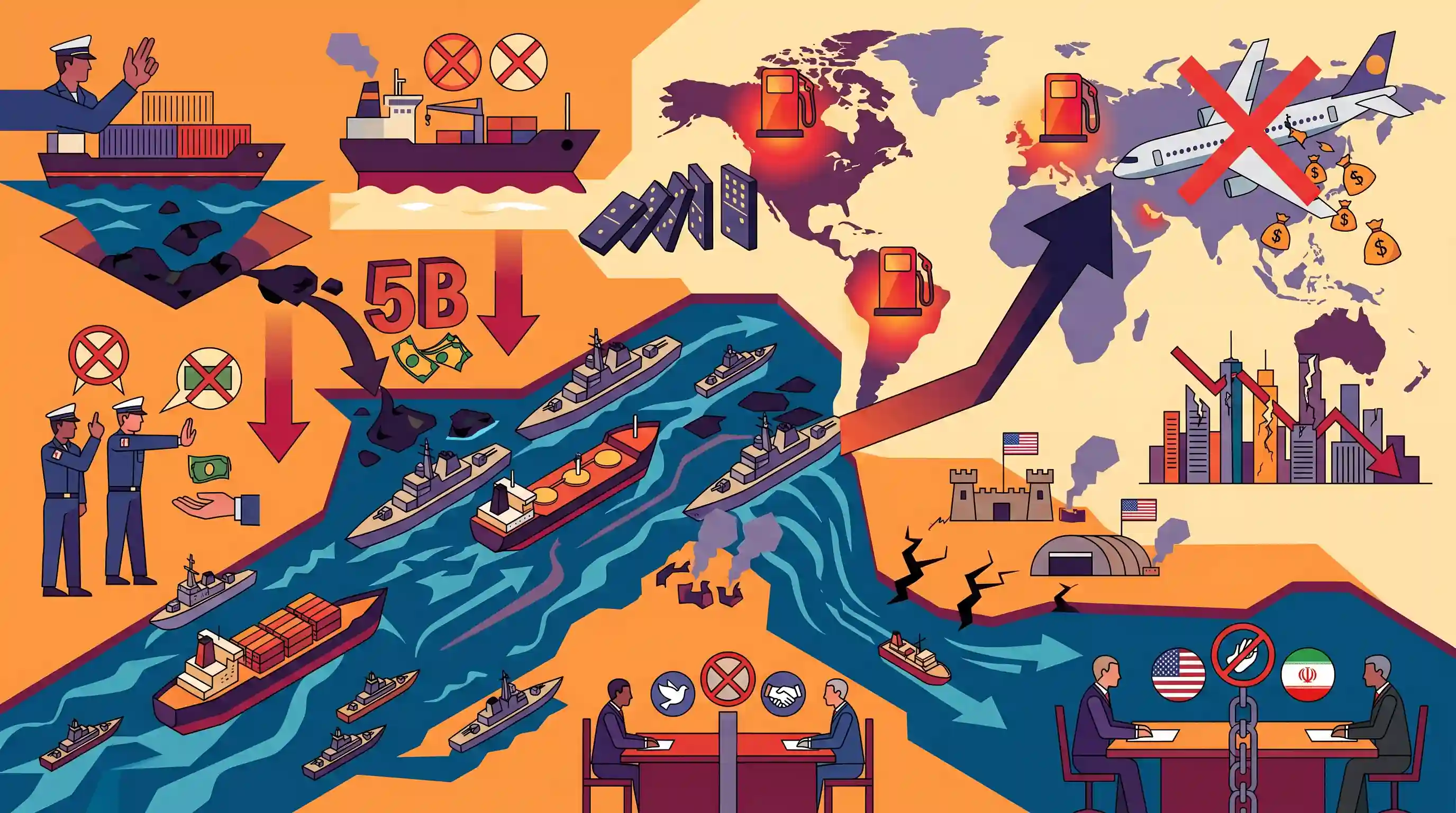
The ongoing US-Iran conflict has precipitated major global economic and security crises, most notably disrupting shipping and oil trade in the Strait of Hormuz. The US has imposed a naval blockade, costing Iran nearly $5 billion in oil revenues and warning shipping firms against paying Iranian "tolls" for safe passage. The resulting spike in global fuel prices has led to severe corporate fallout, including the collapse of Spirit Airlines. Meanwhile, military tensions remain high with damaged US bases in the Gulf and stalled diplomatic efforts, underscoring the severe risks to global energy security.
Key Points
- The US Treasury has warned global maritime shippers against paying "tolls" to Iran for safe passage through the Strait of Hormuz, stating it violates sanctions.
- A US naval blockade has effectively choked off Iran's oil supply routes, leading to nearly $5 billion in revenue losses for Tehran.
- Rising global fuel prices resulting from the US-Iran war have contributed to the collapse of Spirit Airlines, highlighting the conflict's economic contagion.
- The conflict has escalated militarily, with Iran executing alleged Israeli spies and US bases in the Gulf suffering heavy damage.
- The Strait of Hormuz remains a central flashpoint, underlining its critical strategic importance as a chokepoint for global energy supplies.
Important Terms
Strait of Hormuz

A strategic maritime chokepoint between Iran and Oman connecting the Persian Gulf to the Arabian Sea; it handles nearly 20% of global oil and 35% of LNG trade.
UPSC context
GS Paper 1 (Geography) and GS Paper 2 (International Relations); critical for energy security and maritime chokepoints.
Energy Security
The uninterrupted availability of energy sources at an affordable price, encompassing availability, accessibility, and reliability to fuel national economic growth and strategic autonomy.
UPSC context
GS Paper 3 (Economy/Infrastructure); fundamental for India's development and vulnerability to global fuel price shocks.
Naval Blockade
A wartime military operation by naval forces to prevent all vessels from entering or leaving a belligerent state's ports or coast; generally considered an act of war.
UPSC context
GS Paper 2 (International Relations); tests knowledge of international maritime law (San Remo Manual) and methods of warfare.
Maritime Security
The protection of national interests in the maritime domain, including the safeguarding of shipping lanes, coastal integrity, and resources from piracy or military threats.
UPSC context
GS Paper 3 (Internal Security) and GS Paper 2 (IR); central to India's 'SAGAR' initiative and Indo-Pacific strategy.
West Asia Geopolitics
The strategic power dynamics and rivalries in the Middle East, particularly involving Iran, Saudi Arabia, and the US, which influence global energy and security.
UPSC context
GS Paper 2 (International Relations); essential for understanding India’s energy interests, diaspora safety, and 'Look West' policy.
Sea Lanes of Communication (SLOCs)
The primary maritime routes used for global trade and logistics; their security is vital for maintaining the flow of energy and goods between regions.
UPSC context
GS Paper 3 (Security) and GS Paper 2 (IR); vital for trade-dependent economies like India (95% trade by volume).
Economic Sanctions
Commercial and financial penalties applied by one or more countries against a self-governing state, group, or individual to influence behavior or penalize actions.
UPSC context
GS Paper 2 (International Relations); relevant for understanding coercive diplomacy and its impact on global trade and inflation.
Prelims Trap
"Coastal states have sovereign rights to levy transit tolls on foreign shipping through international straits."
UNCLOS mandates 'transit passage' for international straits, which guarantees unimpeded navigation. Coastal states cannot legally levy tolls solely for transit, only for specific services rendered.
Static Concepts Connected
What distinguishes 'Transit Passage' under UNCLOS in international straits?
- Continuous Transit: Vessels enjoy the right of unimpeded, continuous, and expeditious transit through straits used for international navigation (e.g., Hormuz).
- Fee Prohibition: Coastal states bordering the strait cannot levy 'tolls' or fees merely for a vessel's passage; fees are only permitted for specific services.
- Submarine Navigation: Unlike 'innocent passage' in territorial waters, submarines are generally permitted to transit submerged through international straits.
How do West Asian energy shocks structurally impact India's macroeconomy?
- Widening CAD: An inflated crude oil import bill directly widens the Current Account Deficit (CAD) due to India's inelastic energy demand.
- Imported Inflation: Elevated crude prices pass through to domestic logistics and retail fuels, driving broad-based imported inflation.
- Rupee Depreciation: Surging US dollar demand by oil importers to settle energy trade exerts severe downward pressure on the Indian Rupee.
Cross-Topic Patterns
Energy Shocks & Aviation Economics
Geopolitical supply-side disruptions directly inflate Aviation Turbine Fuel (ATF) costs. Since ATF constitutes 30-40% of operating expenses, sustained oil shocks routinely trigger airline bankruptcies.
Secondary Sanctions vs. Strategic Autonomy
US Treasury warnings to global shippers echo CAATSA mechanisms, forcing oil-importing nations to navigate a tightrope between securing energy supplies and risking exclusion from the US dollar system.

Expect a 2026 multi-statement Prelims question combining West Asian chokepoint mapping (Hormuz) with UNCLOS 'transit passage' rules.
Linked PYQs · 5
Linked PYQs · 5
- 2018MainsGS2
In what ways would the ongoing US-Iran Nuclear Pact Controversy affect the national interest of India? How should India respond to this situation?
- 2012MainsGS2
How have the US sanctions against Iran affected India's bilateral relations with Iran?
- 2022MainsGS1
Mention the significance of straits and isthmus in international trade.
- 2017MainsGS2
The question of India's Energy Security constitutes the most important part of India's economic progress. Analyze India's energy policy cooperation with West Asian countries.
- 2025MainsGS2
"Energy security constitutes the dominant kingpin of India's foreign policy, and is linked with India's overarching influence in Middle Eastern countries.” How would you integrate energy security with India's foreign policy trajectories in the coming years?
