West Asian Conflict Impacts on Global Energy and Trade Routes
Source:Indian Express ↗
Why It Matters
The conflict directly impacts India's strategic 'Link West' policy. With over 80% of India's crude oil imported, any disruption in the Strait of Hormuz and subsequent oil price hikes directly stress India's current account balance, increase domestic inflation, and test India's strategic autonomy as it navigates relations with both the US and Iran. This event serves as an active case study of how geopolitical chokepoints dictate global energy economics.
Summary
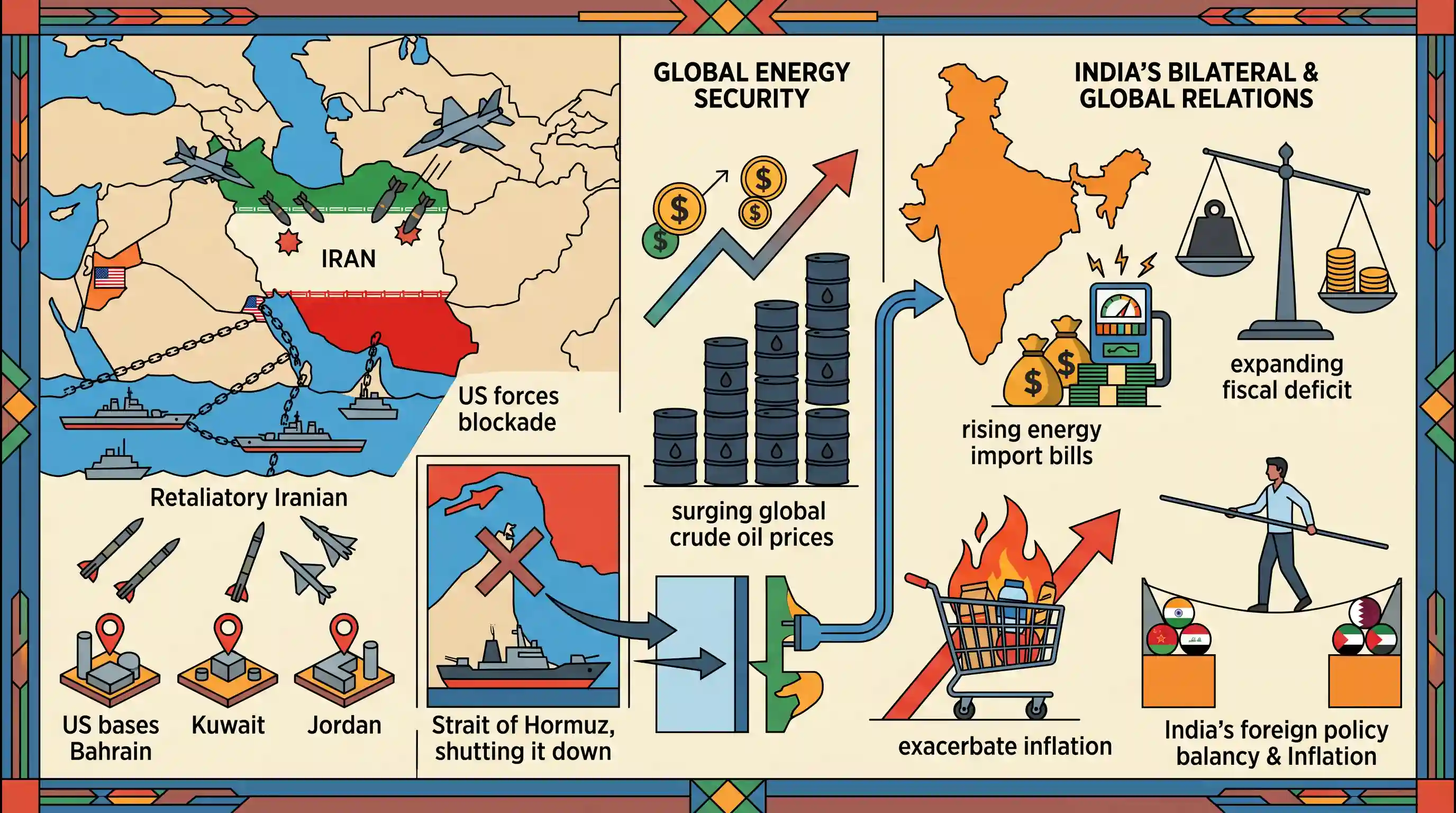
The US-Iran conflict has escalated with US forces conducting extensive airstrikes on Iranian targets and reinstating a naval blockade, prompting retaliatory Iranian strikes against US bases in Bahrain, Kuwait, and Jordan. With the critical maritime chokepoint of the Strait of Hormuz effectively shut down by Iran, global crude oil prices have surged. This disruption presents a significant threat to India's economic and energy security, as rising energy import bills threaten to expand its fiscal deficit, exacerbate inflation, and challenge its West Asian foreign policy balancing act.
Key Points
- US forces launched a seven-hour precision strike operation against Iranian military, drone, missile, and naval capabilities along Iran's southern coast, resuming a naval blockade in response to vessel attacks in the Strait of Hormuz.
- In retaliation, Iran's Islamic Revolutionary Guard Corps (IRGC) targeted major US military hubs, including the Fifth Fleet base in Bahrain, the Mina Abdullah logistics center in Kuwait, and the Azraq airbase in Jordan.
- The IRGC declared that the Strait of Hormuz—the world's most critical maritime oil transit chokepoint—will remain shut, warning against international cooperation with the US naval blockade.
- Crude oil prices surged following the blockades and attacks, with Brent crude rising to $86.19 and WTI climbing to $80.40 per barrel.
- The escalation severely impacts India's macroeconomic stability by driving up the country's crude import bill, widening the fiscal and current account deficits, causing domestic inflation, and squeezing corporate margins.
Important Terms
Islamic Revolutionary Guard Corps (IRGC)

A powerful branch of Iran’s Armed Forces established after the 1979 revolution to defend the Islamic system, manage strategic weapons, and control key parts of the country’s economy and regional proxy operations.
UPSC context
GS Paper II: International Relations and Security, testing Middle East geopolitics, state-sponsored proxies, and global strategic conflicts.
US Central Command (CENTCOM)
A unified combatant command of the United States military established in 1983, responsible for directing military operations across 21 nations in the Middle East, Central Asia, and South Asia.
UPSC context
GS Paper II: International Relations, testing US security policies, regional military dynamics, and security partnerships in West Asia.
Strait of Hormuz
A narrow, strategically vital maritime chokepoint between Iran and Oman that connects the Persian Gulf to the Gulf of Oman, handling over 20% of global oil and liquefied natural gas shipments.
UPSC context
GS Paper I: World Geography & GS Paper III: Infrastructure, testing international trade routes, energy chokepoints, and geographic mapping.
Energy Security
The continuous availability of energy resources at an affordable price, crucial for sustaining industrial growth and domestic consumption while minimizing vulnerability to global supply shocks.
UPSC context
GS Paper III: Infrastructure and Economic Development, focusing on import diversification, strategic reserves, and global resource dependencies.
Prelims Trap
Operation Sankalp is a bilateral maritime security exercise conducted jointly by the Indian Navy and the US Fifth Fleet.
It is a unilateral security deployment launched by the Indian Navy in 2019 to protect Indian-flagged merchant vessels, not a joint/bilateral military exercise.
Static Concepts Connected
What is the geographic layout and strategic significance of the Strait of Hormuz?
- Geographic boundaries: Connects the Persian Gulf with the Gulf of Oman, bordered by Iran to the north and Oman's Musandam Peninsula exclave to the south.
- Sovereignty and transit: Due to narrowness (33 km), commercial ships must traverse the territorial waters of Iran and Oman under international law transit passage rules.
- Energy significance: Acts as the global chokepoint for over 20% of global petroleum consumption and a massive share of Liquefied Natural Gas (LNG).
How do global oil shocks impact India's macroeconomic indicators?
- CAD widening: Every $10/barrel increase expands India's trade deficit by $12-14 billion, directly widening the Current Account Deficit (CAD).
- Imported inflation: Feeds into domestic transportation and fuel costs, raising both WPI and consumer retail inflation (CPI).
- Rupee depreciation: Surging import bills drive up USD demand, causing domestic currency depreciation pressures on the Indian Rupee.
Cross-Topic Patterns
Energy security vs Strategic reserves
Chokepoint disruptions expose India's vulnerability, highlighting the strategic necessity of accelerated Phase-II Strategic Petroleum Reserves (SPRs) to cushion against physical supply cutoffs.
Strategic autonomy in maritime security
India's unilateral Operation Sankalp versus joining Western coalitions like Operation Prosperity Guardian illustrates New Delhi's operational strategic autonomy in volatile West Asian waters.

Hormuz geography, Operation Sankalp, and CAD oil-sensitivity formulas will likely form a single multi-statement 2026 Prelims question.
Linked PYQs · 3
Linked PYQs · 3
- 2026PrelimsGS1
Ships from which of the following countries have to cross the Strait of Hormuz to reach out to the Indian Ocean ? 1. Bahrain 2. Syria 3. Qatar 4. Egypt Select the answer using the code given below :
- 2025MainsGS2
"Energy security constitutes the dominant kingpin of India's foreign policy, and is linked with India's overarching influence in Middle Eastern countries.” How would you integrate energy security with India's foreign policy trajectories in the coming years?
- 2017MainsGS2
The question of India's Energy Security constitutes the most important part of India's economic progress. Analyze India's energy policy cooperation with West Asian countries.
