Strait of Hormuz Closure and Lebanon Strikes Test West Asia Peace
Source:Indian Express ↗
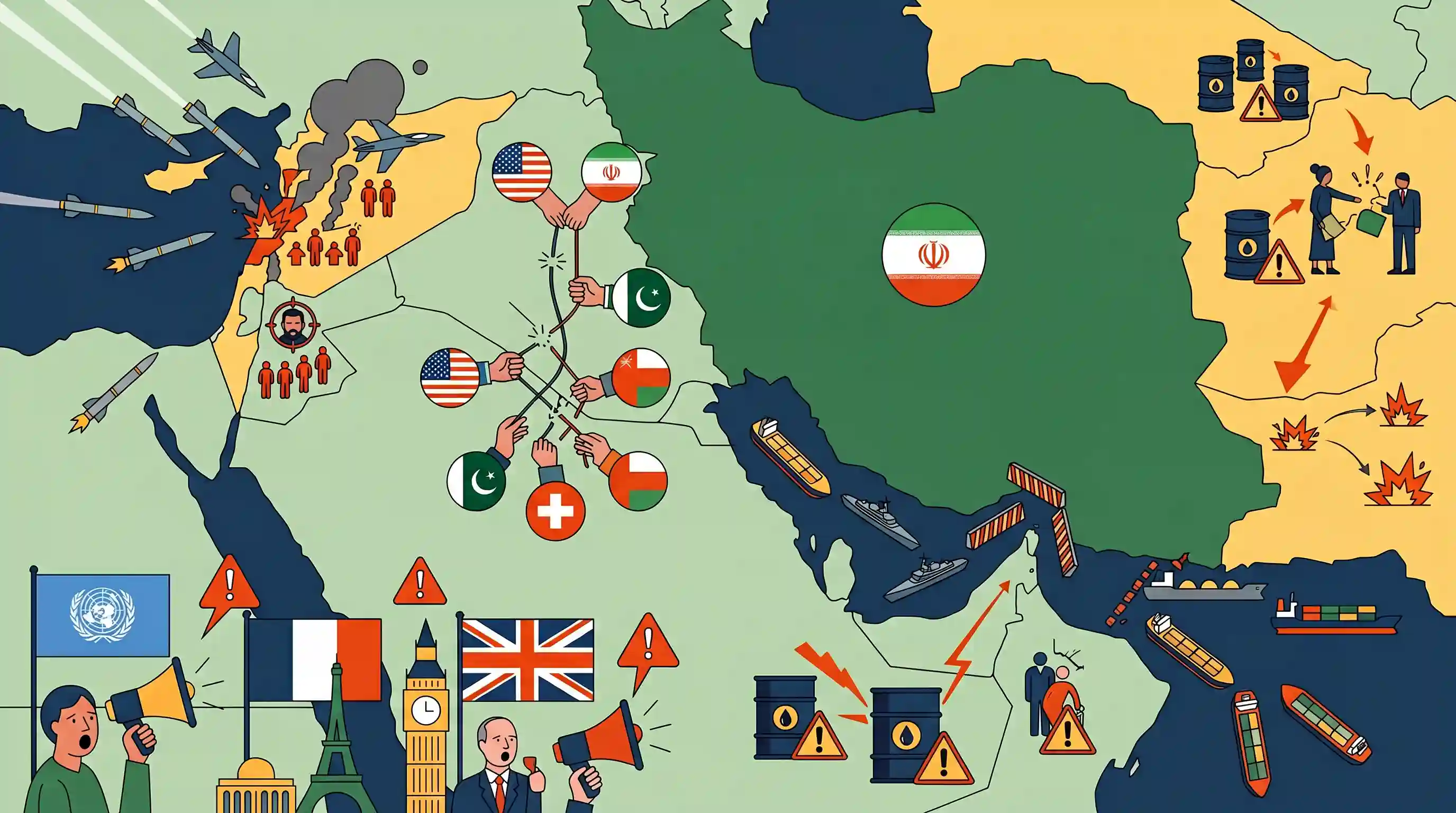
Why It Matters
The conflict highlights the volatility of West Asia and the vulnerability of global energy supply chains. For UPSC aspirants, understanding the strategic importance of the Strait of Hormuz, the dynamics of Israel-Iran proxy conflicts, and their direct impact on India's energy security and diaspora is critical for GS2 (International Relations) and GS3 (Economy/Energy).
Summary
The fragile US-Iran ceasefire talks, mediated by countries like Pakistan, Oman, and Switzerland, face severe disruption following a massive escalation in the Middle East. Israel conducted extensive airstrikes in Lebanon, targeting Hezbollah and resulting in over 250 fatalities, including a relative of a Hezbollah leader. In response, Iran has moved to close the Strait of Hormuz, a crucial maritime chokepoint that handles a significant portion of global oil traffic. The sudden escalation has drawn widespread international condemnation from the UN, France, and the UK, raising alarms about global energy security and the potential for a broader West Asian conflict.
Key Points
- Israeli airstrikes in Lebanon killed over 250 people, targeting Hezbollah positions and severely heightening regional tensions.
- In retaliation to the strikes and escalating hostilities, Iran announced the closure of the Strait of Hormuz, a critical chokepoint for global oil transit.
- The escalation threatens to derail fragile US-Iran ceasefire negotiations that were scheduled to be hosted in Islamabad, with mediation support from Oman and Switzerland.
- Global leaders, including the UN Secretary-General and heads of state from France and the UK, have condemned the strikes and warned of a wider regional war.
- The closure of the Strait of Hormuz raises significant concerns for global energy security and supply chain stability, impacting major oil importers like India.
Important Terms
Strait of Hormuz

A strategic maritime chokepoint between Iran and Oman connecting the Persian Gulf to the Gulf of Oman; it handles approximately 20% of global oil and LNG trade.
UPSC context
GS Paper 2/3: Maritime security, global trade vulnerabilities, and India’s high energy dependence (80%+) on this route.
Hezbollah
A powerful Lebanon-based Shia militant group and political party; primarily funded by Iran as part of its 'Axis of Resistance' against Israel.
UPSC context
GS Paper 2: International Relations—non-state actors, regional proxy dynamics, and the security of the Indian diaspora.
Proxy War
A conflict where rival powers indirectly confront each other by supporting third-party combatants to avoid direct military engagement and minimize costs.
UPSC context
GS Paper 2: Analyzing 'gray zone' warfare and its impact on regional stability and global diplomacy.
Energy Security
The uninterrupted availability of energy sources at an affordable price, often threatened by geopolitical disruptions at maritime chokepoints.
UPSC context
GS Paper 3: India’s Strategic Petroleum Reserves (SPR) and the economic impact of oil price volatility.
United Nations (UN)
The primary intergovernmental organization tasked with maintaining international peace; its Security Council (UNSC) is responsible for authorizing interventions or sanctions.
UPSC context
GS Paper 2: Effectiveness of multilateral institutions and challenges of the Veto power in conflict resolution.
Axis of Resistance
An informal anti-Western and anti-Israeli alliance led by Iran, including the Syrian government, Hezbollah, Hamas, and the Houthi movement.
UPSC context
GS Paper 2: Mapping regional power blocs and the multi-front nature of West Asian conflicts.
Prelims Trap
"The Strait of Hormuz connects the Persian Gulf to the Red Sea and is bordered by Iran and Saudi Arabia."
The Strait of Hormuz connects the Persian Gulf to the Gulf of Oman (Arabian Sea). It is bordered by Iran, Oman, and the UAE, but notably NOT by Saudi Arabia.
Static Concepts Connected
What are the primary maritime chokepoints in West Asia and their geographic locations?
- Strait of Hormuz: Connects the Persian Gulf to the Gulf of Oman; bordered by Iran to the north and Oman (Musandam Peninsula)/UAE to the south.
- Bab el-Mandeb: Connects the Red Sea to the Gulf of Aden; bordered by Yemen on the Arabian Peninsula, and Djibouti/Eritrea in the Horn of Africa.
- Suez Canal: Artificial waterway in Egypt connecting the Mediterranean Sea to the Red Sea, enabling direct Europe-to-Asia maritime trade without circumnavigating Africa.
How do global crude oil price shocks impact India's macroeconomic stability?
- Widening CAD: Since India imports over 80% of its crude requirements, sudden price surges heavily inflate the import bill, causing the Current Account Deficit to expand.
- Imported Inflation: Elevated fuel prices directly increase domestic transportation and production costs, causing a cascading effect that drives up retail inflation (CPI).
- Rupee Depreciation: A higher import bill requires more US Dollars. This increased demand for foreign exchange by Oil Marketing Companies puts depreciative pressure on the Indian Rupee.
Cross-Topic Patterns
Chokepoints & Imported Inflation
Disruptions in the Strait of Hormuz directly link physical geopolitical conflicts to India's Current Account Deficit (CAD) and imported inflation, a recurring analytical theme in UPSC Economy questions.
Vienna Convention & Protecting Powers
Switzerland's role as a US intermediary in Iran connects fluid geopolitics to the static 1961 Vienna Convention on Diplomatic Relations, highlighting the "Protecting Power" mechanism in international law.

Map questions pairing West Asian chokepoints (Hormuz, Bab el-Mandeb) with their exact bordering nations are highly probable for 2026.
Linked PYQs · 2
Linked PYQs · 2
- 2023PrelimsGS1
Consider the following pairs: Regions often mentioned in news Reason for being in news 1. North Kivu and Ituri : War between Armenia and Azerbaijan 2. Nagorno-Karabakh : Insurgency in Mozambique 3. Kherson and Zaporizhzhia : Dispute between Israel and Lebanon How many of the above pairs are correctly matched?
- 2018MainsGS2
“India’s relations with Israel have, of late, acquired a depth and diversity, which cannot be rolled back.” Discuss.
