United States and Iran Nuclear Negotiations in Geneva
Source:The Hindu ↗
Why It Matters
The escalating US-Iran tensions and potential failure of nuclear talks pose significant risks to regional stability in the Middle East and global energy security, particularly concerning the strategic Strait of Hormuz. This is highly relevant for UPSC GS Paper 2 (International Relations) and GS Paper 1/3 (Geography and Energy Security).
Summary
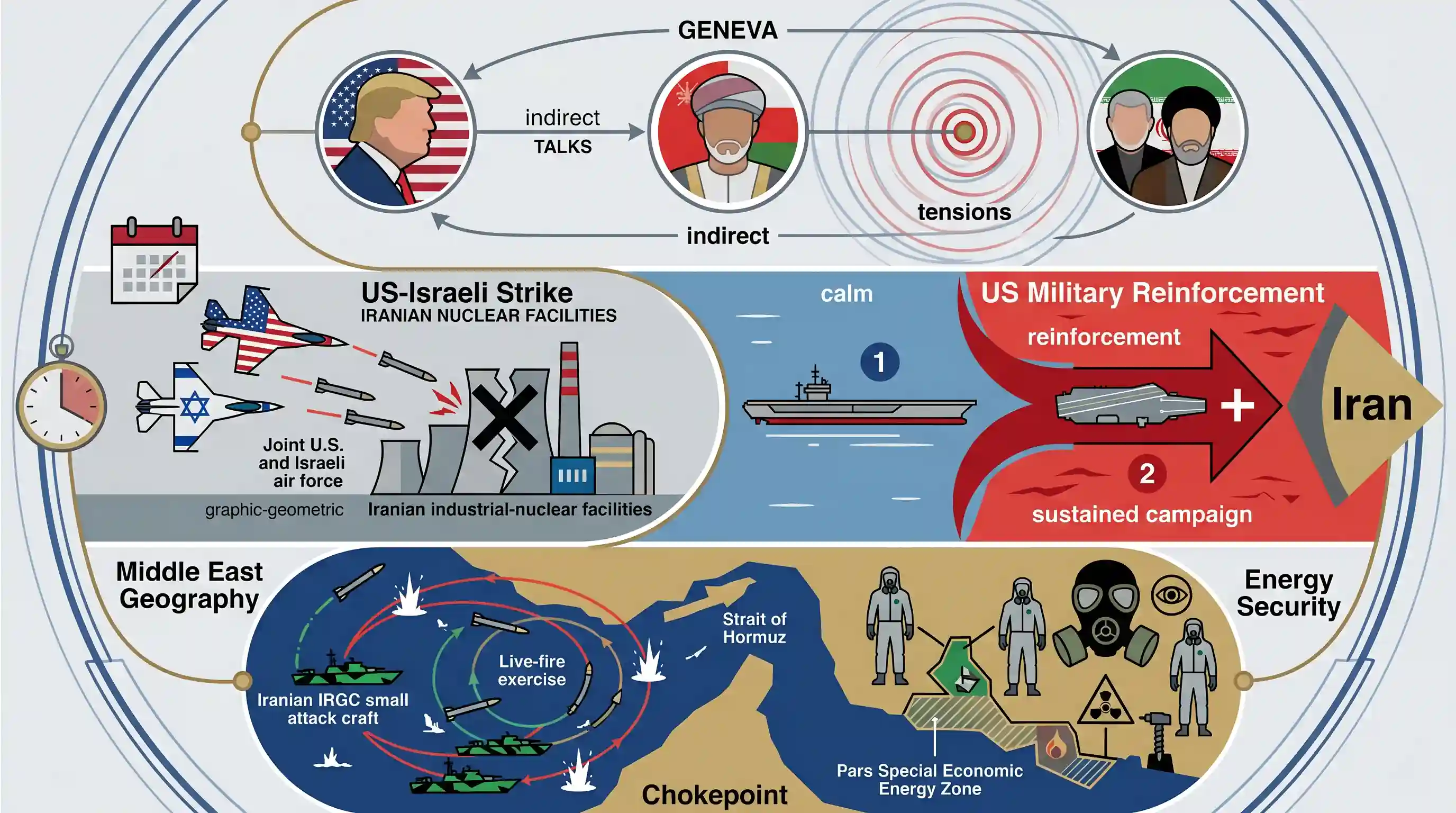
US President Donald Trump announced his 'indirect' involvement in upcoming Geneva talks regarding Iran's nuclear program, occurring amidst high tensions following a US-Israeli strike on Iranian nuclear facilities last June. The US has reinforced its military presence by deploying a second aircraft carrier to the Middle East, signaling readiness for a sustained campaign if negotiations over Iran's domestic uranium enrichment fail. Concurrently, Iran's IRGC has initiated live-fire drills near the strategically vital Strait of Hormuz, and chemical defence drills have been conducted in the Pars Special Economic Energy Zone.
Key Points
- US President Donald Trump indicated he will be 'indirectly' involved in the Geneva talks concerning Iran's nuclear program.
- The negotiations follow stalled talks and a joint US-Israeli strike on Iranian nuclear sites last June, triggered by Washington's demand that Tehran abandon domestic uranium enrichment.
- Signaling potential military escalation if talks fail, the US has deployed a second aircraft carrier to the Middle East.
- In response to soaring tensions, Iran's IRGC commenced live-fire drills near the strategic Strait of Hormuz, and civil defence authorities conducted chemical defence drills in the Pars Special Economic Energy Zone.
Important Terms
Strait of Hormuz

A critical maritime chokepoint between Iran and Oman connecting the Persian Gulf to the Gulf of Oman. It handles approximately 20% of the world's oil and liquefied natural gas (LNG) shipments.
UPSC context
GS Paper 1 & 2: Tests knowledge of strategic maritime chokepoints and their impact on India’s energy security and West Asian geopolitics.
Islamic Revolutionary Guard Corps (IRGC)
An elite branch of the Iranian Armed Forces established to protect the country's Islamic system. It operates independently of the regular army and controls significant political, military, and economic assets.
UPSC context
GS Paper 2: Relevant for West Asian security dynamics, state-sponsored entities, and their influence on international diplomatic relations.
Uranium Enrichment
The physical process of increasing the percentage of the fissile isotope Uranium-235. Low enrichment (3-5%) serves civilian power, while high enrichment (~90%) is required for developing nuclear weapons.
UPSC context
GS Paper 3: Tests understanding of nuclear technology, dual-use materials, and international non-proliferation regimes.
Pars Special Economic Energy Zone (PSEEZ)
A strategic energy hub in Iran's Bushehr province established to exploit the South Pars gas field. it is a major center for oil, gas, and petrochemical industrial activities.
UPSC context
GS Paper 1 & 3: Important for mapping global energy resources and economic drivers in West Asia.
Iran's civil defence organisation
Also known as the National Passive Defense Organization (NPDO), this bureau protects Iran's critical infrastructure from non-traditional threats, including cyber, biological, and chemical warfare.
UPSC context
GS Paper 3: Pertains to internal security, hybrid warfare, and disaster management strategies for critical infrastructure.
Prelims Trap
"The South Pars gas field, the world's largest, is shared between Iran and Saudi Arabia."
It is territorially shared between Iran and Qatar (where it is called the North Field). UPSC frequently swaps neighboring Gulf nations to test precise map awareness.
Static Concepts Connected
What are the key maritime chokepoints in the Middle East?
- Strait of Hormuz: Connects the Persian Gulf to the Gulf of Oman and Arabian Sea; transits over 20% of global oil.
- Bab el-Mandeb: Connects the Red Sea to the Gulf of Aden and the Arabian Sea, controlling access to the Suez Canal.
- Suez Canal: Artificial waterway in Egypt connecting the Red Sea to the Mediterranean Sea.
How is uranium enriched and what is the IAEA Additional Protocol?
- Isotope separation: Gas centrifuges increase the concentration of the fissile isotope U-235 over the heavier, non-fissile U-238.
- Enrichment levels: Civil reactors use Low Enriched Uranium (under 20%); nuclear weapons require Highly Enriched Uranium (around 90%).
- Additional Protocol: Grants IAEA inspectors expanded rights and unhindered access to search for undeclared nuclear activities within a state.
Cross-Topic Patterns
Iran sanctions & India's transit networks
Renewed US-Iran hostilities threaten global crude oil prices and complicate India's strategic operationalization of the Chabahar port and the International North-South Transport Corridor (INSTC).
Contested offshore gas fields in the Gulf
The South Pars/North Dome field (Iran/Qatar) maps onto a wider UPSC trend of testing shared/contested Middle Eastern energy assets, such as the Arash/Dorra field (Iran/Saudi/Kuwait).

Expect a paired-matching map question linking West Asian gas fields (South Pars) to sharing nations, or an IAEA Additional Protocol query.
Linked PYQs · 2
Linked PYQs · 2
- 2025MainsGS2
"Energy security constitutes the dominant kingpin of India's foreign policy, and is linked with India's overarching influence in Middle Eastern countries.” How would you integrate energy security with India's foreign policy trajectories in the coming years?
- 2024PrelimsGS1
Consider the following statements : Statement-I : Sumed pipeline is a strategic route for Persian Gulf oil and natural gas shipments to Europe. Statement-II : Sumed pipeline connects the Red Sea with the Mediterranean Sea. Which one of the following is correct in respect of the above statements?
