US-Iran Doha Talks on Hormuz Security and Frozen Funds
Source:Indian Express ↗
Why It Matters
The geopolitical stability of the West Asian region and security along the Strait of Hormuz are vital to India's energy security, as a large portion of India’s crude oil imports transit through this narrow channel. De-escalation between the US and Iran directly affects global oil supply chains, inflation in emerging economies, and the progress of Indian-backed strategic infrastructure projects like the Chabahar Port in Iran.
Summary
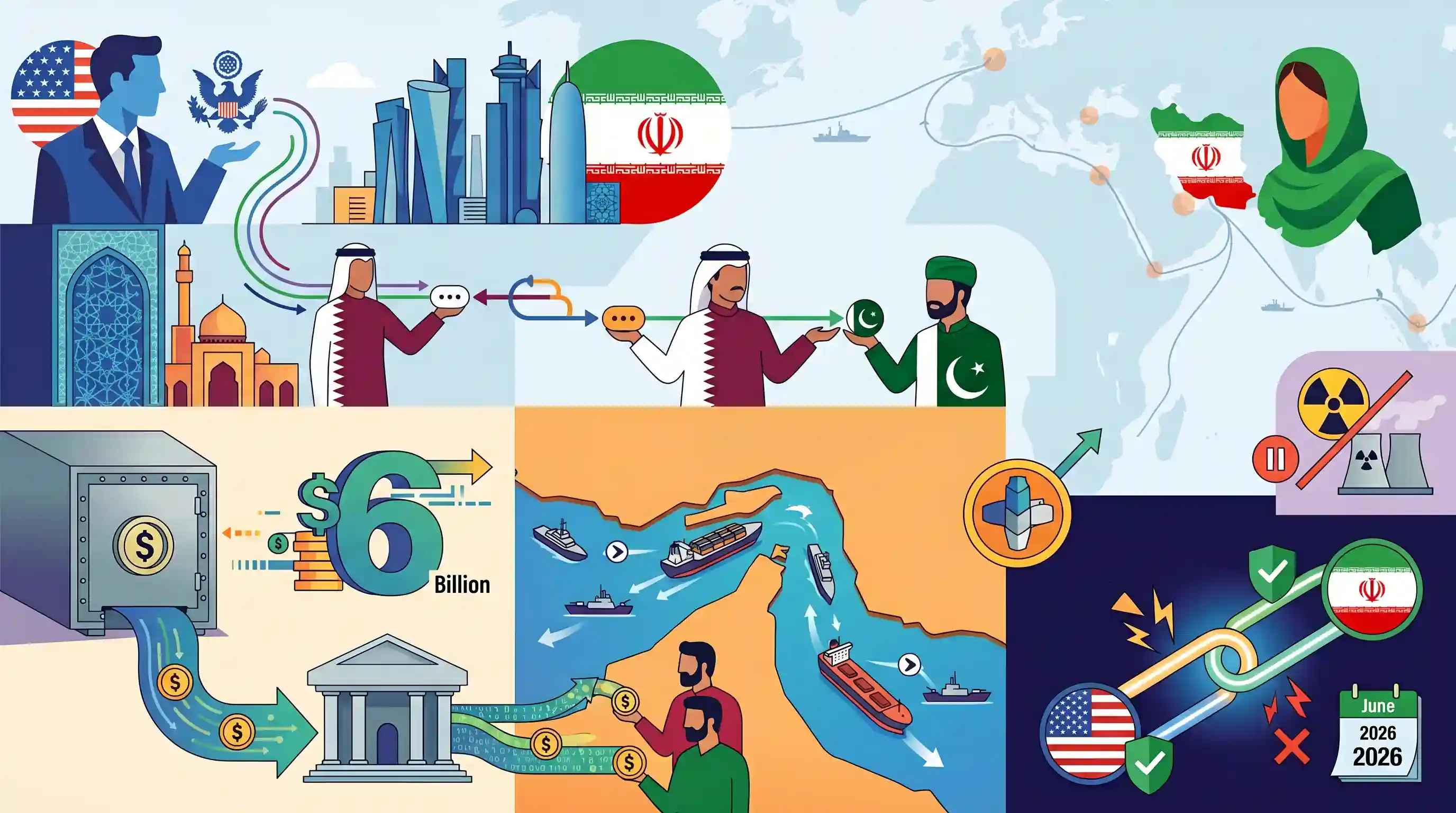
In July 2026, US and Iranian negotiators conducted indirect talks in Doha, facilitated by Qatar and Pakistan, following recent military escalations over shipping routes. The discussions focused on stabilizing transit through the strategic Strait of Hormuz, managing the release of $6 billion in frozen Iranian funds through Qatar's Central Bank, and setting up a bilateral communication channel to prevent violations of their June 2026 peace MoU. While the nuclear issue was sidelined during this round, both sides expressed a commitment to resume nuclear-related talks at a later date.
Key Points
- Iran and the United States held indirect, Qatari- and Pakistani-mediated talks in Doha in July 2026 to de-escalate tensions following maritime conflicts in the Strait of Hormuz.
- The discussions centered around securing shipping routes in the Strait of Hormuz, with US negotiators discouraging Iran from charging transit tolls in exchange for potential nuclear-related concessions.
- The two nations agreed to establish a dedicated bilateral communication channel to resolve disputes and report potential breaches of the peace agreement signed in June 2026.
- Negotiations also addressed the utilization and release of $6 billion in frozen Iranian funds, with the Central Bank of Qatar facilitating the purchase of essential goods for Iran based on its specified needs.
- While the broader Iranian nuclear programme did not feature heavily in this round, both US and Iranian representatives indicated that denuclearization and nuclear issues remain on the future agenda.
Important Terms
Joint Comprehensive Plan of Action (JCPOA)

A 2015 diplomatic agreement between Iran and world powers (P5+1) that restricted Iran’s nuclear program in exchange for lifting international economic sanctions.
UPSC context
GS Paper II (International Relations). Tests understanding of global security groupings, non-proliferation, and impacts of West Asian geopolitics on India.
Strait of Hormuz
A strategically vital maritime chokepoint between Iran and Oman, connecting the Persian Gulf with the Gulf of Oman, through which nearly 20% of global petroleum transits.
UPSC context
GS Paper I (World Geography) and GS Paper III (Security & Energy). Tests knowledge of critical maritime choke points and India's energy import routes.
US-Iran de-escalation MoU (June 2026)
A 14-point diplomatic agreement reached in Switzerland in June 2026, aimed at halting military escalations, resolving maritime incidents, and stabilizing West Asian borders.
UPSC context
GS Paper II (Bilateral Agreements). Tests knowledge of international diplomacy, regional peace initiatives, and their stabilizing effect on Indian trade routes.
Central Bank of Qatar
Qatar's monetary authority responsible for financial stability, acting as an intermediary in holding and releasing frozen Iranian humanitarian funds under US-approved agreements.
UPSC context
GS Paper III (Economy) & GS Paper II (IR). Tests understanding of international banking intermediaries, escrow accounts, and sanction-monitoring frameworks in global trade.
Government of Iran
The Islamic Republic of Iran's executive authority, representing a key regional power in West Asia involved in crucial negotiations over nuclear limits, sanctions, and maritime transit.
UPSC context
GS Paper II (Bilateral & Global Groupings). Tests awareness of major foreign governments whose policies significantly impact India's strategic ties and energy imports.
Prelims Trap
Chabahar Port is situated inside the Persian Gulf, making its maritime access contingent upon passing through the Strait of Hormuz.
Chabahar is located on the Gulf of Oman, outside the Strait of Hormuz, allowing India to bypass this strategic chokepoint entirely to reach Central Asia.
Static Concepts Connected
What is the geographical and strategic significance of the Strait of Hormuz?
- Geography: Connects the Persian Gulf to the Gulf of Oman, bordered by Iran to the north and Oman's Musandam exclave to the south.
- Energy Chokepoint: Transits nearly 20-21 million barrels of oil daily, representing approximately 20% of global petroleum liquid consumption.
- India's Response: India launched 'Operation Sankalp' in 2019 to secure Indian-flagged merchant vessels transiting this volatile maritime corridor.
How does Chabahar Port bypass geopolitical hurdles for India?
- Bypassing Pakistan: Provides direct sea access to Iran's coast, bypassing overland transit blockades through Pakistan to reach Afghanistan and Central Asia.
- Avoiding Hormuz: Positioned outside the Persian Gulf, insulating India's trade route from military conflicts or blockades in the Strait of Hormuz.
- INSTC Connection: Serves as the southern gateway for the multimodal International North-South Transport Corridor (INSTC) connecting India to Russia.
Cross-Topic Patterns
Strategic Chokepoints & India's SPR
Disruptions in Hormuz threaten India's high oil import dependency, directly linking maritime bottlenecks to the critical expansion of India's Strategic Petroleum Reserves.
West Asia Diplomacy & Autonomy
US-Iran friction tests India's strategic autonomy, forcing balancing acts between vital investments in Chabahar and security partnerships with the US and Gulf nations.

West Asian maritime chokepoints combined with India's naval operations like Operation Sankalp are highly probable for a 2026 map question.
Linked PYQs · 3
Linked PYQs · 3
- 2025MainsGS2
"Energy security constitutes the dominant kingpin of India's foreign policy, and is linked with India's overarching influence in Middle Eastern countries.” How would you integrate energy security with India's foreign policy trajectories in the coming years?
- 2012MainsGS2
How have the US sanctions against Iran affected India's bilateral relations with Iran?
- 2026PrelimsGS1
Ships from which of the following countries have to cross the Strait of Hormuz to reach out to the Indian Ocean ? 1. Bahrain 2. Syria 3. Qatar 4. Egypt Select the answer using the code given below :
