US Iran nuclear negotiations and West Asia diplomacy
Source:Indian Express ↗
Why It Matters
The trajectory of US-Iran nuclear negotiations directly affects stability in West Asia, global energy prices, and India's strategic and economic interests in the region, including the Chabahar port project and diaspora security.
Summary
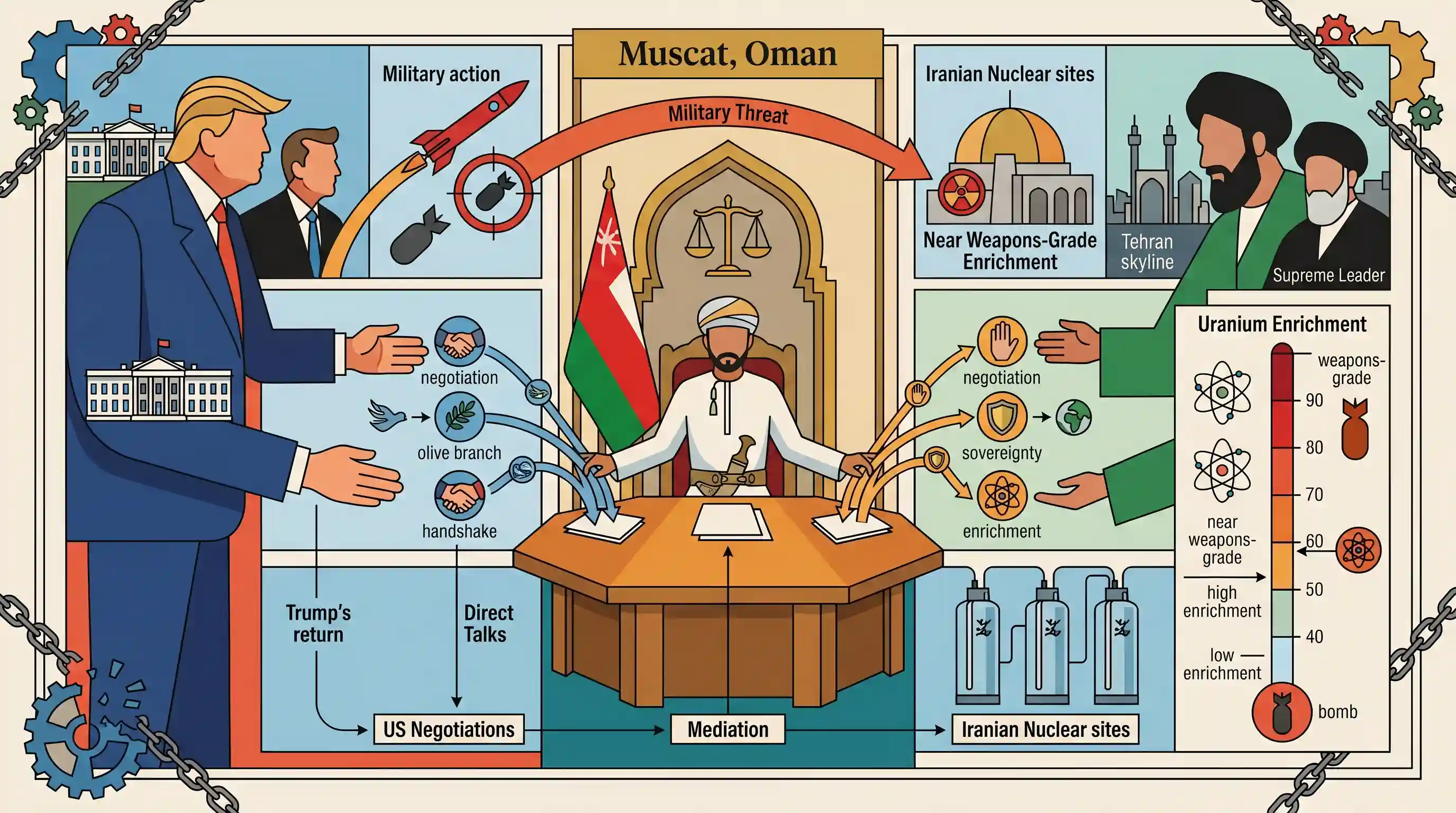
The US and Iran have resumed direct negotiations over Tehran's advancing nuclear program, meeting in Muscat, Oman. These talks mark the first direct diplomatic engagement between the two nations since Donald Trump’s return to the White House. Highlighting the fragility of the situation, Trump has threatened military action against Iran's nuclear sites if a diplomatic resolution is not reached. Iran currently enriches uranium to near weapons-grade levels, making these negotiations critical for regional stability and global non-proliferation efforts.
Key Points
- The United States and Iran held their first direct nuclear negotiations in Oman since Donald Trump returned to the presidency.
- Oman played a crucial intermediary role, hosting talks between US Mideast envoy Steve Witkoff and Iranian Foreign Minister Abbas Araghchi in Muscat.
- The diplomatic engagement occurs under high pressure, with President Trump warning of potential airstrikes against Iranian nuclear facilities if talks fail.
- Iran has been enriching uranium up to 60% purity, which is close to the 90% weapons-grade threshold, intensifying global non-proliferation concerns.
Important Terms
Joint Comprehensive Plan of Action (JCPOA)

A 2015 landmark agreement between Iran and world powers (P5+1) limiting Tehran's nuclear program in exchange for relief from international economic sanctions.
UPSC context
GS-II (International Relations); essential for understanding West Asian diplomacy and India's energy security/strategic balancing with the US and Iran.
Uranium Enrichment
The process of increasing the percentage of Uranium-235. Low-enriched (3-5%) is for power; highly enriched (60%) or weapons-grade (90%) is used for nuclear explosives.
UPSC context
GS-III (Science & Technology/Security); relates to nuclear proliferation, the ‘breakout time’ for weapons, and civilian vs. military nuclear applications.
Non-Proliferation Treaty (NPT)
A multilateral treaty aimed at preventing the spread of nuclear weapons and technology, promoting peaceful nuclear energy use, and furthering the goal of disarmament.
UPSC context
GS-II (Global Groupings); tests knowledge of international law, India’s non-signatory status, and the global nuclear governance framework.
International Atomic Energy Agency (IAEA)
The UN’s nuclear watchdog tasked with verifying that member states (like Iran) use nuclear technology for peaceful purposes through monitoring and inspections.
UPSC context
GS-II (International Institutions); crucial for discussing the enforcement of nuclear safeguards and global security oversight.
Oman’s Role as Mediator
A Gulf nation that acts as a key diplomatic 'bridge' or neutral mediator between Western powers (especially the US) and Iran.
UPSC context
GS-II (Bilateral Relations/Regional Geopolitics); significant for understanding the Muscat track of diplomacy and back-channel negotiations in West Asia.
Strait of Hormuz
A critical maritime chokepoint between Iran and Oman through which approximately 20% of the world’s oil and LNG supply passes daily.
UPSC context
GS-I (World Geography) and GS-II (Energy Security); a strategic flashpoint impacting global oil prices and India’s energy import routes.
Prelims Trap
Iran's 60% enriched uranium is classified as weapons-grade material.
Aspirants confuse 60% with weapons-grade. While it is Highly Enriched Uranium (HEU) and technically close, true weapons-grade requires ~90% U-235 purity. 60% is a stepping stone.
Static Concepts Connected
What are the technical thresholds of Uranium Enrichment?
- Natural Uranium: Natural uranium contains only ~0.7% of the fissile U-235 isotope, requiring enrichment for most reactors to function.
- LEU: Low-Enriched Uranium (3-5%) is the standard fuel used in civilian commercial nuclear power plants.
- Weapons-grade (HEU): Highly Enriched Uranium (HEU) is >20%. Weapons-grade uranium requires ~90% U-235 purity to sustain an explosive chain reaction.
What is the role of IAEA Safeguards and the Additional Protocol?
- Comprehensive Safeguards: Mandatory agreements for NPT non-nuclear-weapon states allowing the IAEA to verify that declared nuclear material is not diverted to weapons.
- Additional Protocol: A voluntary agreement granting the IAEA expanded rights to inspect undeclared facilities and demand short-notice access, a key sticking point with Iran.
Cross-Topic Patterns
Strait of Hormuz & Energy Security
Oman's mediation prevents military escalation that could close the Strait of Hormuz, a chokepoint handling roughly 20% of global oil that is crucial to India's energy imports.
Iran Sanctions, Chabahar & INSTC
US-Iran relations dictate the sanctions regime. India’s strategic investments in Chabahar Port and the INSTC heavily depend on navigating or securing US sanction waivers.

Expect a multi-statement Prelims question testing the distinction between LEU (3-5%) and weapons-grade (90%) enrichment alongside IAEA protocols.
Linked PYQs · 4
Linked PYQs · 4
- 2018MainsGS2
In what ways would the ongoing US-Iran Nuclear Pact Controversy affect the national interest of India? How should India respond to this situation?
- 2017MainsGS2
The question of India's Energy Security constitutes the most important part of India's economic progress. Analyze India's energy policy cooperation with West Asian countries.
- 2018PrelimsGS1
In the Indian context, what is the implication of ratifying the 'Additional Protocol' with the 'International Atomic Energy Agency (IAEA)'?
- 2020PrelimsGS1
In India, why are some nuclear reactors kept under "IAEA Safeguards" while others are not?
