Geneva US Iran Nuclear Talks and Energy Security Implications
Source:The Hindu ↗
Why It Matters
The stability of the Middle East is critical for India's energy security given its heavy dependence on crude oil imports from the region. A military conflict between the U.S. and Iran could disrupt critical shipping lanes like the Strait of Hormuz, driving up global oil prices and posing macroeconomic challenges for India, while complicating its strategic balancing act in the region.
Summary
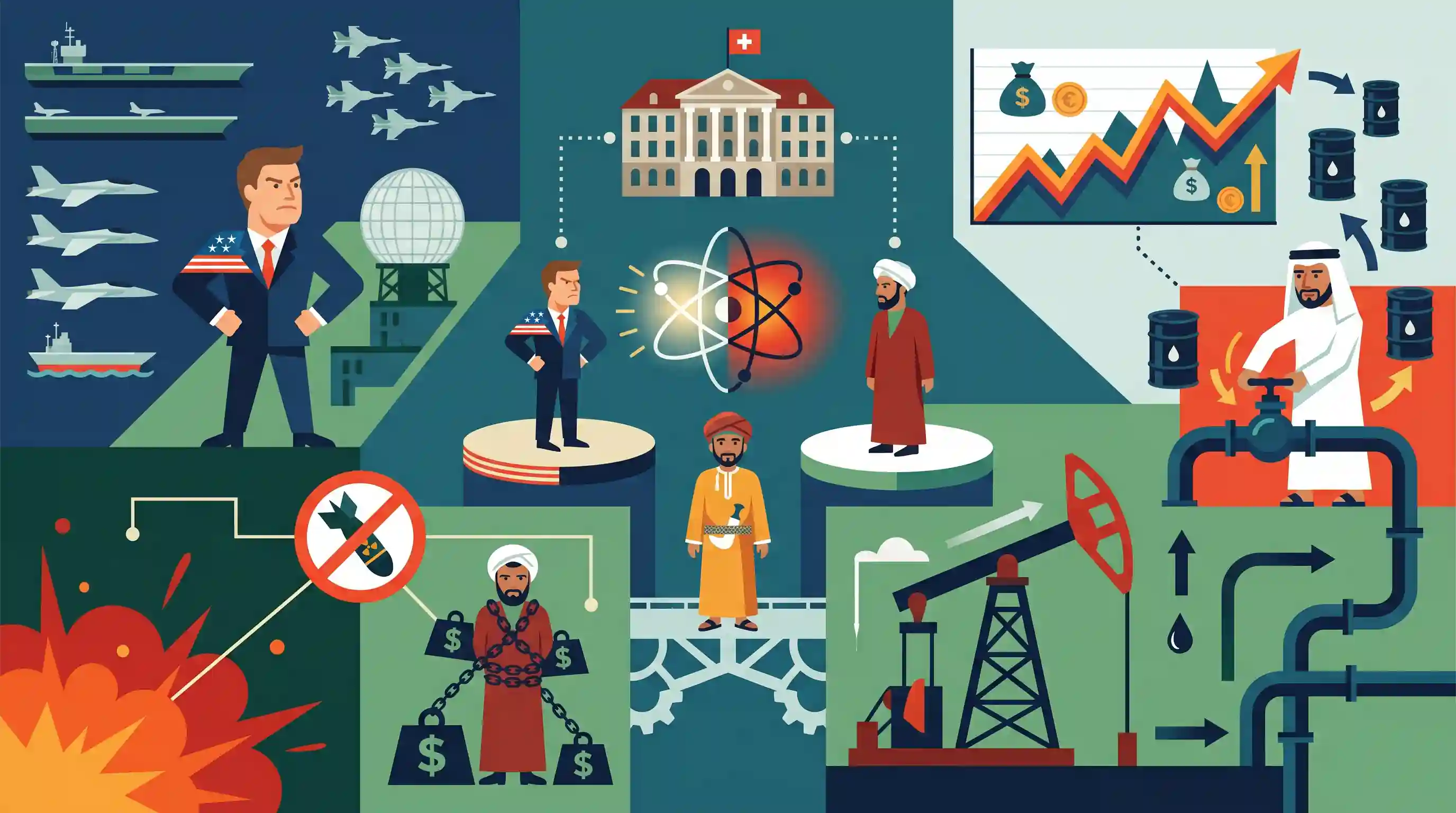
The United States and Iran have resumed indirect nuclear negotiations in Geneva, mediated by Oman, in an attempt to resolve their decades-long nuclear dispute and avert military escalation. While the U.S. has ramped up military deployments in the Middle East and threatened strikes if Iran pursues nuclear weapons, Tehran insists on its right to peaceful nuclear technology and seeks relief from crippling sanctions. The ongoing tensions have raised concerns in global energy markets, prompting Saudi Arabia to prepare to increase oil production to mitigate potential supply disruptions.
Key Points
- Indirect nuclear talks between the U.S. and Iran have resumed in Geneva under Oman's mediation to avert a potential military conflict over Tehran's nuclear program.
- The U.S. administration is demanding Iran abandon any nuclear weapons pathway and has assembled significant military forces in the Middle East as a deterrent, warning of military action if diplomacy fails.
- Iran is reportedly proposing new concessions in exchange for the lifting of economic sanctions and the recognition of its right to enrich uranium for peaceful purposes.
- The geopolitical uncertainty has influenced oil markets, prompting Saudi Arabia to prepare contingency plans to boost crude production should U.S.-Iran hostilities disrupt Middle East supplies.
Important Terms
IAEA (International Atomic Energy Agency)

The UN-affiliated nuclear watchdog responsible for verifying non-proliferation. In 2026, it warned that verification of Iran’s nuclear program is impossible without renewed access to sites affected by military strikes.
UPSC context
GS Paper II: International Organizations. Tests knowledge of global security frameworks, nuclear safeguards, and the role of international institutions in conflict resolution.
JCPOA (Joint Comprehensive Plan of Action)
The 2015 agreement between Iran and P5+1 powers to limit Tehran's nuclear program for sanctions relief. By 2026, it is largely considered an outdated framework for current negotiations.
UPSC context
GS Paper II: International Relations. Crucial for understanding West Asian geopolitics, nuclear diplomacy, and India's regional energy and connectivity interests.
U.S. Sanctions on Iran
Economic penalties used by Washington to pressure Tehran, including 'secondary sanctions' that penalize third countries. In 2026, these include a blockade on Iranian ports to stifle the economy.
UPSC context
GS Paper II: Policies of developed countries. Tests understanding of 'strategic autonomy' and the impact of extraterritorial laws on India’s bilateral trade.
Oman Foreign Ministry
The diplomatic arm of the Sultanate, acting as the primary neutral 'bridge' for indirect back-channel talks between the U.S. and Iran in 2025–2026.
UPSC context
GS Paper II: International Relations. Highlights the importance of regional mediators and 'Think West' policy in maintaining stability in India's extended neighborhood.
Saudi Arabian Government
The leadership of the world's leading 'swing producer' of oil. In May 2026, it coordinated OPEC+ production increases to stabilize global energy markets during the Strait of Hormuz blockade.
UPSC context
GS Paper II & III: IR/Energy Security. Relevant for Middle East power dynamics and India’s dependence on Gulf partners for stable energy imports.
Prelims Trap
The NPT strictly prohibits non-nuclear-weapon states from enriching uranium, and Iran has withdrawn from the treaty.
Under NPT Article IV, states possess the inalienable right to peaceful nuclear technology, including uranium enrichment. Furthermore, Iran remains an NPT signatory, unlike North Korea.
Static Concepts Connected
What is the strategic significance and geographical location of the Strait of Hormuz?
- Geographical Location: It connects the Persian Gulf to the Gulf of Oman and the Arabian Sea.
- Bordering Nations: It is bordered by Iran to the north, and the UAE and Oman (Musandam Peninsula) to the south.
- Global Oil Transit: It is a vital maritime chokepoint through which approximately 20% of the world's global oil trade transits.
What are the core pillars of the Non-Proliferation Treaty (NPT) and Article IV?
- Three Pillars: The treaty rests on non-proliferation, disarmament, and the peaceful use of nuclear energy.
- Article IV Right: It guarantees the inalienable right of all parties to research, develop, and use nuclear energy for peaceful purposes without discrimination.
- India's Stance: India remains a non-signatory, viewing the treaty as discriminatory because it creates an exclusive club of pre-1967 nuclear-weapon states.
Cross-Topic Patterns
Sanctions, Chabahar & Strategic Autonomy
US extraterritorial sanctions on Iran continuously test India's strategic autonomy, forcing halts in cheap crude imports while requiring delicate diplomatic maneuvering to secure waivers for the strategic Chabahar port.
Oman as West Asia's Switzerland
Oman's Ibadi-sect majority and strict neutrality allow it to mediate US-Iran and Saudi-Houthi conflicts, making it a distinct, non-aligned strategic partner for India amidst polarized Gulf geopolitics.

Map-based Prelims questions linking the Strait of Hormuz, Oman's borders, and Chabahar's proximity to the Gulf of Oman are highly likely.
Linked PYQs · 3
Linked PYQs · 3
- 2018MainsGS2
In what ways would the ongoing US-Iran Nuclear Pact Controversy affect the national interest of India? How should India respond to this situation?
- 2012MainsGS2
How have the US sanctions against Iran affected India's bilateral relations with Iran?
- 2025MainsGS3
Why is maritime security vital to protect India's sea trade? Discuss maritime and coastal security challenges and the way forward.
