Geneva Indirect Nuclear Negotiations Between US and Iran
Source:The Hindu ↗
Why It Matters
The US-Iran nuclear standoff is highly relevant for India's foreign policy as it directly affects stability in the Middle East—a crucial region for India's energy security, diaspora, and trade. Disruptions in global oil supply chains, particularly around chokepoints like the Strait of Hormuz, directly impact India's economy.
Summary
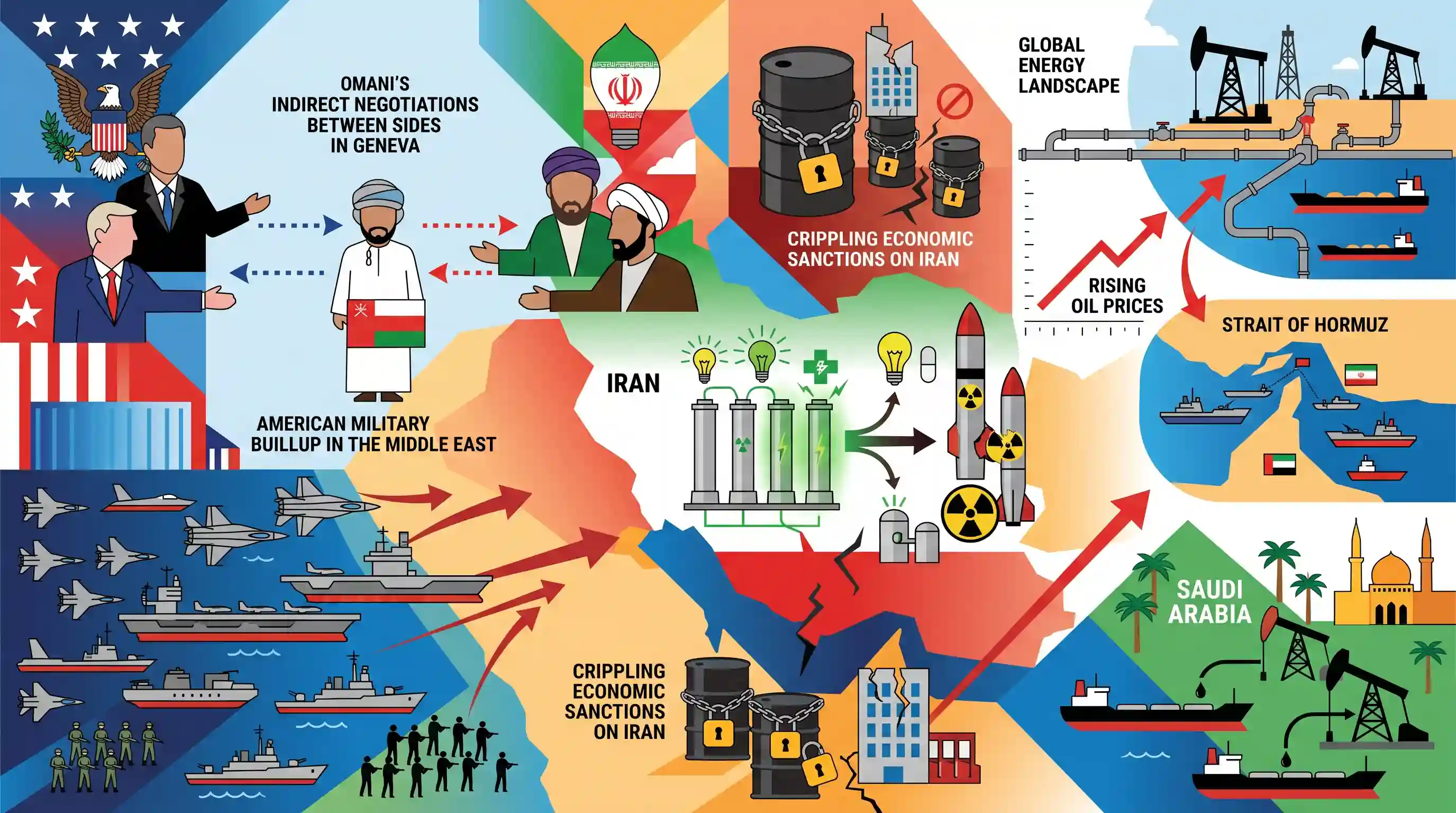
The United States and Iran are holding indirect negotiations in Geneva, mediated by Oman, to address Iran's nuclear program and avert a potential U.S. military strike. Amidst a massive American military buildup in the Middle East, the U.S. aims to prevent Iran from developing nuclear weapons, while Iran seeks relief from crippling economic sanctions and recognition of its right to enrich uranium for peaceful purposes. The escalating tensions have global implications, particularly for energy security, as fears of a regional conflict and disruptions in the Strait of Hormuz have pushed oil prices higher and prompted Saudi Arabia to ramp up production as a contingency plan.
Key Points
- The U.S. and Iran have resumed indirect nuclear talks in Geneva, mediated by Oman, in an attempt to avert a military conflict and resolve the ongoing dispute over Iran's nuclear enrichment.
- The geopolitical tension is heightened by a massive U.S. military buildup in the Middle East and previous joint U.S.-Israel strikes on Iranian nuclear sites.
- Tehran is offering concessions for relief from crippling U.S. sanctions and recognition of its right to peaceful uranium enrichment, while Washington insists Iran cannot have a nuclear weapon.
- The threat of conflict has raised concerns about global energy security, causing oil prices to rise and prompting Saudi Arabia to increase production as a contingency against supply disruptions in the Middle East.
Important Terms
International Atomic Energy Agency (IAEA)

Established in 1957, this Vienna-based autonomous UN body promotes peaceful nuclear technology and verifies non-diversion for military use through rigorous international safeguards.
UPSC context
GS-II International Relations; focuses on nuclear non-proliferation, India's nuclear status, and global governance frameworks.
Joint Comprehensive Plan of Action (JCPOA)
The 2015 agreement between Iran and P5+1 nations that restricted Iran's nuclear program in exchange for relief from international economic sanctions.
UPSC context
GS-II International Relations; critical for understanding West Asian stability and India’s energy security interests.
Strait of Hormuz
A critical maritime chokepoint between Iran and Oman connecting the Persian Gulf to the Arabian Sea, handling approximately 20% of global oil trade.
UPSC context
GS-I Geography & GS-II IR; vital for energy security and regional maritime strategy.
Uranium Enrichment
The process of increasing the concentration of the fissile isotope U-235, typically to 3-5% for power generation or above 90% for nuclear weapons.
UPSC context
GS-III Science & Technology; tests knowledge of the nuclear fuel cycle and dual-use technology.
Oman (Diplomatic Mediator)
A neutral Gulf nation often acting as a bridge between Iran and the West; its "friend to all" policy facilitates regional mediation.
UPSC context
GS-II International Relations; relevant for India’s 'Link West' policy and regional conflict resolution.
Economic Sanctions
Diplomatic and financial penalties used by states to exert pressure; in this context, U.S. measures targeting Iran's energy and banking sectors.
UPSC context
GS-II International Relations; examines instruments of statecraft and their impact on global trade and Indian interests.
Prelims Trap
"The Strait of Hormuz is a chokepoint bordered by Iran to the north and the United Arab Emirates to the south."
While the UAE is nearby, the actual southern shore forming the strait's chokepoint is the Musandam Peninsula, an exclave of Oman.
Static Concepts Connected
What is the geographical and economic significance of the Strait of Hormuz?
- Location: A critical maritime chokepoint connecting the Persian Gulf to the Gulf of Oman and the Arabian Sea.
- Trade volume: It handles approximately 20% of global seaborne oil trade, making it a severe vulnerability for global energy security.
- Bypass mechanisms: Saudi Arabia uses the East-West Pipeline (Petroline) to bypass the strait, transporting crude directly to the Red Sea.
What are the critical thresholds for Uranium enrichment?
- Civilian Power: Typically requires Low-Enriched Uranium (LEU) with a 3-5% concentration of the U-235 isotope.
- High Enrichment: Iran historically increased enrichment to 60%, categorized as Highly Enriched Uranium (HEU) and a short technical step from weaponization.
- Weapons-Grade: Requires a concentration of approximately 90% or higher U-235 to create a viable nuclear weapon.
Cross-Topic Patterns
Chabahar Port & US Sanctions
Iran's nuclear sanctions directly impact India's strategic calculus for the Chabahar port and the International North-South Transport Corridor (INSTC), often requiring complex diplomatic maneuvering and special US waivers.
Oman's "Ibadi Diplomacy" & India
Oman's strict neutral, non-interventionist foreign policy allows it to mediate US-Iran talks. For India, this stable neutrality makes Oman a highly reliable maritime defense partner (e.g., Duqm port access).

Expect a multi-statement prelims question mapping Middle East chokepoints (Hormuz) against alternate energy bypass pipelines (Petroline).
Linked PYQs · 4
Linked PYQs · 4
- 2018MainsGS2
In what ways would the ongoing US-Iran Nuclear Pact Controversy affect the national interest of India? How should India respond to this situation?
- 2012MainsGS2
How have the US sanctions against Iran affected India's bilateral relations with Iran?
- 2025MainsGS2
"Energy security constitutes the dominant kingpin of India's foreign policy, and is linked with India's overarching influence in Middle Eastern countries.” How would you integrate energy security with India's foreign policy trajectories in the coming years?
- 2024PrelimsGS1
Consider the following statements : Statement-I : Sumed pipeline is a strategic route for Persian Gulf oil and natural gas shipments to Europe. Statement-II : Sumed pipeline connects the Red Sea with the Mediterranean Sea. Which one of the following is correct in respect of the above statements?
