Oman Mediates Indirect Nuclear Talks Between US and Iran
Source:The Hindu ↗
Why It Matters
These talks are critical to managing nuclear proliferation risks and stabilizing West Asia, a region vital to India's energy security, diaspora presence, and strategic connectivity initiatives.
Summary
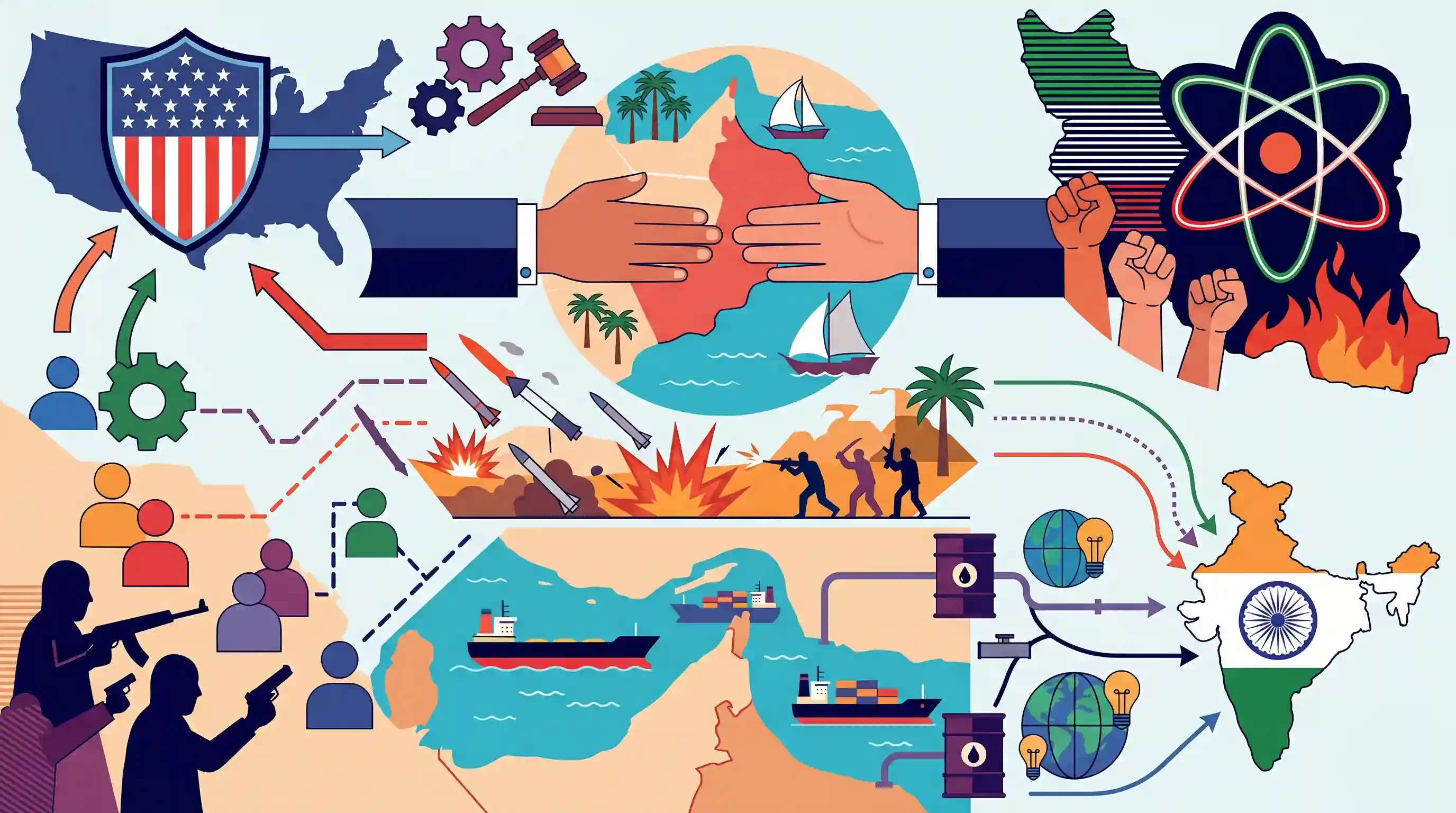
US and Iranian officials have held indirect talks in Oman regarding Iran's nuclear programme, marking a critical diplomatic engagement following recent military escalations in West Asia. Brokered by Oman, these talks occur against the backdrop of the incoming US administration, domestic unrest in Iran, and shifting regional alignments. The geopolitical significance of these negotiations extends to the security of the Strait of Hormuz, the role of non-state actors, and global energy stability.
Key Points
- Indirect diplomatic negotiations between the US and Iran have resumed in Oman regarding the Iranian nuclear programme, following a period of heightened military conflict involving Israel.
- The impending Trump administration is closely monitoring the situation, given their historically stringent stance ('maximum pressure' campaign) on Iran and the US exit from the JCPOA in 2018.
- Oman continues its traditional role as a diplomatic mediator, while other actors like Turkiye, Egypt, and Qatar are also actively engaging in regional stability dialogues.
- The outcome of these talks carries major implications for West Asia's security environment, particularly concerning the Strait of Hormuz, a critical chokepoint for global energy supplies, and the activities of the Iran-backed 'Axis of Resistance'.
- Domestically, the Iranian leadership is navigating these external geopolitical pressures alongside internal economic challenges and recent nationwide protests.
Important Terms
Joint Comprehensive Plan of Action (JCPOA)

2015 agreement between Iran and P5+1 (US, UK, France, China, Russia, Germany) to limit Iran's nuclear activities in exchange for global sanctions relief.
UPSC context
GS Paper II: International Relations. Tests knowledge of nuclear diplomacy, regional stability, and multilateral agreements.
Axis of Resistance
Iran-led informal geopolitical alliance comprising state and non-state actors (Hezbollah, Hamas, Houthis) dedicated to countering Western and Israeli influence in West Asia.
UPSC context
GS Paper II: Regional Geopolitics. Important for understanding non-state actors and Iran’s regional influence.
Nuclear Non-Proliferation Treaty (NPT)
1968 landmark international treaty aimed at preventing the spread of nuclear weapons, promoting cooperation in peaceful nuclear energy, and furthering disarmament.
UPSC context
GS Paper II: International Treaties. Tests understanding of global security architecture and India's specific stance.
Trump administration (Foreign Policy)
U.S. executive leadership characterized by 'Maximum Pressure' on Iran, unilateral withdrawal from the JCPOA, and broker of the Abraham Accords.
UPSC context
GS Paper II: Effect of policies of developed countries. Crucial for India’s energy security and strategic ties.
Prelims Trap
The Strait of Hormuz connects the Persian Gulf to the Red Sea.
The Strait of Hormuz connects the Persian Gulf to the Gulf of Oman. It is the Bab el-Mandeb that connects the Red Sea to the Gulf of Aden.
Static Concepts Connected
What is the IAEA Additional Protocol and its relation to Iran?
- Enhanced verification: It grants IAEA inspectors expanded, short-notice access to all parts of a state's nuclear fuel cycle to verify peaceful use.
- JCPOA obligation: Under the 2015 JCPOA, Iran agreed to provisionally apply the Additional Protocol to assure the world of its nuclear program's civilian nature.
- Current status: Following the US withdrawal from the JCPOA, Iran formally suspended its voluntary compliance with the Additional Protocol in 2021.
Which geographical entities border the strategic Strait of Hormuz?
- Northern shore: The entire northern coastline of the strait is controlled by Iran.
- Southern shore: Bordered by the United Arab Emirates and the Musandam Peninsula, which is a strategic exclave of Oman.
- Strategic linkage: It connects the Persian Gulf to the Gulf of Oman and Arabian Sea, handling roughly 20% of global oil transit.
Cross-Topic Patterns
Oman's neutrality & India's West Asia policy
Oman's 'friend to all' policy provides India a stable gateway to the Persian Gulf, securing a vital diplomatic back-channel. This complements India's balancing act between Israel, Iran, and the Arab states.
Hormuz disruption + Imported inflation
Disruptions in the Strait of Hormuz directly spike crude oil prices, heavily impacting India’s Current Account Deficit (CAD), forex reserves, and imported inflation dynamics.

Expect a map-based or NPT-framework question linking the Strait of Hormuz, IAEA protocols, and Iranian nuclear facilities in Prelims 2026.
Linked PYQs · 3
Linked PYQs · 3
- 2018PrelimsGS1
In the Indian context, what is the implication of ratifying the 'Additional Protocol' with the 'International Atomic Energy Agency (IAEA)'?
- 2024PrelimsGS1
Consider the following statements : Statement-I : Sumed pipeline is a strategic route for Persian Gulf oil and natural gas shipments to Europe. Statement-II : Sumed pipeline connects the Red Sea with the Mediterranean Sea. Which one of the following is correct in respect of the above statements?
- 2018MainsGS2
“India’s relations with Israel have, of late, acquired a depth and diversity, which cannot be rolled back.” Discuss.
