US and Iran Scale Up Military Readiness Amid West Asia Tensions
Source:The Hindu ↗
Why It Matters
The volatile US-Iran relationship, regional proxy conflicts, and Iran's nuclear enrichment have profound implications for global energy security and stability in the Persian Gulf—a critical area for India's energy imports, diaspora, and strategic investments. Understanding the role of the IAEA in nuclear monitoring is also a recurring UPSC focus.
Summary
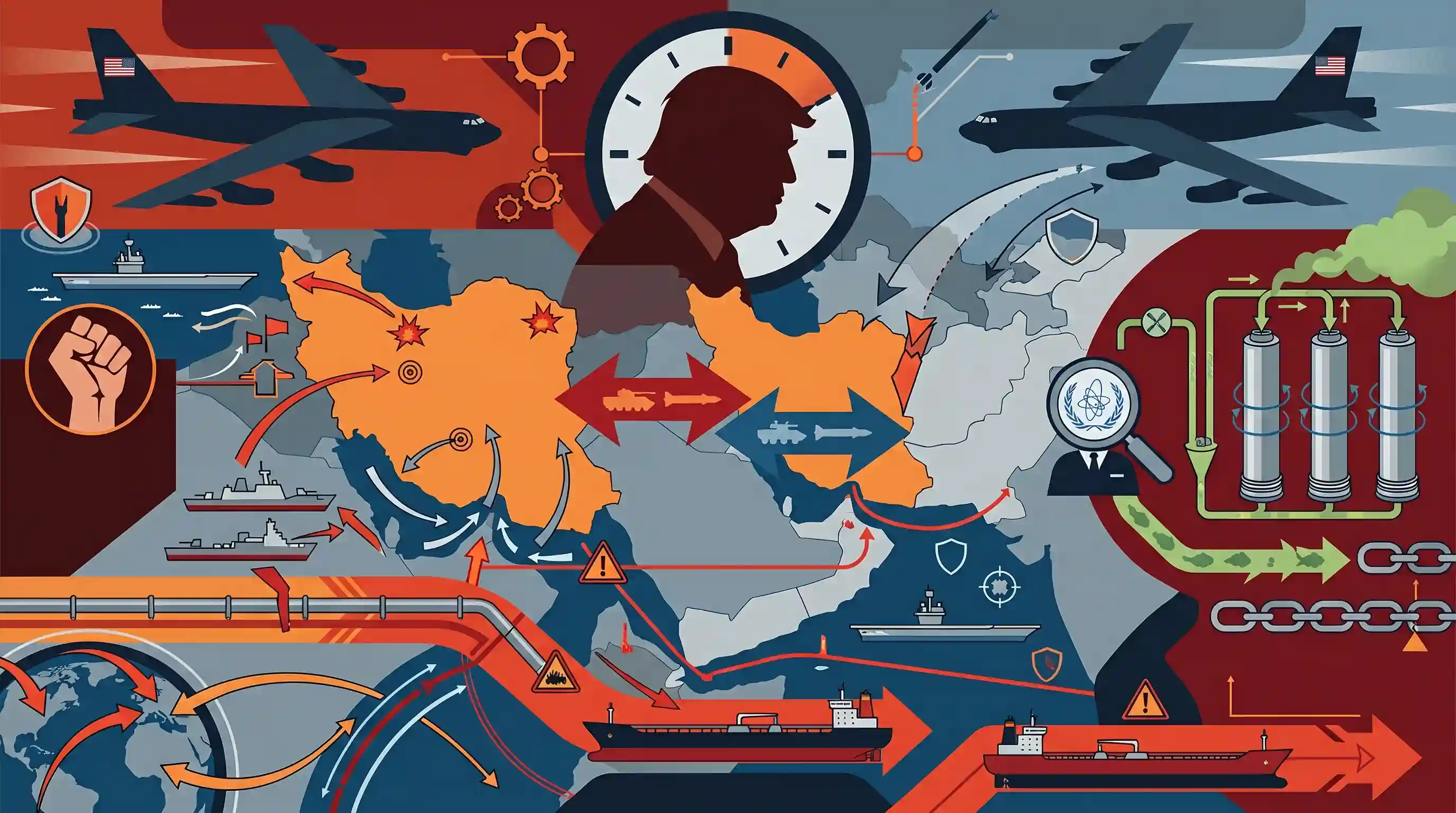
Tensions in West Asia remain critical as both the United States and Iran escalate their military readiness ahead of Donald Trump's return to the US presidency. Iran's Supreme Leader has pledged retaliation for recent Israeli strikes on Iranian military targets, and Tehran is preparing for unprecedented naval drills in the strategically crucial Persian Gulf. The US has responded by deploying B-52 bombers and additional naval assets to protect Israel and deter Iranian action. Concurrently, Iran has advanced its nuclear program by injecting gas into new centrifuges, raising non-proliferation concerns, though it claims to be acting within IAEA frameworks. The overlapping military build-ups and nuclear advancements threaten further instability in a region vital to global energy security.
Key Points
- The US and Iran are significantly bolstering their military postures in West Asia ahead of the transition to the Donald Trump administration.
- Iran plans to conduct its largest-ever naval drills in the Persian Gulf, aimed at asserting dominance over vital maritime chokepoints and demonstrating readiness against Israeli or US strikes.
- The US has deployed advanced strategic assets, including B-52 bombers and naval destroyers, to deter Iranian retaliation against Israel.
- Iran's Atomic Energy Organisation confirmed the injection of gas into advanced centrifuges, signaling an escalation in its uranium enrichment program, although it maintains its actions align with IAEA regulations.
Important Terms
Islamic Revolutionary Guard Corps (IRGC)

Elite military branch of Iran tasked with protecting the country's Islamic system. It operates independently of the regular army and wields significant economic and political influence.
UPSC context
GS-II (IR) & GS-III (Security). Tests understanding of regional actors and their impact on West Asia stability and India’s security.
International Atomic Energy Agency (IAEA)
The UN's autonomous 'nuclear watchdog' that promotes peaceful nuclear energy and verifies non-proliferation via safeguards and inspections to ensure nuclear material is not diverted to weapons.
UPSC context
GS-II (IR). Important International institutions; tests knowledge of global governance and non-proliferation frameworks.
Atomic Energy Organisation of Iran (AEOI)
The primary state body in Iran responsible for nuclear energy, research, and infrastructure, including enrichment facilities like Natanz and Fordow.
UPSC context
GS-II (IR) & GS-III (S&T). Concerns technical control of Iran's nuclear program and its geopolitical implications.
Strait of Hormuz
A vital maritime chokepoint between the Persian Gulf and Gulf of Oman, handling approximately 20% of global oil supplies.
UPSC context
GS-I (Geography) & GS-II (IR). Vital for questions on energy security, global trade, and India's oil supply.
B-52 Stratofortress
A long-range, heavy strategic bomber used by the US Air Force for global power projection and deterrence against regional adversaries.
UPSC context
GS-III (Security/Defense). Example of military power projection used in modern deterrence strategies.
Joint Comprehensive Plan of Action (JCPOA)
The 2015 agreement between Iran and world powers that limited Iran's nuclear program in exchange for the lifting of economic sanctions.
UPSC context
GS-II (IR). Key for questions on international treaties, diplomacy, and West Asian geopolitics.
Prelims Trap
The Strait of Hormuz is a vital chokepoint connecting the Persian Gulf directly to the Red Sea.
The Strait of Hormuz connects the Persian Gulf to the Gulf of Oman. It is the Bab el-Mandeb strait that connects the Gulf of Aden to the Red Sea.
Static Concepts Connected
Which countries border the Persian Gulf and Strait of Hormuz?
- Persian Gulf: Bordered by exactly eight nations: Iran, Iraq, Kuwait, Saudi Arabia, Bahrain, Qatar, United Arab Emirates (UAE), and Oman. Yemen does not border it.
- Strait of Hormuz: A critical maritime chokepoint located between Iran to the north and Oman/UAE to the south, linking the Persian Gulf to the Arabian Sea.
What are IAEA Safeguards and the Additional Protocol?
- Comprehensive Safeguards: Mandatory agreements for NPT non-nuclear-weapon states to ensure declared nuclear material is strictly used for peaceful purposes.
- Additional Protocol: A voluntary agreement granting the IAEA expanded rights to inspect undeclared facilities and conduct short-notice or unannounced inspections.
Cross-Topic Patterns
Chokepoint risks and India's SPR
Strait of Hormuz tensions highlight India's energy vulnerability, emphasizing the strategic necessity of expanding India's Strategic Petroleum Reserves (ISPRL) and diversifying crude sources.
IMEC viability amidst regional conflict
Escalating US-Iran-Israel military postures threaten the regional stability required for operationalizing ambitious geo-economic transit projects like the India-Middle East-Europe Economic Corridor (IMEC).

Expect a 2026 prelims map question pairing West Asian chokepoints (Hormuz/Bab el-Mandeb) with bordering nations and energy transit volumes.
Linked PYQs · 3
Linked PYQs · 3
- 2020PrelimsGS1
In India, why are some nuclear reactors kept under "IAEA Safeguards" while others are not?
- 2023PrelimsGS1
Consider the following statements: Statement-I: India, despite having uranium deposits, depends on coal for most of its electricity production. Statement-II: Uranium, enriched to the extent of at least 60%, is required for the production of electricity. Which one of the following is correct in respect of the above statements?
- 2024PrelimsGS1
Consider the following statements : Statement-I : Sumed pipeline is a strategic route for Persian Gulf oil and natural gas shipments to Europe. Statement-II : Sumed pipeline connects the Red Sea with the Mediterranean Sea. Which one of the following is correct in respect of the above statements?
