US and Iran escalate military posture amid rising West Asia tension
Source:The Hindu ↗
Why It Matters
The escalating U.S.-Iran tensions threaten stability in West Asia and the Persian Gulf, a crucial region for global energy security, trade routes, and regional peace. The developments directly impact India's strategic and economic interests, particularly concerning energy imports, diaspora security, and its delicate diplomatic balancing act in the Middle East.
Summary
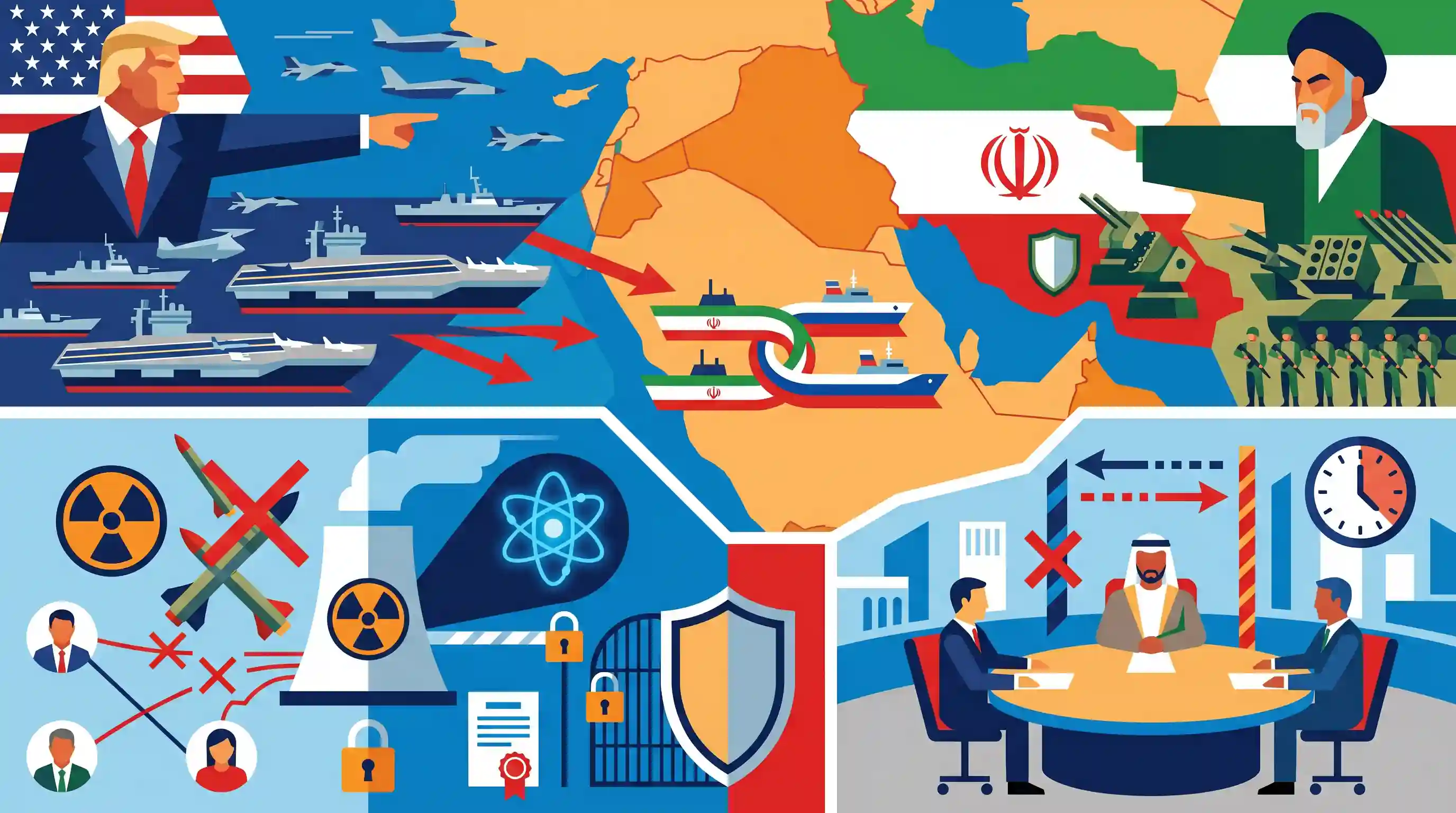
Amid heightened tensions in West Asia, the U.S. has significantly increased its military deployments, including aircraft carriers and warships, following reports that President Trump may authorize military strikes against Iran. In response, Iran and Russia have conducted joint naval drills in the Persian Gulf, and Iranian Supreme Leader Ayatollah Ali Khamenei has urged resistance against potential aggression. Ongoing indirect talks in Geneva, mediated by Oman, show limited progress; the U.S. demands an end to Iranian uranium enrichment and limits on its missile program and proxy support, while Iran maintains its right to peaceful nuclear technology under IAEA guidelines and refuses broader concessions.
Key Points
- The U.S. has bolstered its military presence in West Asia, deploying aircraft carriers, warships, and missile defence systems amid reports that President Trump may order strikes on Iran.
- Iran and Russia conducted joint combat naval drills, including a mock hostage rescue, near the Bandar Abbas port in the Persian Gulf.
- Indirect negotiations between the U.S. and Iran are taking place in Geneva under Oman's mediation, but significant gaps remain.
- The U.S. demands an end to Iran's uranium enrichment, missile program, and support for regional non-state allies, whereas Iran insists on negotiating solely on its nuclear program.
- Iran's Atomic Energy Organisation reiterated its right to peaceful nuclear enrichment under IAEA rules, denying any intentions of building a nuclear weapon.
Important Terms
Islamic Revolutionary Guard Corps (IRGC)

An elite branch of the Iranian Armed Forces, established in 1979, which operates independently of the regular military to safeguard the Islamic Revolution and manage Iran’s ballistic missile program.
UPSC context
GS Paper II (International Relations) and GS III (Security). Tests understanding of regional actors and non-state proxy dynamics in West Asia.
International Atomic Energy Agency (IAEA)
An autonomous international organization within the United Nations system that promotes the peaceful use of nuclear energy and verifies compliance with non-proliferation treaties through inspections and safeguards.
UPSC context
GS Paper II: Important International institutions. Relevant for nuclear diplomacy, India’s nuclear policy, and global security frameworks.
Atomic Energy Organisation of Iran (AEOI)
The primary Iranian government agency responsible for nuclear technology research, development, and the operation of nuclear fuel cycle installations, including uranium enrichment facilities.
UPSC context
GS Paper II: Bilateral and regional agreements involving India and/or affecting India’s interests. Key to understanding Iran’s technical nuclear capabilities.
Strait of Hormuz
A strategic maritime choke point between the Persian Gulf and the Gulf of Oman through which approximately one-fifth of the world's total oil consumption passes daily.
UPSC context
GS Paper I (Geography) and GS II (International Relations). Crucial for energy security and maritime trade route discussions.
Uranium Enrichment
The process of increasing the proportion of the isotope uranium-235 in natural uranium to make it suitable for nuclear reactor fuel or, at higher levels, nuclear weapons.
UPSC context
GS Paper III: Science and Technology. Tests technical knowledge of the nuclear fuel cycle and its dual-use implications for security.
West Asia
A geographic subregion of Asia comprising countries such as Iran, Iraq, Saudi Arabia, and Israel, characterized by its central role in global energy markets and geopolitical conflict.
UPSC context
GS Paper II: Regional groupings and agreements involving India. A core area of study for Indian foreign policy and energy security.
Prelims Trap
The Non-Proliferation Treaty (NPT) prohibits non-nuclear weapon states from natively enriching uranium.
The NPT guarantees the right to peaceful nuclear technology. Non-weapon states can enrich uranium (usually 3-5% for power generation) provided it is subject to rigorous IAEA Safeguards and inspections.
Static Concepts Connected
What distinguishes IAEA Comprehensive Safeguards from the Additional Protocol?
- Comprehensive Safeguards: Mandatory agreements for non-nuclear-weapon NPT states to verify that declared nuclear materials are not diverted to military purposes.
- Additional Protocol: A voluntary, supplementary agreement granting the IAEA expanded inspection rights, including short-notice access to both declared and undeclared nuclear facilities.
What is the strategic relevance of Bandar Abbas port?
- Geographic chokepoint: Situated on the Persian Gulf near the Strait of Hormuz, overlooking one of the world's most critical maritime transit choke points for crude oil.
- INSTC node: Serves as Iran's primary maritime hub for the International North-South Transport Corridor (INSTC), acting as the sea-to-land gateway linking India to Russia and Eurasia.
Cross-Topic Patterns
Bandar Abbas + INSTC vulnerabilities
Conflict in the Persian Gulf threatens the operational viability of the INSTC, complicating India's strategic push to bypass Pakistan for Eurasian connectivity.
Energy Security + Inflation
Military buildup near the Strait of Hormuz risks global oil price shocks, directly impacting India's import bill, inflation targeting, and current account deficit.

Map-based questions on Persian Gulf ports (Bandar Abbas) linked to the INSTC, paired with IAEA safeguard clauses, are highly likely.
Linked PYQs · 3
Linked PYQs · 3
- 2025MainsGS2
"Energy security constitutes the dominant kingpin of India's foreign policy, and is linked with India's overarching influence in Middle Eastern countries.” How would you integrate energy security with India's foreign policy trajectories in the coming years?
- 2018PrelimsGS1
In the Indian context, what is the implication of ratifying the 'Additional Protocol' with the 'International Atomic Energy Agency (IAEA)'?
- 2020PrelimsGS1
In India, why are some nuclear reactors kept under "IAEA Safeguards" while others are not?
