Iran Uranium Enrichment Nears Weapons Grade Threshold
Source:Indian Express ↗
Why It Matters
Iran's nuclear trajectory directly affects regional stability, global energy security, and India's strategic calculus in West Asia. It forms a core case study for understanding international treaties (JCPOA, NPT) and IAEA safeguards, which are heavily tested in UPSC Prelims and Mains. The distinction between civilian (3-5%) and weapons-grade (90%) enrichment is also critical for Science & Technology.
Summary
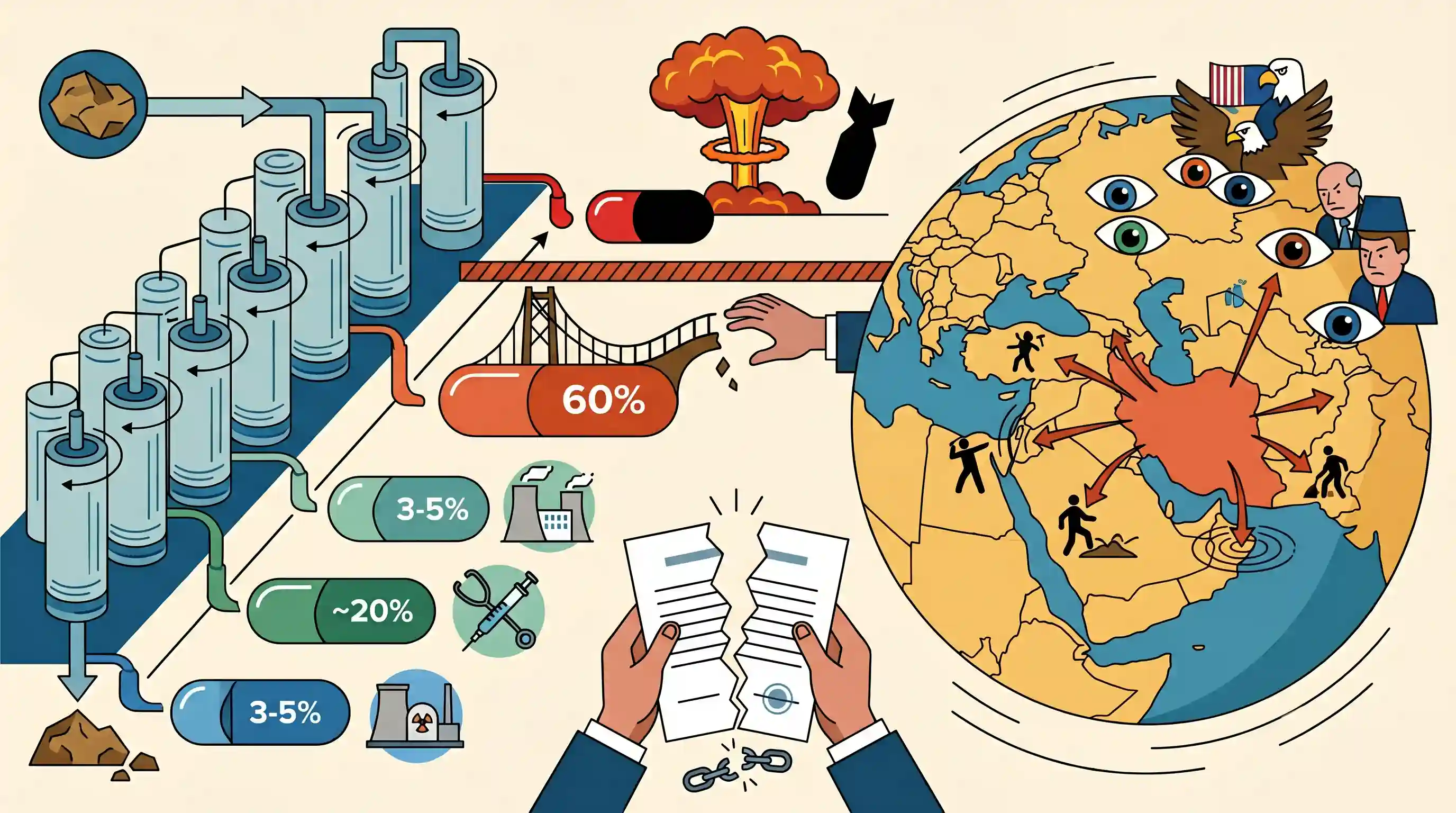
The article explains the significance of Iran enriching uranium to 60% purity, a level that vastly exceeds civilian nuclear requirements and brings Tehran dangerously close to the 90% threshold needed for a nuclear weapon. Natural uranium consists mostly of the U-238 isotope, with only 0.7% being the fissile U-235. Enrichment uses gas centrifuges to increase the concentration of U-235. While commercial reactors need 3-5% and medical research needs up to 20%, 60% enrichment lacks a credible civilian justification. Following the US withdrawal from the JCPOA in 2018, Iran has accelerated its nuclear program, alarming the IAEA and Western powers who fear Iran is becoming a threshold nuclear state, thereby heightening geopolitical instability in the Middle East.
Key Points
- Iran has enriched uranium to 60% purity, far exceeding the 3.67% cap set by the 2015 JCPOA nuclear deal.
- Weapons-grade uranium requires 90% concentration of the U-235 isotope, making 60% enrichment a perilous technical stepping-stone with no credible civilian application.
- Natural uranium contains only 0.7% fissile U-235; enrichment involves spinning uranium hexafluoride gas in centrifuges to separate U-235 from the heavier U-238.
- The IAEA has raised alarms over Iran's restricted inspector access and lack of transparency regarding its advanced centrifuge operations.
- The acceleration of Iran's nuclear program follows the 2018 US withdrawal from the JCPOA and significantly impacts Middle Eastern geopolitics and global non-proliferation efforts.
Important Terms
JCPOA (Joint Comprehensive Plan of Action)

A 2015 landmark agreement between Iran and the P5+1 (UNSC permanent members plus Germany) to restrict Tehran's nuclear program in exchange for relief from economic sanctions.
UPSC context
GS Paper II: International Relations. Tests knowledge of global agreements affecting India’s energy security and regional connectivity projects like Chabahar.
NPT (Non-Proliferation Treaty)
A 1970 international treaty aimed at preventing nuclear weapon spread, promoting peaceful atomic energy, and achieving disarmament. India remains a non-signatory, citing its discriminatory nature.
UPSC context
GS Paper II & III: International Relations/Security. Tests understanding of global non-proliferation architecture and India’s unique strategic position.
IAEA (International Atomic Energy Agency)
Established in 1957, this autonomous UN-related organization acts as the global nuclear watchdog, promoting peaceful atomic use and verifying non-proliferation through rigorous safeguards.
UPSC context
GS Paper II: International Organizations. Essential for Prelims (facts) and Mains (verification roles and India’s specific safeguards agreements).
Uranium Enrichment
The process of increasing the concentration of the fissile isotope U-235. Low-enriched uranium (3-5%) serves power plants, while highly enriched uranium (90%) is weapons-grade.
UPSC context
GS Paper III: Science & Technology. Tests technical understanding of the nuclear fuel cycle and dual-use technology implications.
Threshold Nuclear State
A country that has developed the technical proficiency, material, and infrastructure to assemble nuclear weapons rapidly, despite not having officially declared or tested them.
UPSC context
GS Paper II: International Relations. Analyzes strategic shifts in West Asia and the potential for regional arms races.
Prelims Trap
Iran is not a signatory to the Nuclear Non-Proliferation Treaty (NPT) and thus operates outside IAEA jurisdiction.
Iran IS an NPT signatory (as a Non-Nuclear-Weapon State). This legal status is exactly what gives the IAEA its mandate to inspect. India, Pakistan, and Israel are the notable non-signatories.
Static Concepts Connected
What is Uranium enrichment and how do U-235 and U-238 differ?
- U-235 (Fissile): The only naturally occurring fissile isotope capable of sustaining a nuclear chain reaction. It makes up just 0.7% of natural uranium.
- U-238 (Fertile): Accounts for 99.3% of natural uranium. It is not fissile but is fertile, meaning it can absorb a neutron in a reactor to become fissile Plutonium-239.
- Enrichment Process: The process of using gas centrifuges (spinning uranium hexafluoride) to separate the slightly lighter U-235 from U-238, increasing the concentration of U-235 for reactors or weapons.
What are IAEA Comprehensive Safeguards and the Additional Protocol?
- Comprehensive Safeguards: Mandatory agreements for all NPT non-nuclear-weapon states. They allow the IAEA to verify that declared nuclear material is not diverted to nuclear weapons.
- Additional Protocol: A voluntary, supplementary agreement granting the IAEA expanded rights to inspect undeclared facilities on short notice. Iran suspended its compliance with this protocol after the JCPOA collapsed.
Cross-Topic Patterns
Strait of Hormuz & Energy Security
Escalation over Iran's nuclear breakout could trigger blockades in the Strait of Hormuz, directly impacting India's crude oil supply chains, currency valuation, and imported inflation.
India's non-NPT stance vs Iran's status
While Iran faces severe sanctions despite being an NPT signatory, India secured an NSG civil nuclear waiver (2008) outside the NPT framework due to its impeccable non-proliferation record.

Expect a Prelims pair testing U-235 vs U-238 (fissile vs fertile) combined with statements on IAEA's Additional Protocol applicability.
Linked PYQs · 4
Linked PYQs · 4
- 2018MainsGS2
In what ways would the ongoing US-Iran Nuclear Pact Controversy affect the national interest of India? How should India respond to this situation?
- 2018PrelimsGS1
In the Indian context, what is the implication of ratifying the 'Additional Protocol' with the 'International Atomic Energy Agency (IAEA)'?
- 2020PrelimsGS1
In India, why are some nuclear reactors kept under "IAEA Safeguards" while others are not?
- 2015PrelimsGS1
Consider the following countries: 1. China 2. France 3. India 4. Israel 5. Pakistan Which among the above are Nuclear Weapons States as recognized by the Treaty on the Non-Proliferation of Nuclear Weapons, commonly known as Nuclear Non-Proliferation Treaty (NPT)?
