Iran and United States hold indirect nuclear talks in Geneva
Source:The Hindu ↗
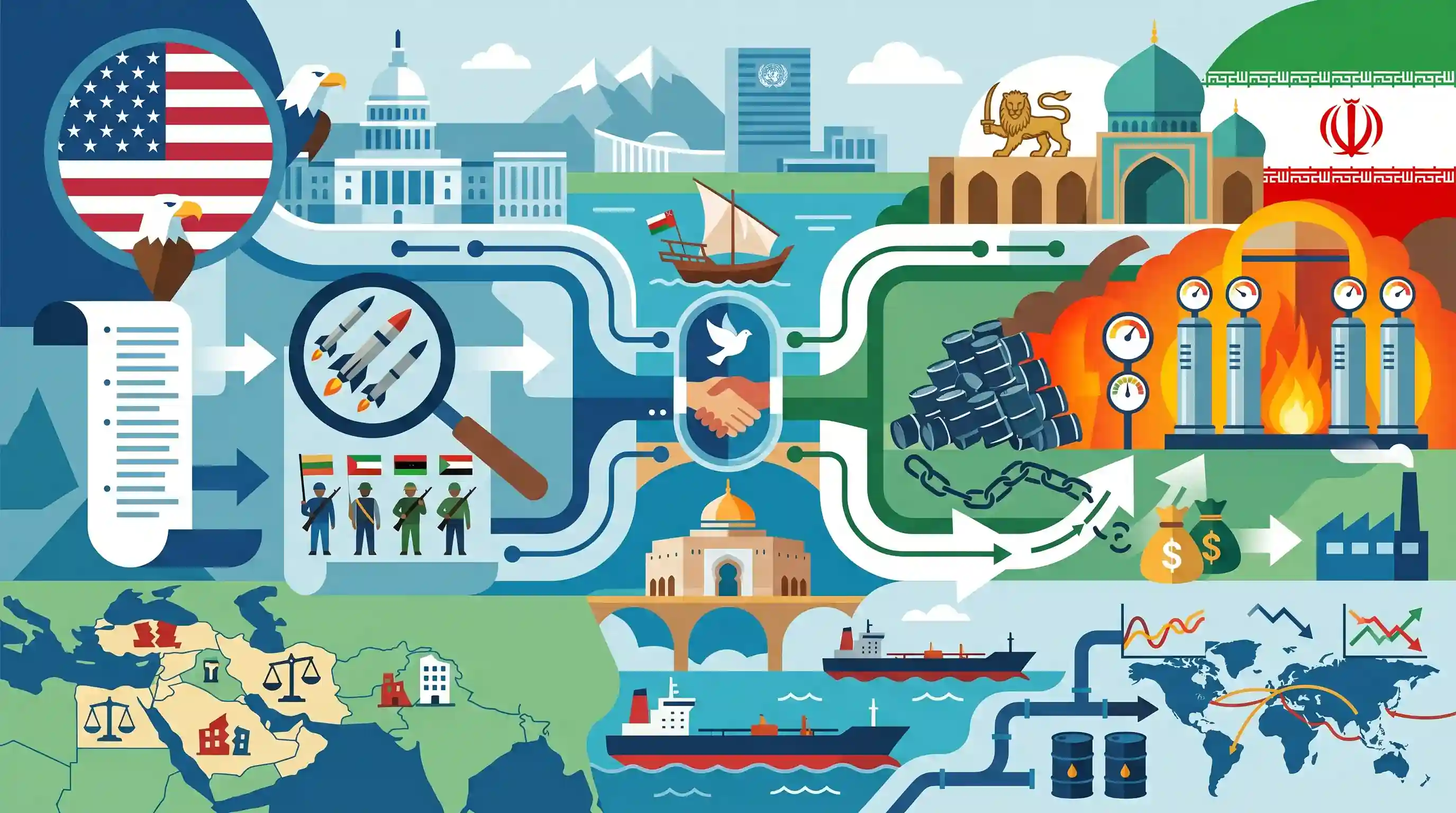
Why It Matters
The US-Iran nuclear standoff directly impacts global energy security, Middle Eastern geopolitics, and India's strategic interests (such as oil imports, the Chabahar port project, and diaspora in the Gulf). The specific details of uranium enrichment (e.g., 60% purity) are also a recurring theme in Prelims Science & Technology questions.
Summary
Iran and the US have resumed indirect nuclear negotiations in Geneva, mediated by Oman. The talks aim to address Iran's rapidly advancing nuclear program, which includes over 400 kg of 60% enriched uranium. While the US seeks to broaden the agenda to include Iran's ballistic missiles and regional proxies, Iran is demanding the lifting of sanctions and concrete economic benefits in exchange for capping its uranium stockpile. The outcome of these talks carries significant implications for Middle Eastern stability and global energy markets.
Key Points
- Iran and the United States held a second round of indirect nuclear talks in Geneva, mediated by Oman and facilitated by Switzerland.
- The US delegation demands that negotiations cover Iran's ballistic missile program and its support for regional proxy groups, not just nuclear issues.
- Iran has accumulated over 400 kg of uranium enriched to 60%, a short step from weapons-grade levels.
- Iran is open to compromising on its enriched uranium stockpile if the US lifts sanctions and provides economic benefits in sectors like aviation, mining, and energy.
Important Terms
Joint Comprehensive Plan of Action (JCPOA)

A 2015 landmark agreement between Iran and P5+1 powers to limit Iran's nuclear activities in exchange for lifting international economic sanctions.
UPSC context
GS Paper II: International agreements affecting India's interests, particularly energy security and regional connectivity projects like Chabahar.
Uranium Enrichment
The process of increasing the concentration of Uranium-235; 60% purity is considered "near-weapons-grade," drastically reducing the "breakout time" required for a nuclear weapon.
UPSC context
GS Paper III: Nuclear technology and security challenges. It tests understanding of nuclear proliferation and technical safeguards.
International Atomic Energy Agency (IAEA)
An autonomous international organization that promotes peaceful use of nuclear energy and verifies non-proliferation through inspections and safeguards.
UPSC context
GS Paper II: Important international institutions and their mandate. Vital for India's civil nuclear cooperation and global status.
Economic Sanctions
Financial and trade penalties imposed by states to influence the behavior of a target country, such as restricting oil exports or banking access.
UPSC context
GS Paper II: Impact of developed countries' policies on India. Sanctions on Iran affect India’s crude oil prices and trade.
Regional Proxies
Non-state armed groups supported by a foreign power to exert influence in a region, often bypassing direct state-to-state military conflict.
UPSC context
GS Paper II/III: West Asia geopolitics and maritime security. Critical for protecting the Indian diaspora and trade routes.
Prelims Trap
"Iran's stockpile of 60% enriched uranium is classified as weapons-grade and can be directly deployed in nuclear warheads."
Weapons-grade uranium requires ~90% enrichment (U-235). While 60% is highly enriched and technically a 'short step' away, it is not yet weapons-grade.
Static Concepts Connected
What are the different grades of Uranium enrichment?
- Low-Enriched (LEU): 3-5% U-235, typically used as standard fuel for commercial civilian light-water nuclear power reactors.
- Highly-Enriched (HEU): 20% or higher U-235, used in specialized research reactors, medical isotope production, and naval propulsion systems.
- Weapons-grade: Approximately 90% U-235, the critical threshold required to build a functional and compact nuclear warhead.
What is the IAEA's Additional Protocol?
- Expanded Access: A legal document granting the IAEA broader rights to access information and physical locations to verify no nuclear material is diverted.
- Undeclared Sites: Enables short-notice or "snap" inspections of both declared and undeclared nuclear facilities within a member state.
- India's Status: India ratified a country-specific Additional Protocol in 2014, placing designated civilian nuclear facilities strictly under IAEA safeguards.
Cross-Topic Patterns
Iran Sanctions & India's INSTC
Easing of US sanctions on Iran directly boosts India's strategic investments in Chabahar Port and accelerates the International North-South Transport Corridor (INSTC), securing access to Central Asia while bypassing Pakistan.
Oman's Ibadi Diplomacy & Chokepoints
Oman's historically neutral 'Ibadi' foreign policy allows it to mediate complex Middle Eastern conflicts (like US-Iran talks) while co-controlling the crucial Strait of Hormuz, vital for India's energy security.

Expect a 2026 prelims question pairing uranium enrichment thresholds (LEU vs HEU) with IAEA's Additional Protocol inspection powers.
Linked PYQs · 4
Linked PYQs · 4
- 2018MainsGS2
In what ways would the ongoing US-Iran Nuclear Pact Controversy affect the national interest of India? How should India respond to this situation?
- 2023PrelimsGS1
Consider the following statements: Statement-I: India, despite having uranium deposits, depends on coal for most of its electricity production. Statement-II: Uranium, enriched to the extent of at least 60%, is required for the production of electricity. Which one of the following is correct in respect of the above statements?
- 2020PrelimsGS1
In India, why are some nuclear reactors kept under "IAEA Safeguards" while others are not?
- 2018PrelimsGS1
In the Indian context, what is the implication of ratifying the 'Additional Protocol' with the 'International Atomic Energy Agency (IAEA)'?
