Iran threatens West Asia power plants linked to US bases
Source:The Hindu ↗
Why It Matters
The Strait of Hormuz is a critical maritime chokepoint for global oil and natural gas shipments. Heightened military tensions between the U.S. and Iran in this region directly threaten global energy supply chains, potentially leading to a spike in crude oil prices. This has significant macroeconomic implications for energy-importing nations like India, affecting inflation, the current account deficit, and overall economic stability.
Summary
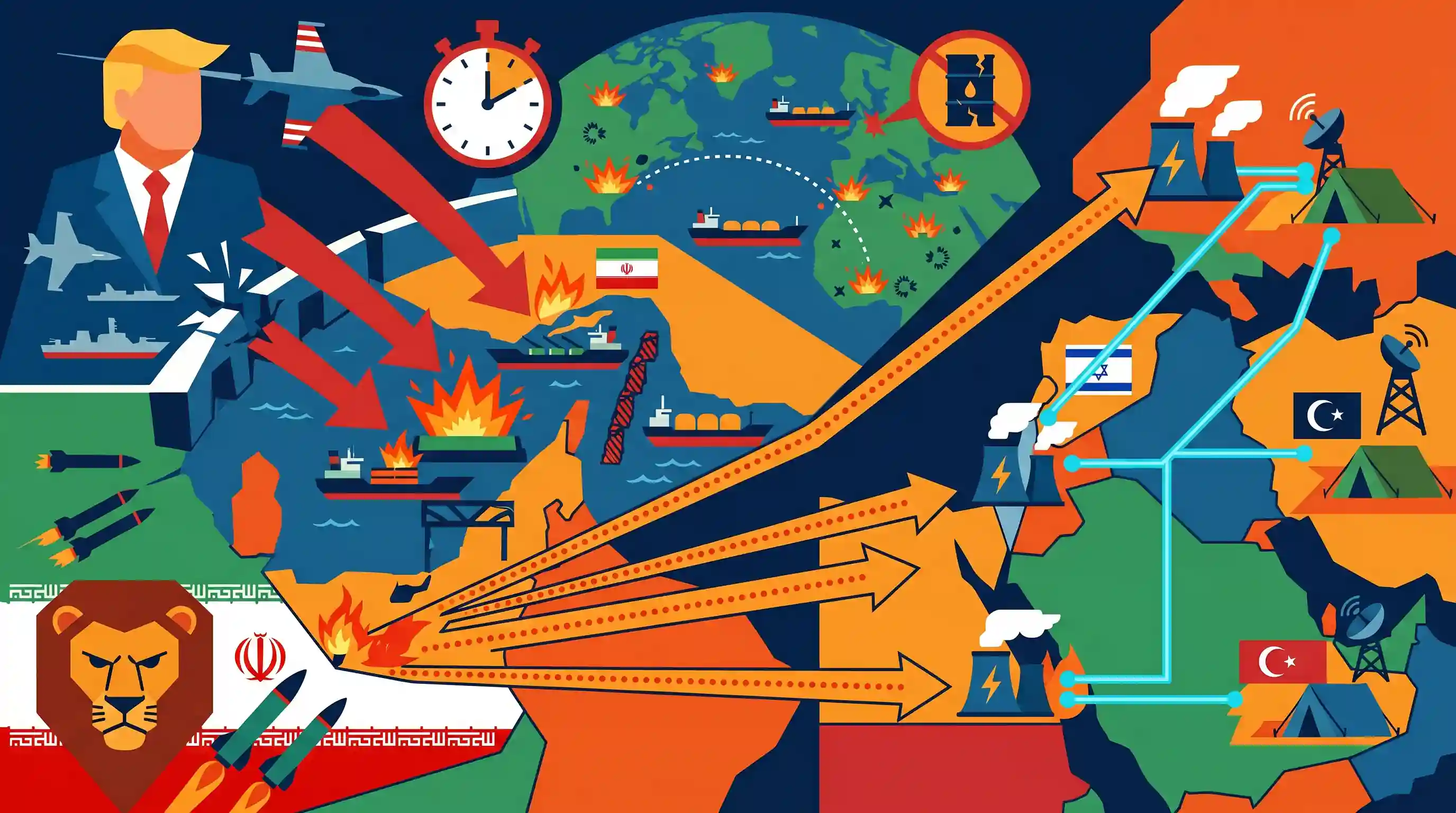
Iran has threatened to target the power plants of Israel and other regional nations that supply electricity to U.S. military bases if its own infrastructure is attacked. This stark warning follows an ultimatum from U.S. President Donald Trump, who gave Iran 48 hours to cease attacks on shipping and reopen the Strait of Hormuz, a crucial shipping lane for global oil. The escalation stems from recent U.S. military action that destroyed an Iranian base allegedly involved in harassing maritime traffic in the strait, raising fears of a wider regional conflict and disruption to global energy markets.
Key Points
- Iran threatened to attack electrical plants powering U.S. bases in West Asia, including those in Israel and other regional nations, if its own power infrastructure is targeted.
- U.S. President Donald Trump issued a 48-hour ultimatum to Iran to stop firing on shipping and reopen the Strait of Hormuz, warning of strikes on Iranian power plants if the deadline is not met.
- The U.S. military claimed to have destroyed an Iranian base that was allegedly threatening the critical Strait of Hormuz oil route.
- The escalating tit-for-tat threats heighten the risk of a broader conflict in the Middle East and threaten global energy supplies traversing the strategic chokepoint.
Important Terms
Strait of Hormuz

A vital waterway between Iran and Oman connecting the Persian Gulf to the Gulf of Oman. It is the world's most critical oil chokepoint, handling ~20% of global petroleum traffic.
UPSC context
GS Paper 1 (Geography) and GS Paper 2 (International Relations). Tests knowledge of strategic maritime routes and India's energy dependency.
Islamic Revolutionary Guard Corps (IRGC)
An elite branch of Iran’s military, independent of the regular army, tasked with protecting the Islamic Republic’s political system and conducting extraterritorial operations via its Quds Force.
UPSC context
GS Paper 2 (IR). Tests understanding of regional actors and non-traditional security threats in West Asia.
Strategic Chokepoint
A narrow, strategically significant maritime passage where traffic is concentrated. Disruptions at these points (e.g., Hormuz, Malacca) can trigger global energy crises and spike shipping insurance costs.
UPSC context
GS Paper 1 (Geography) and GS Paper 3 (Security). Tests understanding of global trade vulnerabilities and maritime security.
Energy Security
The uninterrupted availability of energy sources at an affordable price. For India, it involves diversifying suppliers and securing sea lanes to protect its 80% crude oil import dependency.
UPSC context
GS Paper 3 (Economy/Environment/Security). Tests ability to analyze national vulnerabilities and strategic autonomy in the face of global conflict.
West Asia
The subregion of Asia comprising the Middle East. It is a crucible of geopolitical rivalries (e.g., Iran-Israel-Saudi Arabia) and is India's primary source of energy and diaspora remittances.
UPSC context
GS Paper 2 (IR). Tests knowledge of India's 'Look West' policy and regional stability's impact on domestic interests.
Prelims Trap
The Strait of Hormuz is bordered by Iran to the north and the United Arab Emirates to the south.
The Strait of Hormuz borders Iran to the north and Oman (specifically the Musandam Peninsula exclave) to the south, not the UAE.
Static Concepts Connected
Which are the critical maritime chokepoints in the Middle East region?
- Strait of Hormuz: Connects the Persian Gulf to the Gulf of Oman and Arabian Sea. Bordered strategically by Iran and Oman.
- Bab-el-Mandeb: Connects the Red Sea to the Gulf of Aden. Bordered by Yemen on the Arabian Peninsula and Djibouti/Eritrea in Africa.
- Suez Canal: Artificial sea-level waterway in Egypt connecting the Mediterranean Sea to the Red Sea, bypassing the Cape of Good Hope.
How do West Asian oil shocks destabilize India's macroeconomic indicators?
- Current Account Deficit: Surging crude prices inflate India's import bill, rapidly widening the CAD and putting downward pressure on forex reserves.
- Imported Inflation: Higher fuel prices cascade into increased transportation and logistics costs, driving broad-based domestic inflation.
- Remittance Disruptions: Regional conflicts threaten the 9 million Indian diaspora in the Gulf, potentially slashing India's largest source of global remittance inflows.
Cross-Topic Patterns
Energy security + Diaspora evacuations
Disruptions in Hormuz threaten India's oil supply and could necessitate massive diaspora evacuation operations, stressing airlift capabilities and slashing crucial remittance inflows.
Asymmetric warfare & critical infrastructure
Iran's threat to electrical grids highlights modern warfare trends where states target dual-use civilian infrastructure to paralyze enemy military logistics indirectly.

Expect a multi-statement question mapping West Asian chokepoints alongside India's diaspora reliance and imported inflation.
Linked PYQs · 2
Linked PYQs · 2
- 2017MainsGS2
The question of India's Energy Security constitutes the most important part of India's economic progress. Analyze India's energy policy cooperation with West Asian countries.
- 2024PrelimsGS1
Consider the following statements : Statement-I : Sumed pipeline is a strategic route for Persian Gulf oil and natural gas shipments to Europe. Statement-II : Sumed pipeline connects the Red Sea with the Mediterranean Sea. Which one of the following is correct in respect of the above statements?
