US Naval Blockade and Escalating Geopolitical Risks in West Asia
Source:The Hindu ↗
Why It Matters
The Strait of Hormuz is one of the world's most critical maritime chokepoints, facilitating a substantial portion of global crude oil trade. The U.S.-Iran tensions and resulting naval blockades pose a severe risk to global energy supply chains, directly impacting crude oil prices and heavily oil-dependent economies like India.
Summary
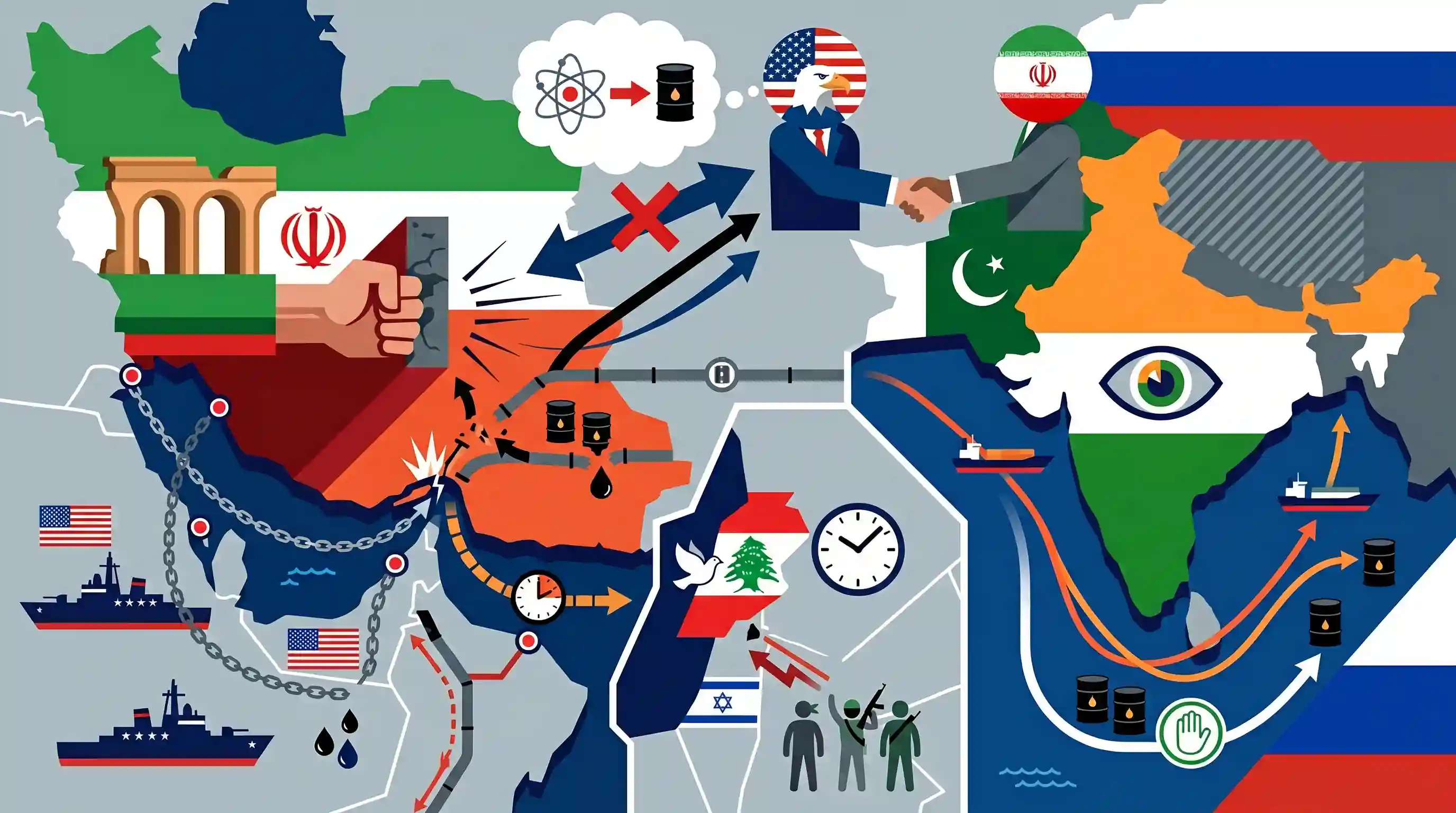
Iran has threatened to block the Strait of Hormuz if the United States continues its naval blockade of Iranian ports, heightening geopolitical tensions in the Middle East. The threat followed Iran's reopening of the strait after a 10-day ceasefire in Lebanon. While U.S. President Donald Trump claimed a peace agreement—including Iran surrendering its enriched uranium—was imminent, Iranian officials denied such concessions and demanded the lifting of the U.S. naval blockade. The ongoing crisis, mediated partly by Pakistan, remains intertwined with Israel's conflict with Hezbollah. To ease global oil markets disrupted by these geopolitical risks, the U.S. announced a temporary waiver allowing the sale of Russian petroleum products.
Key Points
- Iran warned it could block the strategic Strait of Hormuz if the U.S. continues its naval blockade of Iranian ports.
- U.S. President Donald Trump claimed a U.S.-Iran peace deal is imminent and that Tehran agreed to surrender its enriched uranium, an assertion Iranian officials strongly denied.
- The developments follow a 10-day ceasefire in Lebanon, part of broader regional negotiations mediated by Pakistan involving direct talks between U.S. and Iranian envoys.
- Despite the temporary ceasefire, Israeli Prime Minister Benjamin Netanyahu stated that the military campaign to dismantle Hezbollah is not yet over.
- To mitigate the impact of the blockade on global energy markets, the U.S. issued a waiver allowing the sale of Russian oil and petroleum products.
Important Terms
Strait of Hormuz

A strategic maritime chokepoint between Iran and Oman connecting the Persian Gulf to the Gulf of Oman; it facilitates approximately 20% of global oil and 35% of LNG transit.
UPSC context
GS Paper 1 (Geography) and GS Paper 2 (International Relations); critical for India's energy security and West Asian geopolitics.
U.S. Central Command (CENTCOM)
A U.S. Department of Defense unified combatant command responsible for military operations and security cooperation across 21 nations in the Middle East, Central, and South Asia.
UPSC context
GS Paper 2 (International Relations); represents U.S. military footprint and regional security frameworks affecting India’s interests in West Asia.
Hezbollah
A Lebanon-based Shia Islamist political party and paramilitary group; it is a primary regional proxy for Iran and a key member of the 'Axis of Resistance.'
UPSC context
GS Paper 2 (International Relations); tests understanding of non-state actors, proxy warfare, and instability in the Levant region.
Enriched Uranium
Uranium processed to increase the concentration of the U-235 isotope; low-enriched uranium is used for power, while highly-enriched uranium (HEU) is essential for nuclear weapons.
UPSC context
GS Paper 3 (Science & Technology and Security); central to nuclear non-proliferation debates and the Joint Comprehensive Plan of Action (JCPOA).
Naval Blockade
A military effort to block maritime access to a country's ports or coasts, often used to exert economic pressure or prevent military supplies from reaching an adversary.
UPSC context
GS Paper 2 (International Relations/Law); tests concepts of maritime law, UNCLOS, and the strategic use of force in global trade.
Energy Security
The reliable and affordable availability of energy sources; for India, this involves safeguarding oil/gas supply lines in volatile regions like the Persian Gulf.
UPSC context
GS Paper 3 (Economy and Infrastructure); a key pillar of India's strategic autonomy and economic growth.
Prelims Trap
"The Strait of Hormuz is bordered by Iran, Saudi Arabia, and the United Arab Emirates."
Saudi Arabia does not border the Strait of Hormuz. It is actually bordered by Iran to the north, and Oman (Musandam peninsula) and the UAE to the south.
Static Concepts Connected
What are the key geographical features of the Strait of Hormuz?
- Water Bodies: It is a critical maritime chokepoint connecting the Persian Gulf to the Gulf of Oman and the broader Arabian Sea.
- Bordering Nations: It is bordered by Iran to the north, and the United Arab Emirates and Oman to the south.
- Economic Significance: It serves as the transit route for roughly 20% of the world's daily oil supply, making it essential for global energy security.
What distinguishes Low Enriched Uranium (LEU) from Highly Enriched Uranium (HEU)?
- U-235 Concentration: Uranium enrichment is the process of increasing the proportion of the fissile U-235 isotope compared to the more common U-238.
- LEU (Civilian): Typically contains 3-5% U-235 and is used primarily as fuel for commercial nuclear power plants.
- HEU (Military): Enriched to 20% or above. Weapons-grade uranium, necessary for nuclear warheads, requires enrichment levels of 90% or higher.
Cross-Topic Patterns
Sanctions waivers & Energy Security
The US issuing waivers on Russian oil to offset Iranian blockade risks shows how major powers utilize secondary sanctions exemptions to prevent domestic and global energy inflation.
Hormuz disruptions & INSTC viability
Geopolitical instability and naval blockades in the Strait of Hormuz directly threaten freight security and insurance premiums for India’s strategic investments in the Chabahar port and the INSTC route.

Map-based Prelims matching of West Asian chokepoints (Hormuz, Bab el-Mandeb) with bordering nations and water bodies is highly likely.
Linked PYQs · 2
Linked PYQs · 2
- 2018MainsGS2
In what ways would the ongoing US-Iran Nuclear Pact Controversy affect the national interest of India? How should India respond to this situation?
- 2024PrelimsGS1
Consider the following statements : Statement-I : Sumed pipeline is a strategic route for Persian Gulf oil and natural gas shipments to Europe. Statement-II : Sumed pipeline connects the Red Sea with the Mediterranean Sea. Which one of the following is correct in respect of the above statements?
