US-Iran Nuclear Negotiations and Middle East Security
Source:Indian Express ↗
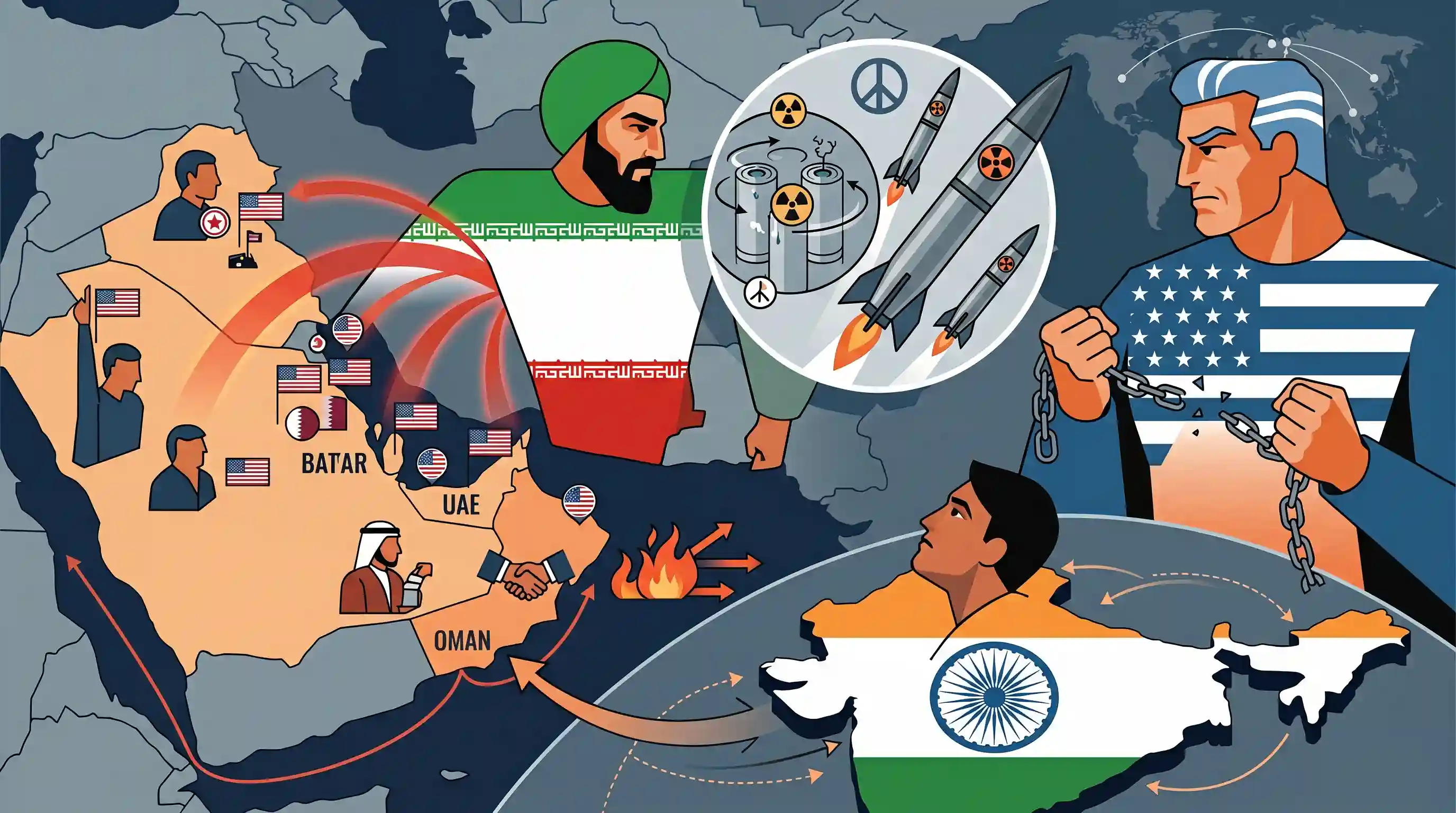
Why It Matters
The Middle East is vital to India's energy security (oil and gas imports) and diaspora remittances. Any US-Iran conflict or failure of nuclear negotiations can destabilize the region, spike global oil prices, and impact India's strategic connectivity projects like the Chabahar Port.
Summary
Iran has warned that it will target US military bases situated in host countries across the Middle East if upcoming nuclear negotiations collapse into conflict. The threat comes ahead of the sixth round of US-Iran talks in Oman, aimed at securing a new agreement following the collapse of the 2015 JCPOA. US President Donald Trump has expressed skepticism about reaching a deal to halt Tehran's uranium enrichment. A major obstacle remains Iran's advancing ballistic missile program—highlighted by a recent test of a missile with a two-ton warhead—which Tehran refuses to negotiate, while maintaining its nuclear program is strictly for civilian purposes.
Key Points
- Iranian Defence Minister Aziz Nasirzadeh threatened military action against US bases in the region if nuclear talks fail and lead to conflict.
- The sixth round of US-Iran nuclear negotiations is set to take place in Oman to address uranium enrichment and regional security.
- US President Donald Trump voiced decreased confidence in achieving a successful nuclear deal with Tehran to halt enrichment.
- Iran's expanding ballistic missile capabilities, including a recent test of a missile with a two-ton warhead, remain a major sticking point in negotiations.
- Iran insists its nuclear program is entirely civilian and refuses to accept restrictions on its missile development.
Important Terms
JCPOA (Joint Comprehensive Plan of Action)

A 2015 landmark agreement where Iran agreed to limit its nuclear program and allow international inspections in exchange for relief from economic sanctions.
UPSC context
GS Paper II (International Relations); critical for understanding India's energy security and regional connectivity projects like Chabahar Port.
Uranium Enrichment
The process of increasing the concentration of the fissile isotope Uranium-235; 3-5% is needed for power, while 90% is considered weapons-grade.
UPSC context
GS Paper III (Science & Technology); tests knowledge of nuclear technology, dual-use capabilities, and global non-proliferation standards.
Ballistic Missile Program
Iran’s development of rockets following a parabolic trajectory; viewed by Tehran as essential deterrence but by the West as a potential nuclear delivery system.
UPSC context
GS Paper II & III (Security/IR); significant for assessing regional power balances and hurdles in international nuclear diplomacy.
IAEA (International Atomic Energy Agency)
The UN-affiliated 'nuclear watchdog' responsible for monitoring and verifying that national nuclear programs are used exclusively for peaceful purposes.
UPSC context
GS Paper II (International Organizations); tests understanding of global governance and verification mechanisms in arms control.
West Asia Geopolitics
The study of power dynamics in the Middle East, primarily shaped by energy resources, religious rivalries, and the influence of external global powers.
UPSC context
GS Paper II (Effect of Policies on India's Interests); vital for India’s diaspora safety, energy security, and 'Look West' policy.
Prelims Trap
The 2015 JCPOA explicitly restricted Iran's ballistic missile development alongside its nuclear enrichment.
The original JCPOA only restricted nuclear enrichment. Ballistic missiles were deliberately excluded from the agreement, which became the primary justification for the US withdrawal in 2018.
Static Concepts Connected
What are the different grades of uranium enrichment?
- LEU (Civilian): Contains 3-5% U-235 concentration, primarily used for commercial nuclear power generation.
- HEU (Research): Contains 20% or more U-235 concentration, frequently used for medical isotopes and research reactors.
- Weapons-grade: Requires roughly 90% U-235 concentration to sustain the fast explosive chain reaction needed for warheads.
Why is Oman strategically significant in West Asian diplomacy?
- Mediation hub: It follows a strict foreign policy of non-alignment and neutrality, earning it the moniker 'Switzerland of West Asia' and allowing it to mediate US-Iran disputes.
- Chokepoint control: Oman shares geographic control of the Strait of Hormuz with Iran, a critical chokepoint through which approximately a fifth of global oil consumption passes.
Cross-Topic Patterns
Gulf Tensions & Rupee Volatility
Conflict in the Persian Gulf threatens the Strait of Hormuz, risking a crude oil price shock that inflates India's import bill, widens the Current Account Deficit (CAD), and depreciates the Rupee.
US Sanctions & Chabahar Port
Escalating US sanctions on Iran test India's strategic autonomy, directly threatening the operational viability of the Shahid Beheshti terminal at Chabahar and broader INSTC connectivity to Central Asia.

A multi-statement Prelims question merging the Strait of Hormuz geography, JCPOA nuclear caps, and INSTC connectivity is highly likely.
Linked PYQs · 2
Linked PYQs · 2
- 2025MainsGS2
"Energy security constitutes the dominant kingpin of India's foreign policy, and is linked with India's overarching influence in Middle Eastern countries.” How would you integrate energy security with India's foreign policy trajectories in the coming years?
- 2017MainsGS2
The question of India's Energy Security constitutes the most important part of India's economic progress. Analyze India's energy policy cooperation with West Asian countries.
