Strait of Hormuz Military Escalation and Middle East Security
Source:Indian Express ↗
Why It Matters
The Strait of Hormuz is a critical maritime chokepoint for global oil supply. Military escalations between the US and Iran directly threaten international energy security, could trigger global inflation, and significantly impact India's strategic and economic interests in the Middle East. It highlights the vulnerability of global trade networks to regional geopolitical instability.
Summary
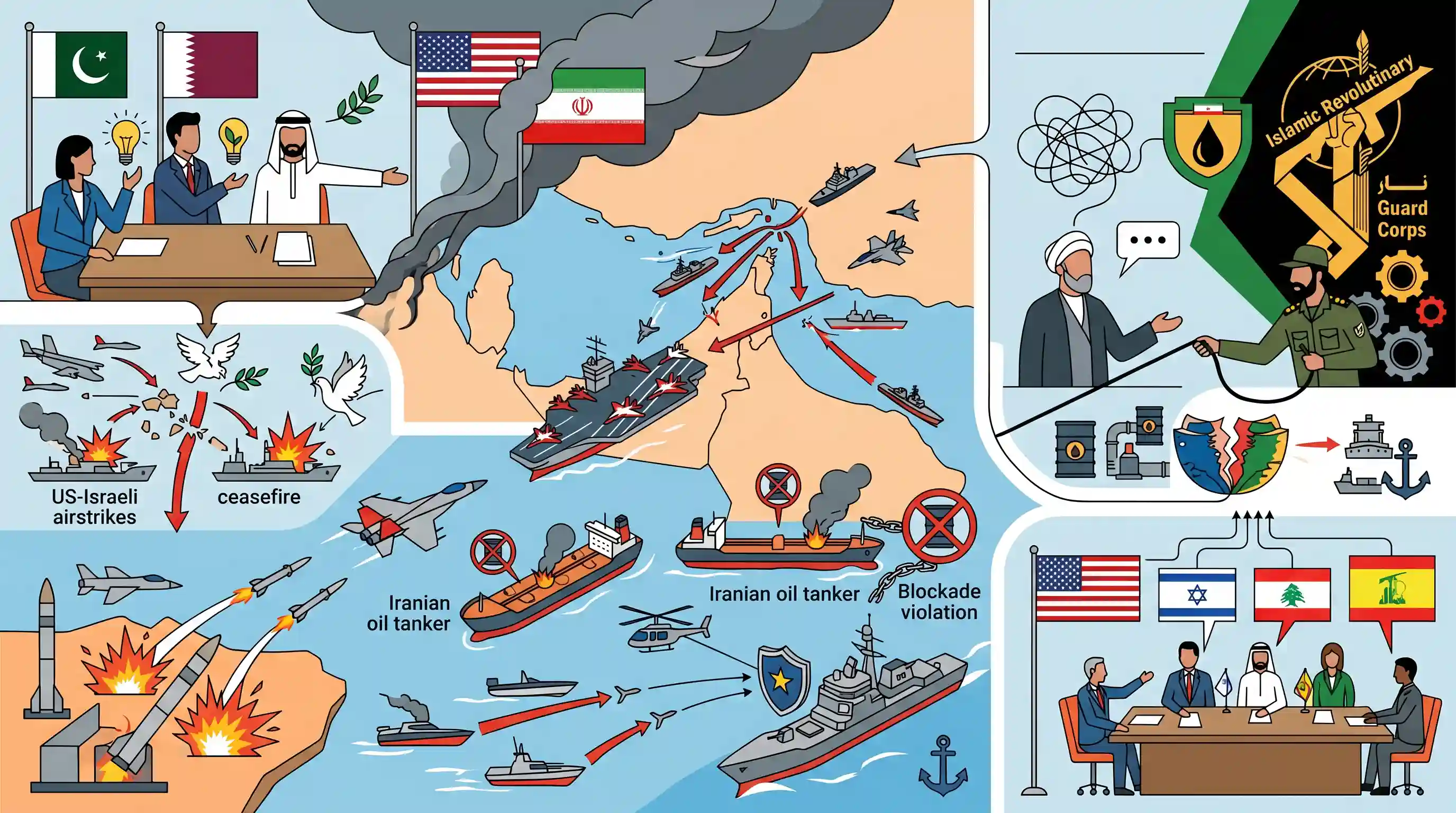
Recent military clashes between the US and Iran in the Strait of Hormuz threaten to upend a fragile ceasefire following previous US-Israeli airstrikes. The US targeted Iranian missile sites and disabled two Iranian oil tankers in the Gulf of Oman for violating a US blockade, while Iran claimed to retaliate against US Navy ships. Diplomatic efforts led by Pakistan and Qatar are underway to mediate the crisis, though internal Iranian dynamics involving the Islamic Revolutionary Guard Corps (IRGC) pose challenges. Concurrently, the US plans to host talks to address the Israel-Lebanon conflict involving Hezbollah.
Key Points
- The US and Iran exchanged fire in the Strait of Hormuz, testing a delicate ceasefire initiated after previous US-Israeli strikes on Iran.
- US forces targeted Iranian missile and drone sites, while Centcom intercepted and disabled two Iranian oil tankers in the Gulf of Oman for violating a US blockade.
- Iran's Foreign Minister Abbas Araghchi criticized the US for choosing a 'reckless military adventure' over diplomacy and warned against the US's 'Project Freedom' plan for merchant ships.
- Mediation efforts are being led by Pakistan, with involvement from Qatar's Prime Minister, though talks are complicated by the growing influence of Iran's IRGC.
- The US is preparing to host a new round of Israel-Lebanon talks to halt clashes with Hezbollah, demanding the full disarmament of the Iranian-backed group.
Important Terms
Islamic Revolutionary Guard Corps (IRGC)

An elite branch of Iran's Armed Forces, separate from the regular military, reporting directly to the Supreme Leader. It manages internal security, asymmetric warfare, and regional proxy networks.
UPSC context
GS Paper II/III: Crucial for understanding West Asian security dynamics, state-sponsored militancy, and India's energy interests in the Persian Gulf.
Strait of Hormuz
A strategically vital maritime chokepoint between the Persian Gulf and the Gulf of Oman, through which approximately one-fifth of global oil consumption passes.
UPSC context
GS Paper I (Geography) and GS Paper III (Energy Security): Tests knowledge of maritime trade routes and global energy supply chain vulnerabilities.
Project Freedom
A U.S. naval mission launched in May 2026 to ensure freedom of navigation and protect commercial shipping in the Strait of Hormuz against Iranian interference and blockades.
UPSC context
GS Paper II: Significant as a contemporary example of maritime security operations and U.S. military intervention in West Asia.
US Central Command (CENTCOM)
A major U.S. military command responsible for operations in the Middle East, Central Asia, and South Asia, including managing regional security and maritime blockades.
UPSC context
GS Paper II: Key actor in global security architecture and primary coordinator for U.S. military engagement in India's extended neighborhood.
Hezbollah
A powerful Lebanese Shia militant group and political party, heavily backed by Iran, and a primary non-state actor in the conflict with Israel.
UPSC context
GS Paper II: Essential for analyzing Middle Eastern proxy wars, the Israel-Lebanon border crisis, and regional instability.
Quds Force
The elite extraterritorial wing of the IRGC responsible for unconventional warfare and military intelligence operations outside Iran's borders, particularly supporting regional proxies.
UPSC context
GS Paper III: Relevant for studying international security, asymmetric threats, and Iranian influence across the "Shiite Crescent."
Prelims Trap
Chabahar Port is located in the Persian Gulf and its access is controlled by the Strait of Hormuz.
Chabahar Port is strategically located on the Gulf of Oman, *outside* the Strait of Hormuz. This allows India to bypass the vulnerable Hormuz chokepoint entirely.
Static Concepts Connected
What are the key maritime chokepoints in the Middle East region?
- Strait of Hormuz: Connects the Persian Gulf to the Gulf of Oman and Arabian Sea. Bordered by Iran and Oman (Musandam Peninsula).
- Bab-el-Mandeb: Connects the Red Sea to the Gulf of Aden. Bordered by Yemen on the Arabian Peninsula, and Djibouti and Eritrea in the Horn of Africa.
How does India mitigate energy supply risks from Middle East conflicts?
- Strategic Petroleum Reserves: India maintains crude oil reserves at Visakhapatnam, Mangalore, and Padur to provide a buffer against short-term maritime supply disruptions.
- Import Diversification: Reducing over-reliance on the Persian Gulf by systematically increasing crude imports from Russia, the USA, and African nations.
- Alternative Logistics: Investing in ports like Chabahar (Gulf of Oman) and Duqm (Oman) that sit outside the volatile Strait of Hormuz.
Cross-Topic Patterns
Chokepoints & Macroeconomic stability
Disruptions in Hormuz directly inflate India's import bill and current account deficit, triggering imported inflation and impacting the RBI's monetary policy decisions.
US sanctions & INSTC connectivity
Escalating US-Iran military conflicts and maritime blockades severely threaten the operational viability of the International North-South Transport Corridor (INSTC) and India's Eurasian outreach.

Expect a 2026 map question matching Middle East ports (Chabahar, Bandar Abbas) to specific water bodies (Gulf of Oman vs Persian Gulf).
Linked PYQs · 3
Linked PYQs · 3
- 2025MainsGS2
"Energy security constitutes the dominant kingpin of India's foreign policy, and is linked with India's overarching influence in Middle Eastern countries.” How would you integrate energy security with India's foreign policy trajectories in the coming years?
- 2024PrelimsGS1
Consider the following statements : Statement-I : Sumed pipeline is a strategic route for Persian Gulf oil and natural gas shipments to Europe. Statement-II : Sumed pipeline connects the Red Sea with the Mediterranean Sea. Which one of the following is correct in respect of the above statements?
- 2024MainsGS2
Discuss the geopolitical and geostrategic importance of Maldives for India with a focus on global trade and energy flows. Further also discuss how this relationship affects India's maritime security and regional stability amidst international competition ?
