US Iran Maritime Tensions and Threats to Global Oil Trade
Source:Indian Express ↗
Why It Matters
The Strait of Hormuz is essential to India's energy security, as a large portion of its oil imports pass through this chokepoint. Any conflict or blockade involving the US and Iran in this region can trigger global oil supply shocks, inflation, and maritime security challenges, directly affecting India's macroeconomic stability and foreign policy maneuvering.
Summary
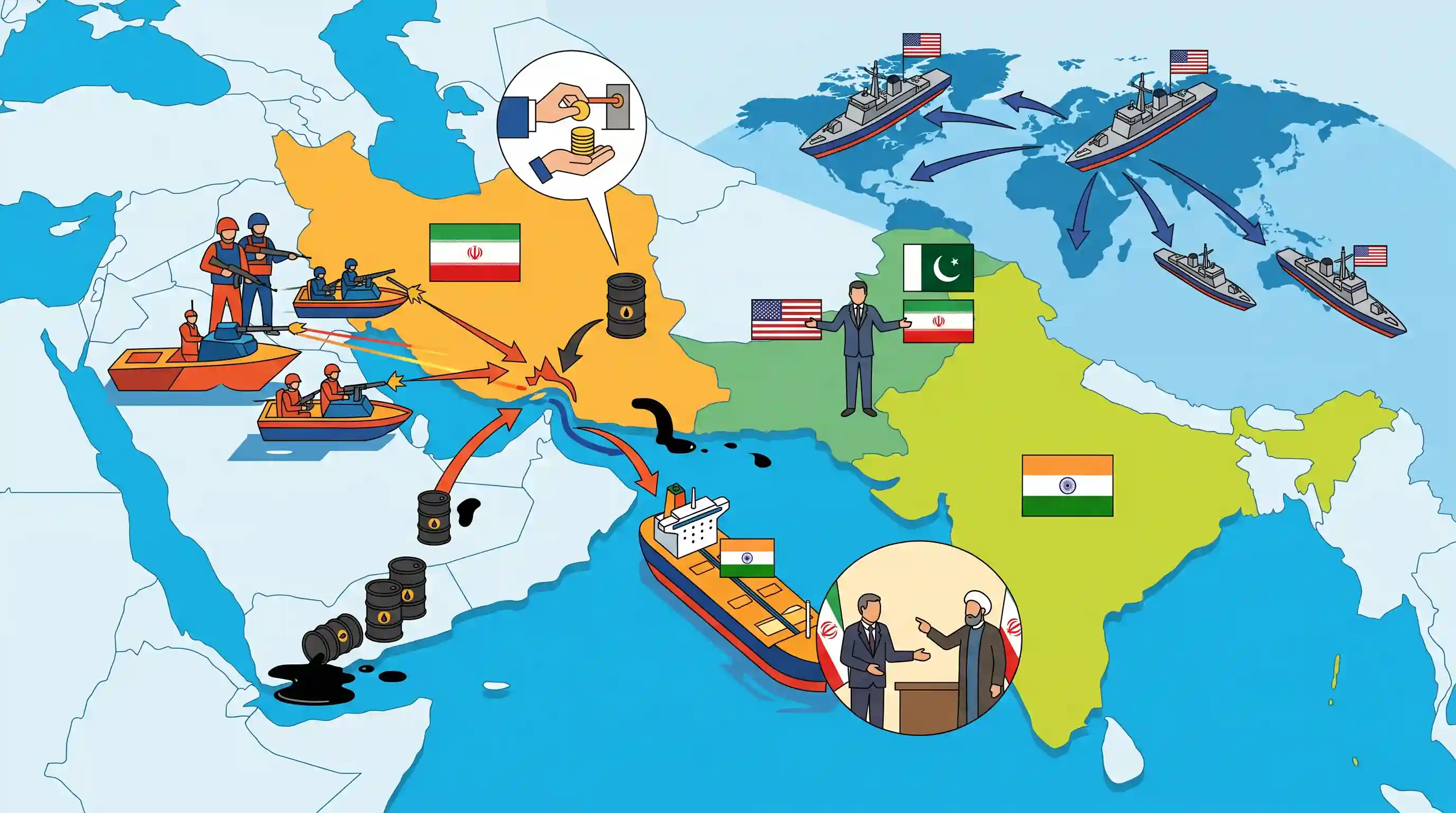
Escalating tensions in the Strait of Hormuz, a critical maritime chokepoint handling a fifth of global oil shipments, have raised significant energy security and geopolitical concerns. The situation deteriorated after Iranian forces fired upon an Indian-flagged commercial tanker and Tehran proposed imposing tolls on transiting ships. In response, US President Donald Trump asserted that the US naval blockade will continue and directed the military to prepare to intercept Iran-linked vessels globally. India has lodged a diplomatic protest by summoning the Iranian ambassador, while Pakistan is attempting to mediate a ceasefire. The conflict underscores the vulnerability of international energy supply chains to Middle Eastern geopolitical instability.
Key Points
- Tensions have escalated in the Strait of Hormuz after Iran fired upon an Indian-flagged commercial tanker.
- US President Donald Trump announced preparations for the US military to board and seize Iran-linked oil tankers and commercial ships globally, reaffirming the ongoing US naval blockade.
- The Strait of Hormuz is a vital global chokepoint, handling approximately 20% of global oil shipments, making disruptions highly consequential for global energy markets.
- Iran proposed imposing tolls on ships passing through the strait, a move rejected by the US, which insists on freedom of navigation.
- India summoned Iran's ambassador to protest the incident, while Pakistan is working to mediate ceasefire negotiations ahead of an impending deadline.
Important Terms
Strait of Hormuz

A strategically vital waterway connecting the Persian Gulf and Gulf of Oman. It is the world’s most critical oil chokepoint, handling roughly 20-30% of global seaborne oil and 20% of LNG trade.
UPSC context
GS Paper 1 (Geography) and Paper 2 (International Relations); central to India's energy security and West Asian geopolitical stability.
Islamic Revolutionary Guard Corps (IRGC)
An elite branch of Iran’s Armed Forces, separate from the regular military, tasked with protecting the Islamic Republic. It exerts significant strategic influence over regional maritime operations and internal security.
UPSC context
GS Paper 2 (International Relations); significant for understanding West Asian security dynamics and their impact on Indian maritime interests.
Energy Security
The uninterrupted availability of energy sources at an affordable price. For India, this involves ensuring safe passage through maritime chokepoints and diversifying crude oil and natural gas import sources.
UPSC context
GS Paper 3 (Economic Development/Infrastructure); a core pillar of India's strategic autonomy and sustainable economic growth.
UK Maritime Trade Operations (UKMTO)
A Royal Navy capability acting as the primary point of contact for merchant vessels and a liaison with military forces in the Indian Ocean, providing vital security information and warnings.
UPSC context
GS Paper 3 (Security); relevant to international mechanisms for safeguarding global Sea Lanes of Communication (SLOCs).
Maritime Security
The protection of a nation's territorial waters, sea lanes, and maritime interests from threats like piracy, conflict, and blockades to ensure the safe flow of international trade.
UPSC context
GS Paper 3 (Security/Internal Security); vital for India’s role as a "net security provider" in the Indian Ocean Region.
US Navy
The maritime branch of the US military. Its Fifth Fleet, based in Bahrain, is responsible for naval operations and maintaining freedom of navigation in the Persian Gulf and Arabian Sea.
UPSC context
GS Paper 2 (International Relations); central to the US maritime strategy and security architecture in the Indo-Pacific and West Asia.
Maritime Chokepoint
Narrow channels along widely used global sea routes that are essential for trade. Their strategic nature makes them vulnerable to blockades, significantly impacting global energy costs and supply chains.
UPSC context
GS Paper 1 (World Geography) and GS Paper 3 (Infrastructure); tests knowledge of geographical bottlenecks and global trade resilience.
Prelims Trap
"Coastal states bordering the Strait of Hormuz can temporarily suspend passage or levy tolls for security reasons."
Under UNCLOS, Hormuz is governed by the regime of 'transit passage', not standard 'innocent passage'. Coastal states absolutely cannot suspend navigation or unilaterally levy tolls.
Static Concepts Connected
What differentiates 'Transit Passage' from 'Innocent Passage' under UNCLOS?
- Transit Passage: Applies to straits used for international navigation (e.g., Hormuz). It cannot be suspended by coastal states, and submarines are allowed to navigate submerged.
- Innocent Passage: Applies to standard territorial waters. It can be temporarily suspended by the coastal state for security reasons, and submarines must navigate on the surface and show their flag.
What is the geographical layout of the Strait of Hormuz?
- Connecting bodies: It is a critical maritime chokepoint connecting the Persian Gulf in the west with the Gulf of Oman and the Arabian Sea in the southeast.
- Bordering nations: It is bounded by Iran to the north, and the United Arab Emirates and Oman (specifically the Musandam Peninsula exclave) to the south.
Cross-Topic Patterns
Hormuz disruption + Strategic Petroleum Reserves
Geopolitical shocks in the Strait of Hormuz directly test India's energy resilience, linking to the capacity, expansion, and locations of the Indian Strategic Petroleum Reserves (ISPRL).
Chabahar Port diplomacy + US Sanctions
India's diplomatic balancing act is severely tested when its Central Asian connectivity node (Chabahar Port, Iran) clashes with US sanctions, naval blockades, and regional maritime volatility.

Expect a multi-statement Prelims question pairing Middle East chokepoints (Hormuz, Bab-el-Mandeb) with UNCLOS transit passage rules.
Linked PYQs · 5
Linked PYQs · 5
- 2025MainsGS2
"Energy security constitutes the dominant kingpin of India's foreign policy, and is linked with India's overarching influence in Middle Eastern countries.” How would you integrate energy security with India's foreign policy trajectories in the coming years?
- 2018MainsGS2
In what ways would the ongoing US-Iran Nuclear Pact Controversy affect the national interest of India? How should India respond to this situation?
- 2012MainsGS2
How have the US sanctions against Iran affected India's bilateral relations with Iran?
- 2024PrelimsGS1
Consider the following statements : Statement-I : Sumed pipeline is a strategic route for Persian Gulf oil and natural gas shipments to Europe. Statement-II : Sumed pipeline connects the Red Sea with the Mediterranean Sea. Which one of the following is correct in respect of the above statements?
- 2025MainsGS3
Why is maritime security vital to protect India's sea trade? Discuss maritime and coastal security challenges and the way forward.
