Spain Airspace Ban on US Military Flights Amid West Asian Crisis
Source:Indian Express ↗
Why It Matters
The event exposes the limits of the US-Europe strategic partnership and internal divisions within NATO over the Middle East crisis. Understanding these geopolitical fractures is crucial for analyzing the evolving global order and its impact on India's diplomatic balancing act in West Asia.
Summary
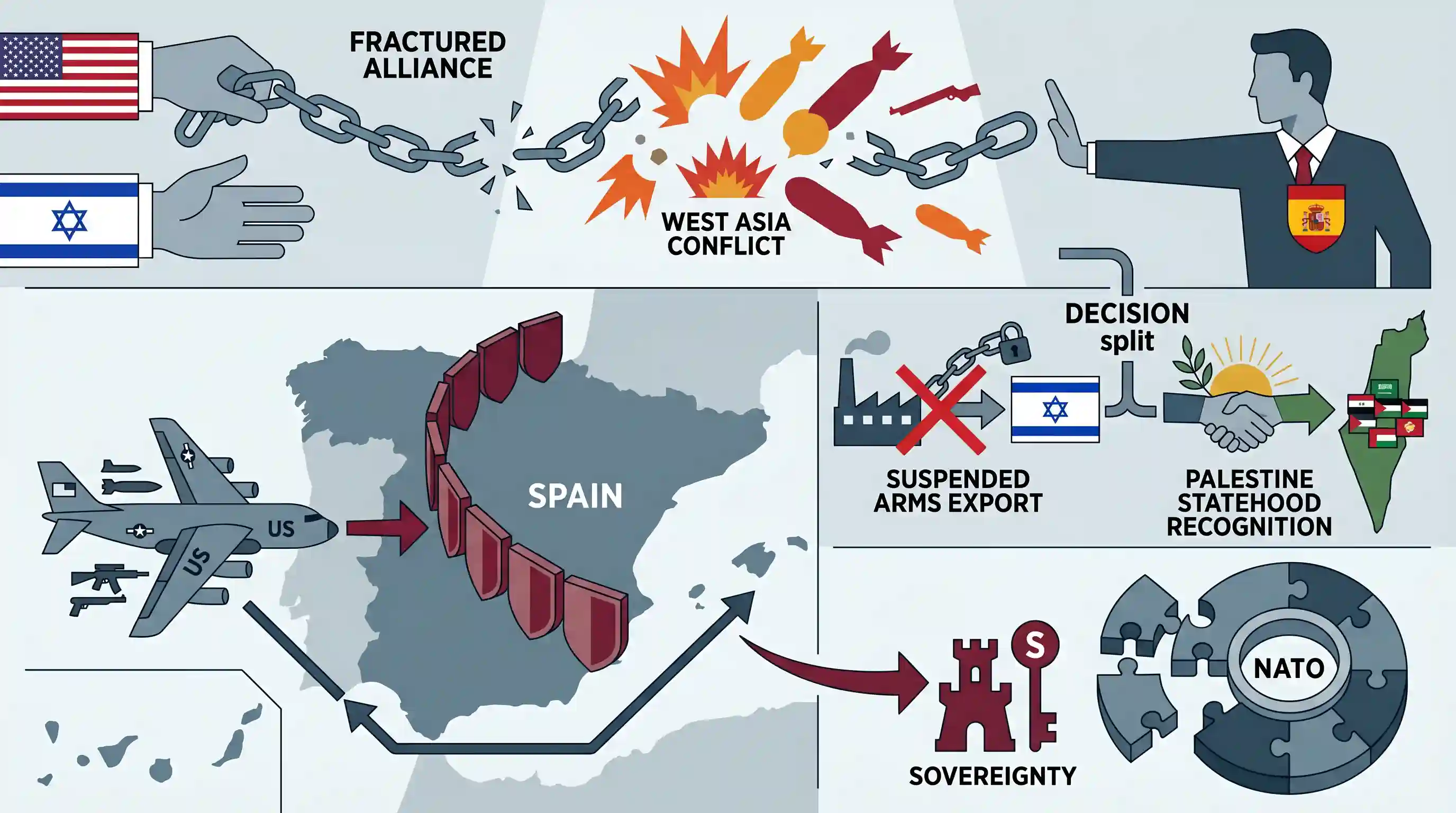
Spain, under Prime Minister Pedro Sanchez, has denied US military aircraft permission to use its airspace for transporting weapons related to the ongoing West Asia conflict. This decision underscores a significant fracture within Western alliances (such as NATO) over Israel's military campaigns in Gaza and tensions with Iran. By asserting sovereignty over its airspace, Spain reinforces its distinct foreign policy stance, which has also included suspending arms exports to Israel and pushing for the formal recognition of Palestinian statehood.
Key Points
- Spain has barred US military aircraft carrying weapons for the West Asia conflict from flying through its sovereign airspace.
- The move, led by Prime Minister Pedro Sanchez, reflects Spain's critical stance on Israel's actions in Gaza and the broader escalation involving Iran.
- Spain's decision highlights a growing divergence among NATO and EU members regarding unconditional military support for Israel.
- The airspace denial aligns with Spain's recent diplomatic measures, including halting arms sales to Israel and advocating for the recognition of a Palestinian state.
Important Terms
NATO

An intergovernmental military alliance established in 1949 by the Washington Treaty, focused on collective defense where an attack on one member is considered an attack on all.
UPSC context
GS Paper II (International Relations). Tests knowledge of global security groupings and the dynamics of collective defense in modern geopolitics.
Sovereignty
The supreme and independent authority of a state to govern its territory and people, including its airspace and maritime zones, without external interference.
UPSC context
GS Paper II (Polity & International Relations). Essential for understanding state autonomy, territorial integrity, and constitutional principles (Preamble).
West Asia
A geopolitical region spanning from Iran to the Levant and Arabian Peninsula, critical for global energy security and home to a massive Indian diaspora.
UPSC context
GS Paper II (India's Interests). Crucial for questions on 'Link West' policy, energy security, and regional stability affecting India.
Two-State Solution
A proposed diplomatic resolution to the Israel-Palestine conflict that envisions an independent State of Palestine existing peacefully alongside the State of Israel.
UPSC context
GS Paper II (International Relations). Relates to India’s long-standing principled position on the Palestinian cause and regional stability.
European Union (EU)
A unique political and economic union of 27 European countries that operates through a system of supranational independent institutions and intergovernmental-negotiated decisions.
UPSC context
GS Paper II (Regional Groupings). Key for understanding international trade, regional integration, and global diplomatic blocs.
Prelims Trap
"Under the Chicago Convention, NATO allies have automatic overflight rights for military aircraft across member states."
The Chicago Convention applies exclusively to civil aircraft. State aircraft (military, customs, police) require explicit prior authorization to enter foreign airspace, regardless of alliances.
Static Concepts Connected
How is sovereign airspace regulated under international law?
- Chicago Convention (1944): Recognizes that every state has complete and exclusive sovereignty over the airspace above its land territory and territorial waters.
- State vs Civil Aircraft: Military, customs, and police aircraft are deemed state aircraft and cannot fly over another state's territory without special agreement or authorization.
- UNCLOS intersection: Airspace sovereignty extends up to 12 nautical miles over territorial waters, but innocent passage does not apply to the airspace above it.
What is the evolution of India's diplomatic stance on Palestine?
- Early Recognition: India was the first non-Arab State to recognize the PLO (1974) and formally recognized the State of Palestine in 1988.
- De-hyphenation Policy: India transitioned to a de-hyphenated foreign policy, managing its strategic ties with Israel and Palestine independently of each other.
- Two-State Solution: India consistently advocates for a sovereign, independent, and viable State of Palestine living in peace alongside Israel.
Cross-Topic Patterns
Strategic Autonomy within NATO
Spain's airspace denial, like France's periodic push for European strategic autonomy, highlights growing fractures in unquestioned US-led NATO alignment regarding West Asian conflicts.
Geography of the Levant region
Geopolitical shifts in West Asia frequently trigger UPSC map-based questions. Countries bordering Israel, the Mediterranean, and the broader Levant region remain high-probability targets.

Expect a 2026 prelims statement mixing Chicago Convention's military aircraft rules with UNCLOS territorial waters airspace sovereignty.
Linked PYQs · 3
Linked PYQs · 3
- 2023MainsGS2
‘The expansion and strengthening of NATO and a stronger US-Europe strategic partnership works well for India.’ What is your opinion about this statement ? Give reasons and examples to support your answer.
- 2025MainsGS2
"With the waning of globalization, post-Cold War world is becoming a site of sovereign nationalism.” Elucidate.
- 2022PrelimsGS1
The term "Levant" often heard in the news roughly corresponds to which of the following regions?
