Diplomatic negotiations and strategic maritime control in Middle East
Source:The Hindu ↗
Why It Matters
The evolving US-Iran dynamics and the status of the Strait of Hormuz are critical for global energy security and maritime trade. For UPSC aspirants, understanding these geopolitical maneuvers is essential for analyzing India's foreign policy challenges, especially regarding energy procurement and diaspora safety in the Middle East.
Summary
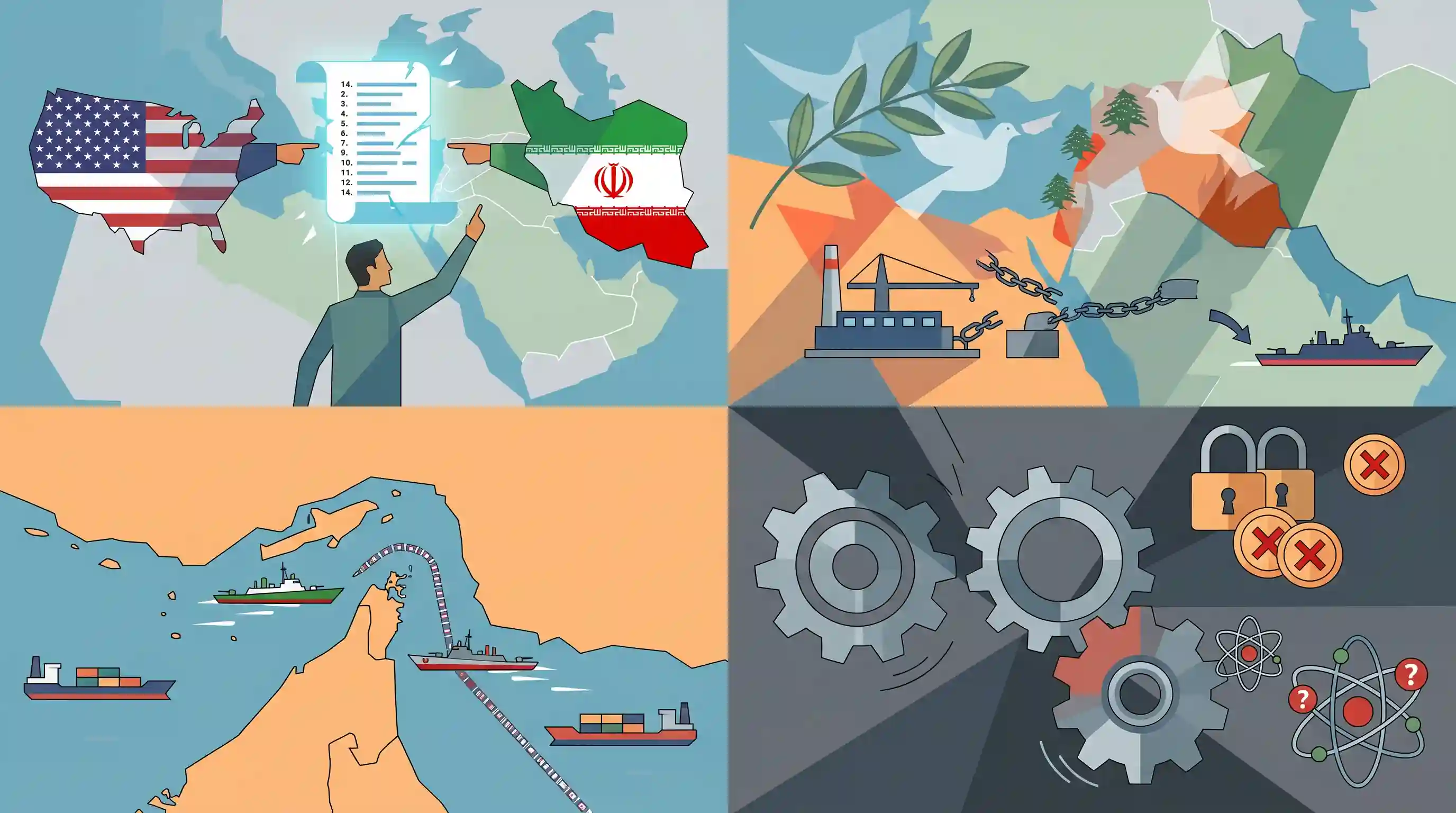
Iran is drafting a 14-point framework for an agreement with the United States aimed at ending the ongoing regional conflict, although full convergence on all issues has not been reached. Mediated by Pakistan, the talks focus on a ceasefire across multiple fronts, including Lebanon, and ending the US naval blockade on Iranian ports. A critical aspect of the draft involves the Strait of Hormuz, where Iran insists that maritime traffic regulations be managed jointly with Oman, explicitly rejecting US involvement. Meanwhile, broader issues such as Iran's nuclear program and comprehensive sanctions relief remain largely unresolved in this framework.
Key Points
- Iran is finalizing a 14-point draft framework for a potential agreement with the US to end the ongoing conflict, though significant gaps remain.
- The proposed framework focuses on ending the war across all fronts, including Lebanon, and terminating the US naval blockade on Iranian ports.
- The strategic Strait of Hormuz is a key element, with Iran asserting that vessel traffic mechanisms should be determined by Iran and Oman, excluding the US.
- Contentious issues such as Iran's nuclear program and comprehensive sanctions relief are not detailed in the current draft.
- Pakistani army chief Asim Munir is reportedly acting as a mediator in these indirect negotiations between Tehran and Washington.
Important Terms
14-point framework

A 14-clause diplomatic draft proposed by Iran, mediated by Pakistan, outlining terms to end regional conflict, lift blockades, and establish maritime security.
UPSC context
GS Paper II (IR): Important for understanding crisis resolution mechanisms and bilateral negotiation frameworks in the Middle East.
Strait of Hormuz
A strategic maritime chokepoint between the Persian Gulf and the Gulf of Oman, handling approximately 20% of global oil and LNG consumption.
UPSC context
GS Paper I (Geography) and Paper II (IR): Vital for energy security and maritime security of India.
Persian Gulf Strait Authority (PGSA)
A newly established Iranian regulatory body tasked with managing navigation and overseeing maritime traffic within the Strait of Hormuz.
UPSC context
GS Paper II (IR): Relates to regional hegemony, maritime jurisdiction, and international law challenges.
Naval Blockade
The use of maritime forces to prevent ships from accessing a nation's ports, currently employed by the US to pressure Iran into diplomatic concessions.
UPSC context
GS Paper II (IR): Significant as a tool of statecraft and its legality under international maritime law.
Pakistan’s Mediation Role
The diplomatic role played by Islamabad in facilitating indirect communications and peace negotiations between Tehran and Washington.
UPSC context
GS Paper II (IR): Highlights neighborhood diplomacy and the role of middle powers in global conflict resolution.
Transit Passage
An UNCLOS regime allowing vessels to traverse international straits continuously and expeditiously, a right contested by proposed Iranian transit fees.
UPSC context
GS Paper II (IR/International Law): Tests knowledge of UNCLOS and freedom of navigation principles.
Prelims Trap
"The Strait of Hormuz is a maritime chokepoint bordered by Iran and the United Arab Emirates."
The Strait of Hormuz is bordered by Iran to the north and Oman's Musandam Peninsula to the south. Aspirants often incorrectly choose the UAE due to its geographic proximity.
Static Concepts Connected
What are the key maritime chokepoints in West Asia?
- Strait of Hormuz: Connects the Persian Gulf to the Gulf of Oman and Arabian Sea. Bounded by Iran and Oman.
- Bab el-Mandeb: Connects the Red Sea to the Gulf of Aden and Arabian Sea. Bounded by Yemen, Djibouti, and Eritrea.
- Suez Canal: An artificial sea-level waterway in Egypt connecting the Mediterranean Sea to the Red Sea, vital for Europe-Asia trade.
Why is US-Iran diplomacy critical for India's Chabahar Port?
- Sanctions Waivers: India requires specific exemptions from US sanctions on Iran to legally procure equipment, attract investment, and operate terminals at Chabahar.
- INSTC Gateway: The port is India's crucial node for the International North-South Transport Corridor (INSTC), bypassing Pakistan to reach Central Asia and Eurasia.
Cross-Topic Patterns
Strait of Hormuz + Macroeconomic stability
Disruptions in the Strait of Hormuz threaten 20-25% of global oil trade, directly impacting India's import bill, inflation, and forex reserves due to high energy dependence.
Proxy warfare + Axis of Resistance
Peace frameworks involving Lebanon underscore how Iran uses non-state proxy networks like Hezbollah (the 'Axis of Resistance') to project power and negotiate with conventional adversaries like the US.

Expect a match-the-following Prelims question in 2026 pairing West Asian straits (Hormuz, Bab el-Mandeb) with their bordering nations.
Linked PYQs · 4
Linked PYQs · 4
- 2018MainsGS2
In what ways would the ongoing US-Iran Nuclear Pact Controversy affect the national interest of India? How should India respond to this situation?
- 2025MainsGS2
"Energy security constitutes the dominant kingpin of India's foreign policy, and is linked with India's overarching influence in Middle Eastern countries.” How would you integrate energy security with India's foreign policy trajectories in the coming years?
- 2024PrelimsGS1
Consider the following statements : Statement-I : Sumed pipeline is a strategic route for Persian Gulf oil and natural gas shipments to Europe. Statement-II : Sumed pipeline connects the Red Sea with the Mediterranean Sea. Which one of the following is correct in respect of the above statements?
- 2016PrelimsGS1
Which of the following is not a member of 'Gulf Cooperation Council'?
