Iran sentences Nobel laureate Narges Mohammadi to prison term
Source:Indian Express ↗
Why It Matters
This event serves as a critical contemporary case study for UPSC aspirants regarding the tension between the State and Civil Society Organizations/Human Rights defenders. It illustrates how authoritarian states view dissent, which is directly relevant to GS Paper II topics on fundamental rights (comparative perspective), the role of civil society, and international affairs.
Summary
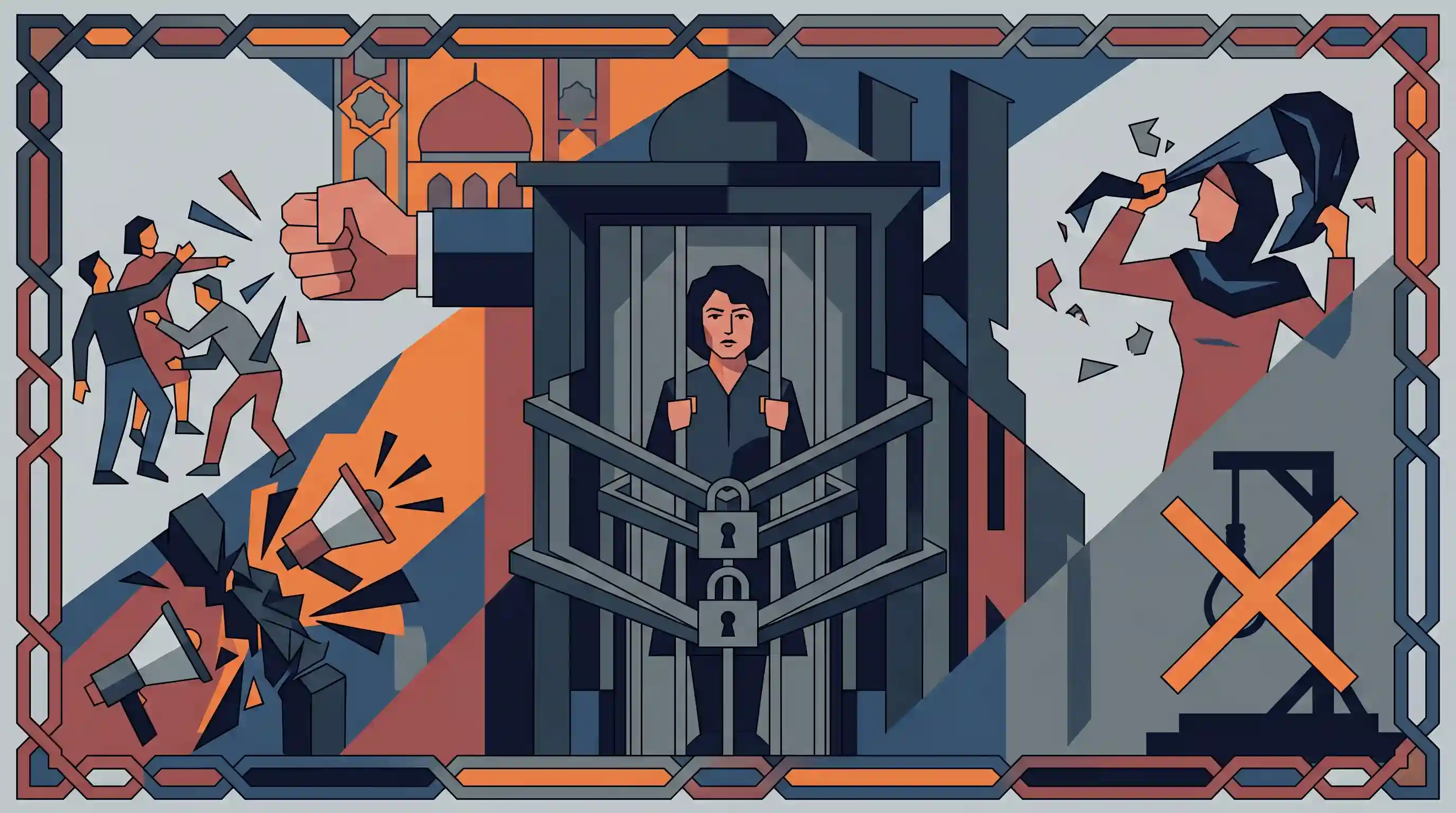
Nobel Peace Prize laureate Narges Mohammadi has been sentenced to over seven additional years in an Iranian prison on charges of 'gathering and collusion' and 'propaganda' against the state. The renowned human rights activist, who has persistently campaigned against the mandatory hijab and capital punishment in Iran, is already serving a lengthy sentence. This development underscores the ongoing, intense suppression of civil society, freedom of expression, and political dissent by the Iranian authorities.
Key Points
- Iranian human rights activist and Nobel Peace Prize laureate Narges Mohammadi has been sentenced to an additional seven-plus years in prison.
- She was convicted of 'gathering and collusion against national security' and 'spreading propaganda against the system'.
- Mohammadi has been historically targeted for her advocacy against the mandatory hijab laws and the death penalty in Iran, enduring multiple arrests and long-term imprisonment.
- Her case highlights the severe crackdown by the Iranian state on civil society actors, human rights defenders, and political dissenters.
Important Terms
Narges Mohammadi

The 2023 Nobel Peace Prize laureate and Iranian human rights activist. She is recognized for her campaign against the oppression of women and advocacy for human rights and freedom for all.
UPSC context
GS Paper 2: International Relations. Relevant for topics on human rights, civil society, and the role of international awards in global diplomacy.
Norwegian Nobel Committee
A five-member body appointed by the Norwegian Parliament (Storting) responsible for selecting the Nobel Peace Prize laureates. It operates independently of any government or political influence.
UPSC context
GS Paper 2: International Institutions. Tests knowledge of global award-giving bodies and their influence on international moral and ethical standards.
Iranian Judiciary
A branch of the Iranian government under the Supreme Leader, overseeing the legal system. It includes specialized Revolutionary Courts that handle cases involving national security and political dissent.
UPSC context
GS Paper 2: Comparative Constitutions. Crucial for understanding authoritarian governance models and the lack of judicial independence in non-democratic states.
Revolutionary Courts (Iran)
Specialized courts in Iran established after the 1979 Revolution to prosecute 'enemies of the state.' They often handle charges like 'propaganda against the system' with limited due process.
UPSC context
GS Paper 2: Governance and Polity. Relevant for analyzing the suppression of dissent and violations of international fair trial standards.
Woman, Life, Freedom Movement
A popular political slogan used by demonstrators in Iran following the death of Mahsa Amini, symbolizing the struggle for gender equality and broader human rights.
UPSC context
GS Paper 1: Social Issues. Relates to women's empowerment, social movements, and the impact of mandatory religious laws on civil liberties.
Capital Punishment
The legal termination of a person's life by the state as punishment for a crime. Mohammadi has persistently campaigned against its high rate of use in Iran.
UPSC context
GS Paper 2: Human Rights. Important for discussions on the global trend toward abolition and the ethical implications of state-sanctioned executions.
Prelims Trap
"Narges Mohammadi was awarded the Nobel Peace Prize by the Royal Swedish Academy of Sciences in Stockholm."
Unlike other Nobel Prizes awarded in Stockholm, Sweden, the Nobel Peace Prize is awarded in Oslo, Norway, by a committee appointed by the Norwegian parliament.
Static Concepts Connected
What is the judicial doctrine governing the death penalty in India?
- Rarest of Rare: Established in the Bachan Singh case (1980), ensuring capital punishment is an exception, not the rule.
- Machi Singh (1983): Laid down guidelines to determine "rarest of rare" based on the manner, motive, and magnitude of the crime.
- Pardon Power: Article 72 (President) and Article 161 (Governor) allow executive clemency, acting as an additional constitutional safeguard against judicial error.
What are the constitutional grounds for restricting free speech in India?
- Article 19(2): The Constitution allows the state to impose reasonable restrictions on freedom of speech and expression.
- Security & Sovereignty: Speech can be curtailed to protect the sovereignty, integrity, and security of the State, or friendly relations with foreign states.
- Public Order: Restrictions apply if speech incites violence, disrupts public order, or constitutes defamation or contempt of court.
Cross-Topic Patterns
Civil Society vs. National Security laws
Mohammadi's "collusion" charges reflect a global trend where states invoke national security and public order laws (similar to debates around UAPA or FCRA in India) to restrict human rights advocacy and civil society.
Hijab protests, Article 25 & Bodily Autonomy
Iran’s mandatory hijab enforcement contrasts with India’s judicial debates (e.g., Karnataka hijab row), which grapple with balancing "essential religious practices" under Article 25 against institutional discipline and individual bodily autonomy.

Expect a Prelims 'match-the-following' pairing recent Nobel Peace laureates (Mohammadi, Bialiatski) with their home countries and causes.
Linked PYQs · 3
Linked PYQs · 3
- 2025MainsGS2
Civil Society Organizations are often perceived as being anti-State actors than non-State actors. Do you agree? Justify.
- 2014MainsGS2
What do you understand by the concept "freedom of speech and expression"? Does it cover hate speech also ? Why do the films in India stand on a slightly different plane from other forms of expression ? Discuss.
- 2025MainsGS2
"Energy security constitutes the dominant kingpin of India's foreign policy, and is linked with India's overarching influence in Middle Eastern countries.” How would you integrate energy security with India's foreign policy trajectories in the coming years?
