Tanker Seizure in Strait of Hormuz and Maritime Security
Source:The Hindu ↗
Why It Matters
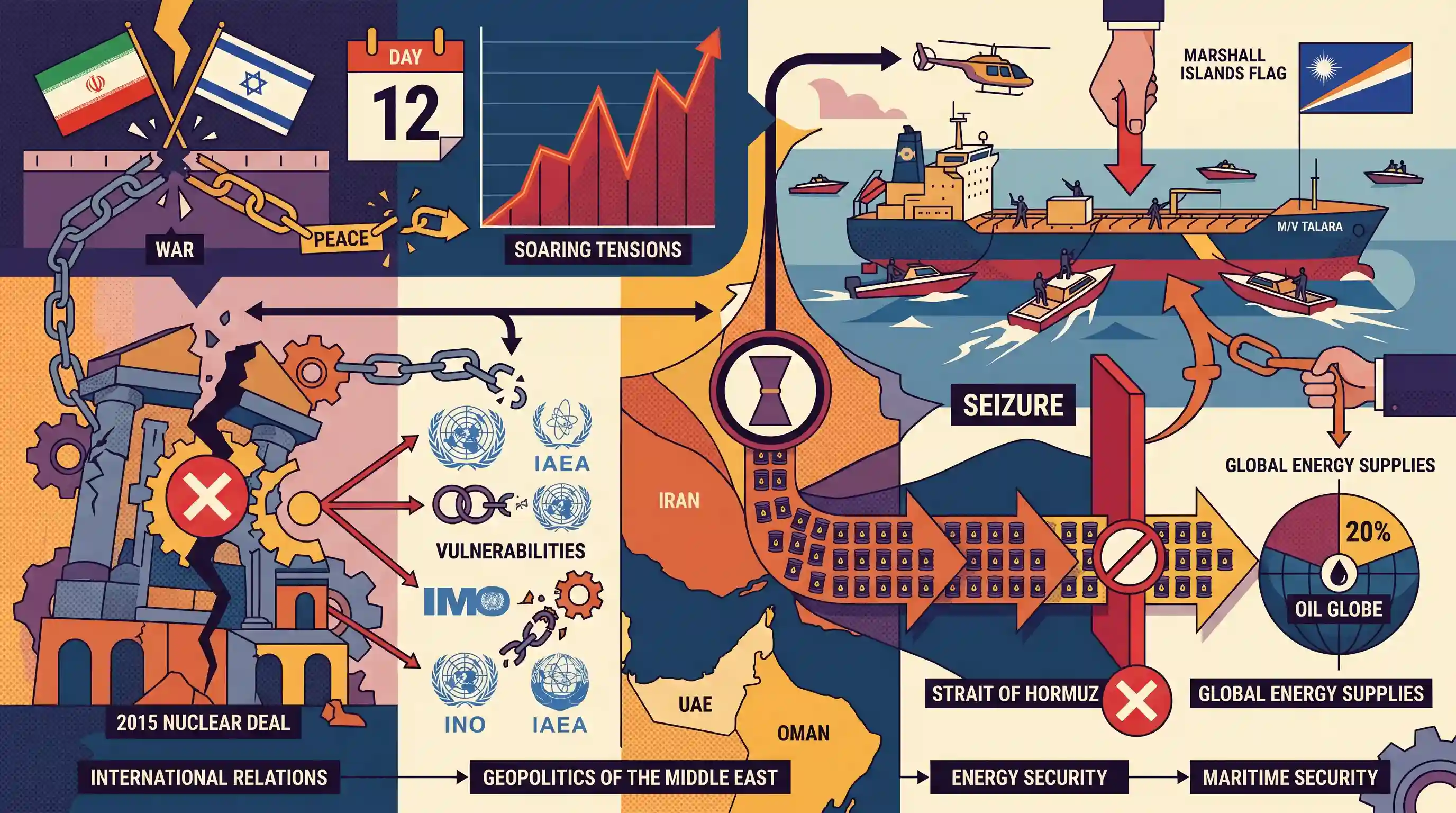
The Strait of Hormuz is one of the world's most critical maritime chokepoints. Any disruption here directly impacts global energy security and oil prices, carrying significant macroeconomic implications for energy-dependent nations like India. The incident also highlights shifting Middle East geopolitical dynamics and the broader strategic fallout of the Iran nuclear deal's collapse.
Summary
Iran seized a Marshall Islands-flagged oil tanker, the Talara, in the strategic Strait of Hormuz amidst soaring regional tensions. The incident occurred in the wake of a recent 12-day war involving Iran and Israel. The seizure highlights ongoing vulnerabilities in maritime security and energy supply chains, as the Strait of Hormuz serves as a transit route for 20% of all globally traded oil. The continued instability in the Persian Gulf region traces back to the fallout from the collapse of the 2015 Iran nuclear deal and intersecting regional conflicts.
Key Points
- Iran intercepted and seized the Marshall Islands-flagged oil tanker Talara in the Strait of Hormuz.
- The seizure follows heightened regional tensions, including a recent 12-day war between Iran and Israel that involved US strikes on Iranian nuclear sites.
- The Strait of Hormuz remains a critical global maritime chokepoint, facilitating the transit of approximately 20% of the world's traded oil.
- Such maritime security incidents in the region have increased since the unilateral US withdrawal from the 2015 Iran nuclear deal.
Important Terms
Strait of Hormuz

A strategic waterway between Iran and Oman connecting the Persian Gulf to the Gulf of Oman; it facilitates roughly 20% of global seaborne oil trade.
UPSC context
GS Paper 2 (International Relations) and GS Paper 3 (Energy Security); tests knowledge of global maritime chokepoints and energy supply chains.
Joint Comprehensive Plan of Action (JCPOA)
A 2015 agreement between Iran and world powers (P5+1) limiting Iran's nuclear program in exchange for sanctions relief; its breakdown drives current regional instability.
UPSC context
GS Paper 2 (International Relations); essential for understanding Middle East geopolitics and the impact of international agreements on India's interests.
US Navy 5th Fleet
A United States Navy numbered fleet headquartered in Bahrain, responsible for maritime security in the Persian Gulf, Red Sea, and Arabian Sea.
UPSC context
GS Paper 3 (Internal Security/Maritime Security); tests awareness of major international military presences and their roles in safeguarding trade routes.
Houthis (Ansar Allah)
A Zaidi Shia militant group in Yemen, backed by Iran, that frequently targets commercial shipping to exert regional political pressure.
UPSC context
GS Paper 2 (IR) and GS Paper 3 (Security); relevant for studying non-state actors and proxy wars in the Middle East.
United Kingdom Maritime Trade Operations (UKMTO)
A Royal Navy-operated information center providing a primary point of contact for merchant vessels to report security incidents in the Middle East and Indian Ocean.
UPSC context
GS Paper 2/3 (International Institutions/Security); identifies critical global maritime surveillance and communication frameworks.
Ambrey
A private UK-based maritime intelligence and security company that provides real-time threat assessments and armed protection services for commercial shipping.
UPSC context
GS Paper 3 (Security); represents the role of private agencies in modern maritime security and threat intelligence.
Prelims Trap
The Strait of Hormuz is a narrow strategic waterway lying between Iran and the United Arab Emirates.
While the UAE is extremely close, the southern shore of the Strait of Hormuz is actually the Musandam Peninsula, which is an exclave of Oman.
Static Concepts Connected
What are the key maritime chokepoints in the Middle East?
- Strait of Hormuz: Connects the Persian Gulf to the Gulf of Oman and the Arabian Sea. It is the world's most critical energy transit route.
- Bab el-Mandeb: Connects the Red Sea to the Gulf of Aden. It is a major bottleneck for Europe-Asia trade and vulnerable to Houthi disruptions.
- Suez Canal: An artificial sea-level waterway connecting the Red Sea to the Mediterranean Sea, bypassing the longer Cape of Good Hope route.
What does the maritime practice Flags of Convenience entail?
- The Practice: Registering a merchant ship in a country different from the owner's home nation to exploit lower taxes, cheaper labor, or bypass strict environmental regulations.
- UNCLOS Loopholes: UNCLOS mandates a "genuine link" between the ship and flag state, but weak enforcement allows "shadow fleets" to obscure true ownership and evade international sanctions.
Cross-Topic Patterns
Strait disruptions & India's SPRs
Frequent chokepoint blockades underscore the importance of India expanding its Strategic Petroleum Reserves (SPRs) beyond the current limited crude coverage to ensure long-term energy security.
Op Sankalp & Maritime Security
Sustained instability in the Persian Gulf justifies the Indian Navy's continuous deployment under Operation Sankalp, pivoting from reactive deployments to a proactive maritime security presence.
Flags of Convenience & Sanctions
Geopolitical conflicts accelerate the use of 'Flags of Convenience' by shadow fleets, linking maritime law (UNCLOS) directly to the effectiveness of international economic sanctions.

Map-based pairing of West Asian chokepoints (Hormuz, Bab el-Mandeb, Tiran) with their bordering nations is highly probable for 2026.
Linked PYQs · 4
Linked PYQs · 4
- 2024PrelimsGS1
Consider the following statements : Statement-I : Sumed pipeline is a strategic route for Persian Gulf oil and natural gas shipments to Europe. Statement-II : Sumed pipeline connects the Red Sea with the Mediterranean Sea. Which one of the following is correct in respect of the above statements?
- 2025MainsGS2
"Energy security constitutes the dominant kingpin of India's foreign policy, and is linked with India's overarching influence in Middle Eastern countries.” How would you integrate energy security with India's foreign policy trajectories in the coming years?
- 2018MainsGS2
In what ways would the ongoing US-Iran Nuclear Pact Controversy affect the national interest of India? How should India respond to this situation?
- 2025MainsGS3
Why is maritime security vital to protect India's sea trade? Discuss maritime and coastal security challenges and the way forward.
