Iran Condemns New US Travel Restrictions on International Migration
Source:The Hindu ↗
Why It Matters
The policy marks a significant shift in U.S. immigration and foreign relations, carrying direct implications for international law, global mobility, and human rights. For UPSC aspirants, understanding the geopolitical fallout of such unilateral bans—especially regarding U.S.-Iran tensions and their ripple effects on global diplomacy—is crucial for the International Relations segment.
Summary
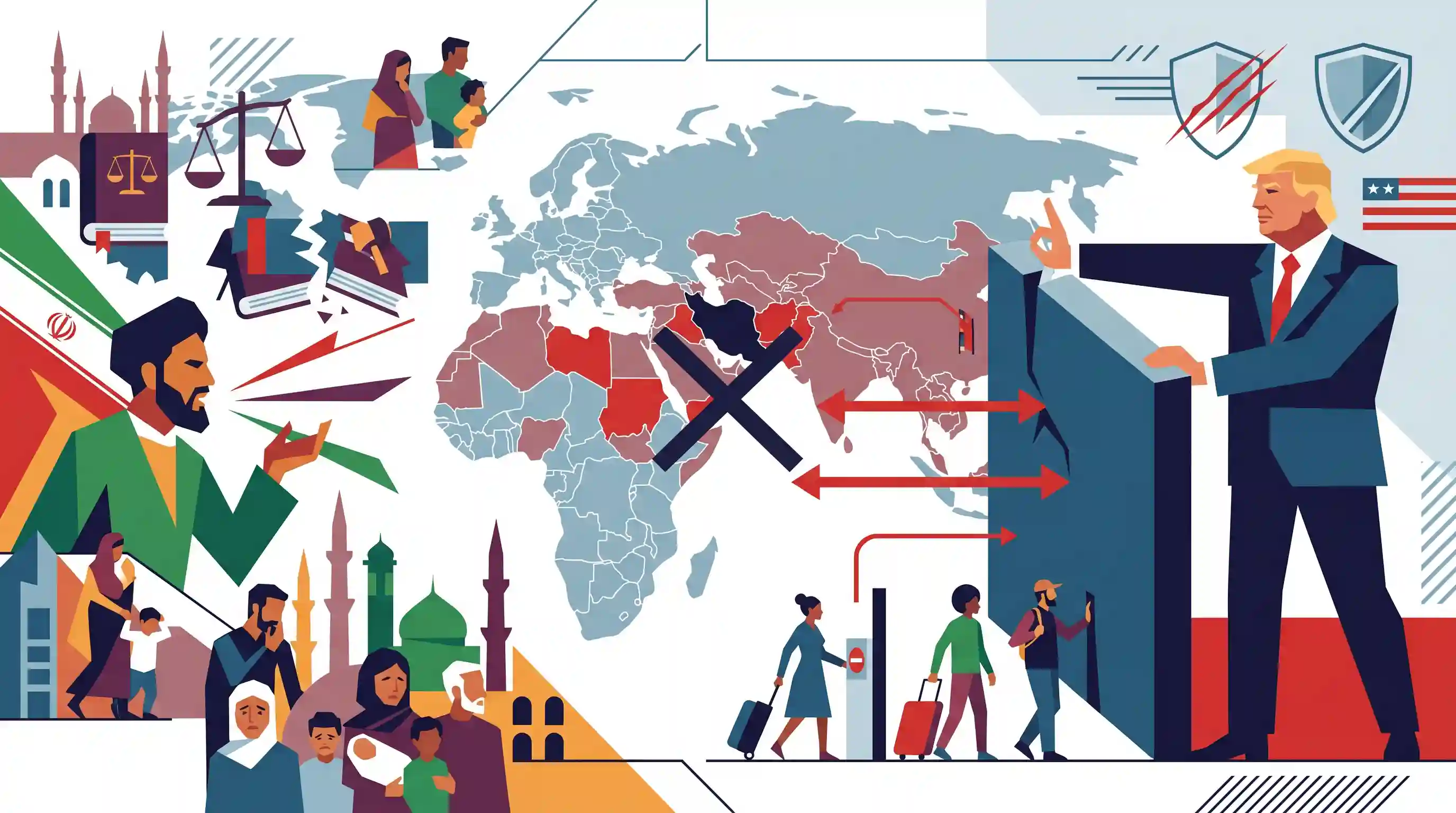
Iran has strongly criticized the U.S. administration's decision to impose a new travel ban on citizens from 12 countries across the Middle East, Africa, and Asia. Defended by U.S. President Donald Trump as a necessary measure to guard against "foreign terrorists," the ban targets countries including Iran, Afghanistan, Libya, and Sudan. Iran's Foreign Ministry denounced the sweeping restriction as a violation of international law, stating it reflects a "deep hostility" toward Iranians and the broader Muslim community. The move mirrors similar executive actions taken during Trump's previous term and threatens to escalate geopolitical tensions between the U.S. and the affected nations.
Key Points
- The U.S. government under President Donald Trump announced a travel ban barring citizens from 12 countries, including Iran, Afghanistan, and Myanmar, citing the need to protect against 'foreign terrorists'.
- Iran's Foreign Ministry strongly condemned the decision, arguing that restricting entry based on religion and nationality violates international law and shows 'deep hostility' towards Iranians and Muslims.
- The ban echoes similar policies implemented during Donald Trump's first term (2017-2021), which targeted multiple Muslim-majority nations.
- The proclamation is expected to further strain U.S.-Iran diplomatic relations and raise broader concerns regarding global immigration, human rights, and international law.
Important Terms
U.S. Travel Ban

A U.S. federal policy, typically issued via executive action, that restricts or prohibits entry for nationals from specific countries based on purported national security or counter-terrorism concerns.
UPSC context
GS Paper 2: International Relations; specifically the impact of policies of developed countries on the interests of other nations and global mobility.
Executive Order
In the U.S. constitutional system, a signed directive from the President that manages federal operations and carries the force of law without requiring immediate Congressional approval.
UPSC context
GS Paper 2: Comparison of the Indian constitutional scheme with that of other countries, focusing on executive powers and judicial review.
International Law
The body of rules, norms, and standards generally accepted in relations between nations, including principles of non-discrimination and human rights enshrined in treaties like the ICCPR.
UPSC context
GS Paper 2: Important International institutions, agencies and fora—their structure, mandate; and fundamental principles of global governance and human rights.
Strait of Hormuz
A strategic maritime chokepoint between the Persian Gulf and the Gulf of Oman, critical for global energy security as nearly one-fifth of the world's oil passes through it.
UPSC context
GS Paper 2: West Asia geopolitics and India's energy security; GS Paper 1: Important geophysical features (Chokepoints).
US-Iran Bilateral Relations
The formal political, economic, and strategic interactions between the United States and Iran, characterized by high tension, sanctions, and periodic diplomatic crises since 1979.
UPSC context
GS Paper 2: Bilateral, regional and global groupings and agreements involving India and/or affecting India’s interests.
Foreign Ministry
The government department responsible for a state's foreign policy and relations; in Iran, it often issues formal 'Diplomatic Protests' against perceived violations of sovereignty.
UPSC context
GS Paper 2: Diplomatic protocols and the role of state institutions in conducting international relations and expressing sovereign objections.
Prelims Trap
"India manages affected asylum seekers under its obligations as a signatory to the 1951 UN Refugee Convention."
India is NOT a signatory to the 1951 Refugee Convention or the 1967 Protocol. It lacks a specific domestic refugee law, managing asylum seekers administratively.
Static Concepts Connected
What is the 1951 Refugee Convention and India's stance on it?
- Core Principle: It establishes the principle of 'non-refoulement', which prevents returning refugees to territories where their life or freedom would be threatened.
- India's Stance: India is not a signatory to the 1951 Convention or the 1967 Protocol, citing border permeability and national security concerns.
- Domestic Management: India deals with refugees via ad-hoc administrative measures and domestic laws like the Foreigners Act, 1946, rather than a dedicated national refugee framework.
What is the geostrategic significance of Chabahar Port for India?
- Strategic Location: Located in Iran's Sistan-Balochistan province on the Gulf of Oman, sitting safely outside the strategically vulnerable Strait of Hormuz.
- Bypassing Pakistan: It provides India direct sea-land transit access to Afghanistan and resource-rich Central Asia, entirely bypassing Pakistan.
- INSTC Linkage: It serves as a critical maritime-to-land node for the International North-South Transport Corridor (INSTC), aiming to boost Eurasian trade.
Cross-Topic Patterns
Extraterritorial Sanctions & Strategic Autonomy
US "Maximum Pressure" on Iran often triggers secondary sanctions. India frequently navigates this by securing targeted carve-outs (e.g., Chabahar Port) to balance US ties with its Eurasian connectivity goals.
Protectionism vs. Diaspora Economics
Rising US isolationism links national security travel bans with broader immigration tightening, directly impacting India's diaspora mobility, service-led exports, and remittance economy.

Prelims 2026 may feature a multi-statement question on the 1951 Refugee Convention, non-refoulement, and India's non-signatory status.
Linked PYQs · 2
Linked PYQs · 2
- 2012MainsGS2
How have the US sanctions against Iran affected India's bilateral relations with Iran?
- 2020MainsGS2
Indian diaspora has a decisive role to play in the politics and economy of America and European Countries'. Comment with examples.
