Iran Nuclear Agreement Negotiations and Enrichment Framework
Source:The Hindu ↗
Why It Matters
The Iranian nuclear crisis is a central issue in Middle Eastern geopolitics and global non-proliferation. For UPSC aspirants, understanding the JCPOA, IAEA safeguards, and the sanctions regime is vital for analyzing India's foreign policy challenges, particularly concerning energy security, bilateral ties with Iran (e.g., Chabahar Port), and balancing relations with the U.S. and Israel.
Summary
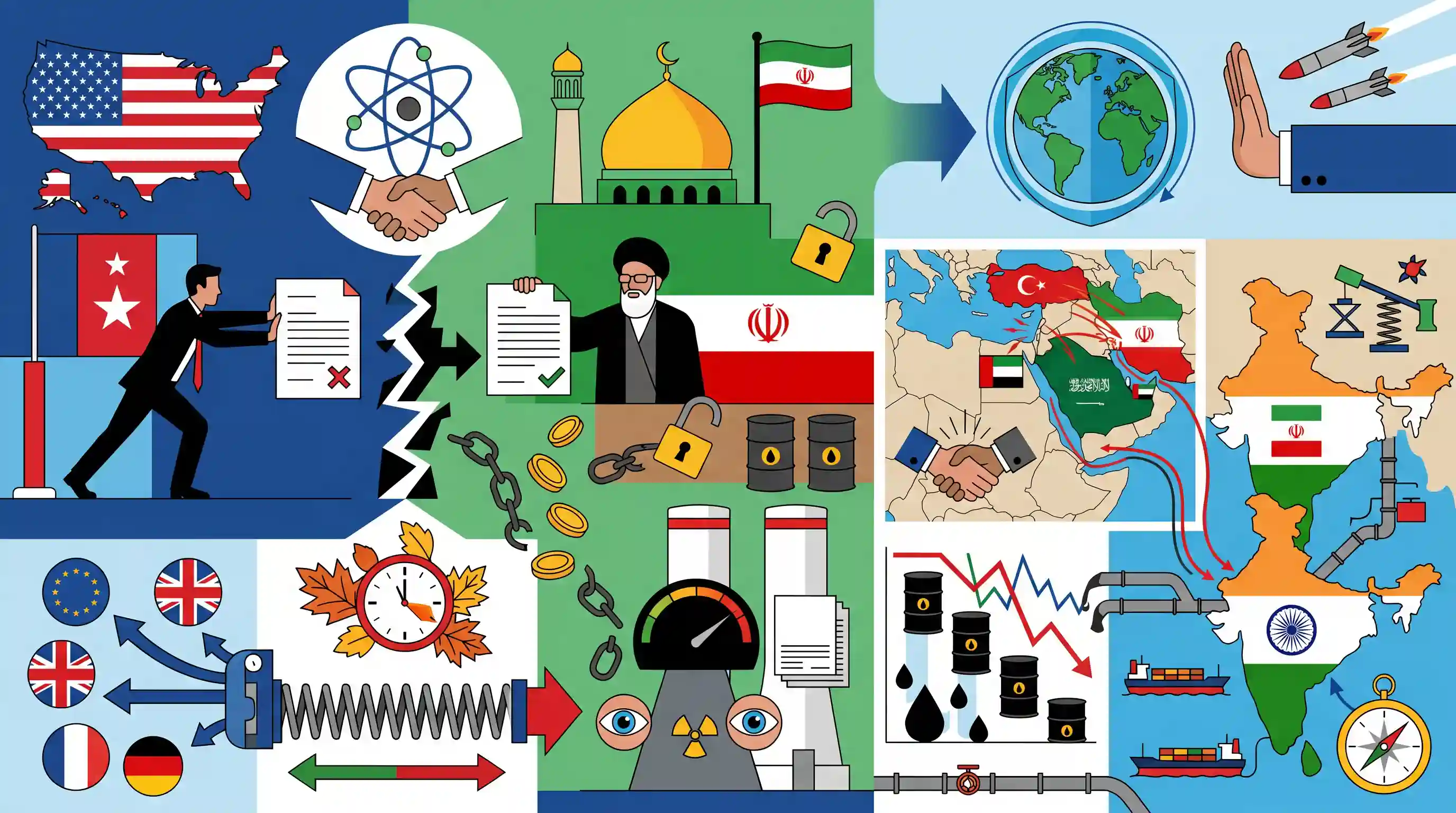
The article discusses the ongoing diplomatic stalemate between Iran and the United States over reviving the 2015 nuclear agreement (JCPOA). Iran plans to present its own proposal, rejecting a U.S. offer that it claims fails to address the lifting of economic sanctions. Meanwhile, Iran continues to enrich uranium to 60%, a move defended by its Supreme Leader but heavily scrutinized by the IAEA. Concurrently, European nations are considering triggering the JCPOA's sanctions 'snapback' mechanism before it expires in October. This development is critical for global nuclear non-proliferation efforts and Middle Eastern geopolitics, with direct spillover effects on global energy markets and India's strategic interests in the region.
Key Points
- Iran intends to submit its own nuclear proposal to the United States as a counter to a recent U.S. offer that Tehran claims contains ambiguities and fails to lift sanctions.
- Indirect talks have been ongoing to replace the 2015 Joint Comprehensive Plan of Action (JCPOA), which the U.S. unilaterally abandoned in 2018.
- Iran's Supreme Leader Ayatollah Ali Khamenei stated that the U.S. offer contradicts Iran's independence and defended uranium enrichment up to 60% as 'key' to their nuclear program.
- The IAEA Board of Governors is holding meetings to discuss Iran's nuclear activities amidst concerns over its near-weapons-grade enrichment.
- European powers (UK, France, Germany) are deliberating whether to invoke the 'snapback' mechanism to restore UN sanctions before the provision expires in October.
Important Terms
Joint Comprehensive Plan of Action (JCPOA)

A 2015 landmark agreement between Iran and the P5+1 (US, UK, France, China, Russia, and Germany) limiting Iran's nuclear program in exchange for economic sanctions relief.
UPSC context
GS Paper II (International Relations). Relevant for global nuclear diplomacy, West Asia geopolitics, and energy security.
International Atomic Energy Agency (IAEA)
An autonomous UN-affiliated organization established in 1957 that promotes peaceful nuclear energy use and verifies compliance with international safeguards to prevent military diversion.
UPSC context
GS Paper II (Important International Institutions). Tests understanding of global watchdogs and their role in non-proliferation.
Nuclear Non-Proliferation Treaty (NPT)
A 1970 international treaty aiming to prevent nuclear weapon proliferation, promote peaceful nuclear energy, and achieve disarmament. India is a notable non-signatory, citing its discriminatory nature.
UPSC context
GS Paper II (International Relations). Key for nuclear policy, India’s strategic stance, and disarmament frameworks.
European trio (E3)
An informal diplomatic grouping of France, Germany, and the United Kingdom that leads European efforts in negotiating and preserving the Iran nuclear deal.
UPSC context
GS Paper II (International Relations). Illustrates multilateral diplomacy and European influence on Middle Eastern security issues.
Snapback Mechanism
A JCPOA provision allowing participant states to unilaterally reimpose UN sanctions if Iran commits "significant non-performance" of its nuclear commitments, bypassing the standard Security Council veto.
UPSC context
GS Paper II (International Relations). Relevant for understanding enforcement protocols and diplomatic leverage in international treaties.
Prelims Trap
"The 'snapback' mechanism under JCPOA requires unanimous P5 approval to reimpose UN sanctions on Iran."
The snapback mechanism was designed specifically to bypass the usual UNSC veto structure. Any JCPOA participant can automatically restore UN sanctions without requiring P5 consensus.
Static Concepts Connected
What is the 'Snapback' mechanism in the context of the Iran Nuclear Deal?
- UNSCR 2231: It is enshrined in UN Security Council Resolution 2231, which formally endorsed the 2015 Joint Comprehensive Plan of Action (JCPOA).
- Veto-proof design: It allows any participant state to unilaterally and automatically trigger the reimposition of all previously lifted UN sanctions if Iran breaches the deal, bypassing P5 vetoes.
- October 2025 Expiry: The mechanism includes a 10-year sunset clause and is scheduled to permanently expire in October 2025, forcing urgent diplomatic action.
How are uranium enrichment levels classified for civilian and military use?
- Low-Enriched Uranium (LEU): Requires roughly 3-5% enrichment of the U-235 isotope. It is safely used in commercial light-water nuclear power reactors.
- Highly Enriched Uranium: Uranium enriched to 20% or more. Iran's current enrichment to 60% is a major non-proliferation concern as it drastically shortens the "breakout time."
- Weapons-grade: Requires roughly 90% enrichment of U-235 to create a viable nuclear weapon.
Cross-Topic Patterns
Chabahar operations amidst US sanctions
India's 10-year bilateral pact to operate Iran's Chabahar port remains vulnerable to US secondary sanctions, directly linking the JCPOA's failure to India's INSTC and Eurasian connectivity ambitions.
IAEA Additional Protocol vs. Sovereignty
Iran's restriction of IAEA inspections mirrors broader global debates on the Additional Protocol, a voluntary agreement granting inspectors unannounced access to both declared and undeclared nuclear sites.

Expect a 2026 paired-statement question linking the JCPOA 'snapback' expiry to India's INSTC and Chabahar Port sanctions vulnerability.
Linked PYQs · 3
Linked PYQs · 3
- 2018MainsGS2
In what ways would the ongoing US-Iran Nuclear Pact Controversy affect the national interest of India? How should India respond to this situation?
- 2018PrelimsGS1
In the Indian context, what is the implication of ratifying the 'Additional Protocol' with the 'International Atomic Energy Agency (IAEA)'?
- 2020PrelimsGS1
In India, why are some nuclear reactors kept under "IAEA Safeguards" while others are not?
