US-Iran Nuclear Talks and Regional Diplomacy
Source:The Hindu ↗
Why It Matters
The trajectory of US-Iran nuclear diplomacy directly influences stability in West Asia, which is critical to India's energy security, trade, and the safety of its diaspora. Any escalation or resolution will have profound impacts on global energy markets (especially via the Strait of Hormuz) and India's strategic balancing in the Middle East.
Summary
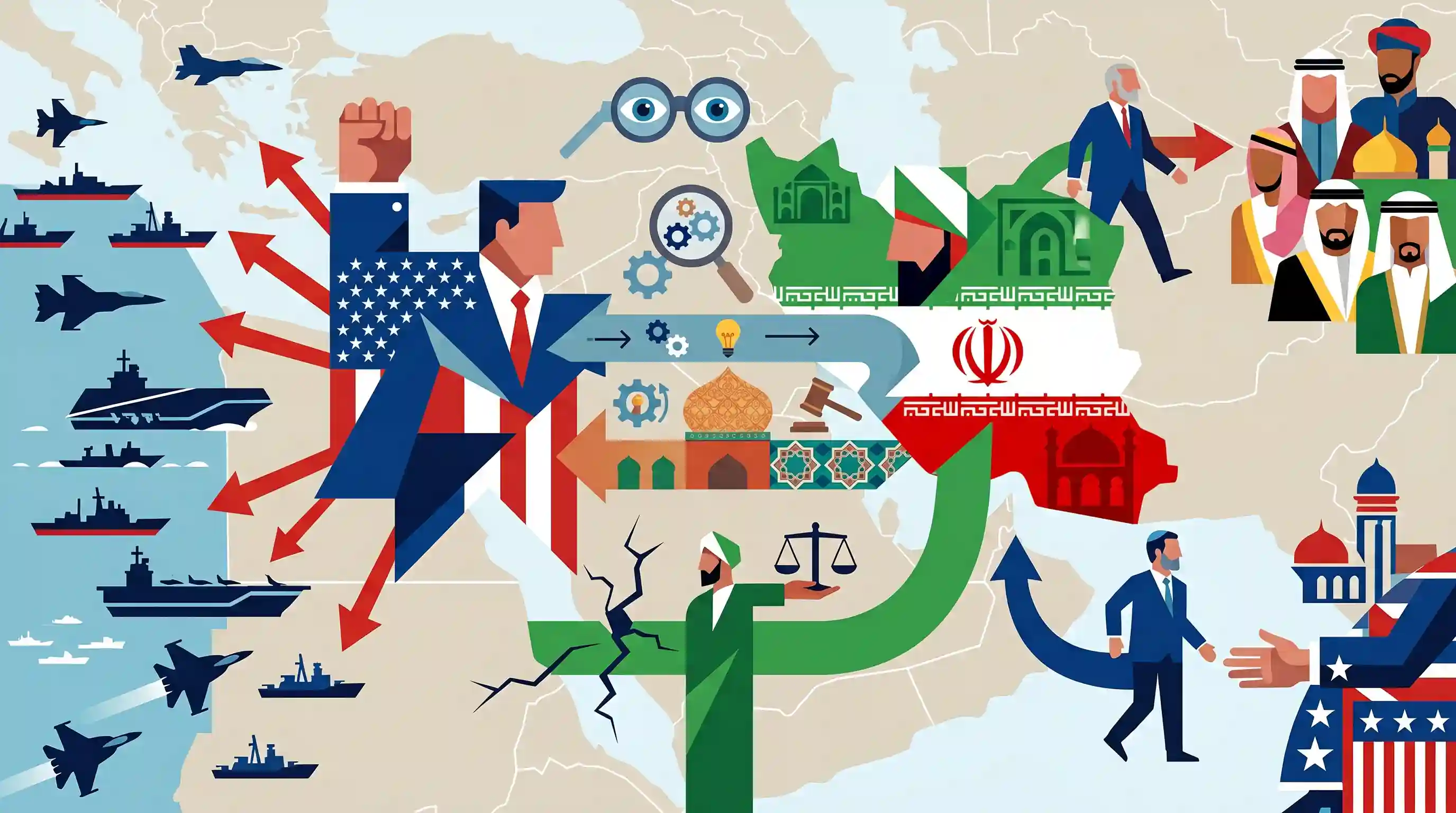
Iran has confirmed holding indirect nuclear discussions with the United States through Omani mediation, aiming to gauge the US's "seriousness" regarding diplomacy. These back-channel negotiations contrast with the heightened military posture adopted by US President Donald Trump, who recently deployed a naval flotilla to the region and warned of potential strikes against Iranian aggression. Despite this pressure, Iran's Foreign Ministry emphasized a consensus on continuing the diplomatic path. Concurrently, broader regional diplomacy is in motion, with a senior Iranian advisor visiting Gulf nations and the Israeli Prime Minister preparing for a visit to Washington.
Key Points
- Iran and the US have engaged in indirect nuclear talks facilitated by Oman to assess Washington's seriousness toward a diplomatic resolution.
- The talks occur against a backdrop of US military pressure, with President Donald Trump deploying a naval flotilla to the region.
- Iranian officials emphasized a national consensus to pursue diplomacy despite US threats of military strikes if Iran misbehaves.
- Regional diplomacy is accelerating, underscored by Iranian advisor Ali Larijani's visits to Oman and Qatar, and an upcoming trip by the Israeli Prime Minister to Washington.
Important Terms
Joint Comprehensive Plan of Action (JCPOA)

A 2015 landmark agreement between Iran and the P5+1 powers (plus EU) to limit Iran's nuclear program in exchange for sanctions relief. By 2026, its legal standing collapsed following 'snapback' sanctions.
UPSC context
GS-II: International Relations. Essential for understanding West Asian geopolitics, nuclear non-proliferation, and India’s energy security interests.
Snapback Mechanism
A provision under UNSC Resolution 2231 allowing any JCPOA participant to reimpose previous UN sanctions if Iran significantly violates the deal. Triggered in 2025, it ended the 2015 accord's framework.
UPSC context
GS-II: Important international institutions and agreements. Tests knowledge of multilateral diplomacy and UN enforcement tools.
Strait of Hormuz
A vital maritime chokepoint between the Persian Gulf and Gulf of Oman. It is the world's most significant oil transit artery, often a focal point for US-Iran military tensions.
UPSC context
GS-I (Geography) & GS-II/III (Security). Critical for understanding global energy supply chains and maritime security.
International Atomic Energy Agency (IAEA)
The United Nations' nuclear watchdog responsible for monitoring and verifying Iran's compliance with nuclear safeguards. It plays a central technical role in verifying enrichment levels and facility access.
UPSC context
GS-II: Important International institutions. High frequency in prelims/mains regarding global governance and technical regulation.
Back-channel Diplomacy (Omani Mediation)
The use of a third-party neutral state (Oman) to facilitate communication between two conflicting parties (US and Iran) that lack formal diplomatic relations.
UPSC context
GS-II: Bilateral and regional relations. Tests understanding of diplomatic conflict resolution and the role of middle powers.
Breakout Time
The estimated time required for a country to produce enough weapons-grade fissile material for one nuclear device. Short breakout times increase regional instability and pressure for military action.
UPSC context
GS-III: Security/Science & Tech. Critical metric in arms control and nuclear strategy discussions.
Prelims Trap
"The JCPOA is a bilateral nuclear disarmament treaty between the United States and Iran."
UPSC often mischaracterizes multilateral agreements as bilateral. The JCPOA is a multilateral pact involving the P5+1, the EU, and Iran, not just the US.
Static Concepts Connected
What is the Joint Comprehensive Plan of Action (JCPOA)?
- Signatories: Signed in 2015 between Iran and the P5+1 (US, UK, France, Russia, China, Germany) plus the EU.
- Core Objective: Aims to dismantle Iran's nuclear weapons capability in exchange for lifting international economic sanctions.
- Snapback Mechanism: Allows for the automatic reinstatement of UN sanctions if Iran is found violating the agreed terms, circumventing vetoes.
Why is the Strait of Hormuz a critical geopolitical chokepoint?
- Geography: A narrow waterway linking the Persian Gulf to the Gulf of Oman and the Arabian Sea.
- Bordering Nations: Bounded by Iran to the north and Oman and the UAE to the south.
- Energy Security: Handles roughly 20-30% of global oil consumption, making it highly sensitive to US-Iran naval posturing.
Cross-Topic Patterns
Strategic Autonomy & INSTC Logistics
US-Iran tensions directly threaten India's Chabahar port investments and the broader International North-South Transport Corridor (INSTC), testing New Delhi's reliance on sanctions waivers.
Oman's Neutrality & IOR Security
Oman's neutral mediation highlights its vital role in Gulf stability, connecting directly to India's maritime security strategy which relies on military access to Oman's Duqm port.

Expect map-based questions on the Strait of Hormuz coupled with multi-statement Qs on the IAEA's Additional Protocol and JCPOA in 2026.
Linked PYQs · 3
Linked PYQs · 3
- 2018MainsGS2
In what ways would the ongoing US-Iran Nuclear Pact Controversy affect the national interest of India? How should India respond to this situation?
- 2012MainsGS2
How have the US sanctions against Iran affected India's bilateral relations with Iran?
- 2025MainsGS2
"Energy security constitutes the dominant kingpin of India's foreign policy, and is linked with India's overarching influence in Middle Eastern countries.” How would you integrate energy security with India's foreign policy trajectories in the coming years?
