Iran Assesses US Seriousness Through Recent Indirect Nuclear Talks
Source:The Hindu ↗
Why It Matters
The fragile state of nuclear diplomacy between the US and Iran and the evolving geopolitical landscape in the Middle East directly impact global energy security and regional stability. This is highly relevant to India's foreign policy, diaspora in the Gulf, and energy import dependency.
Summary
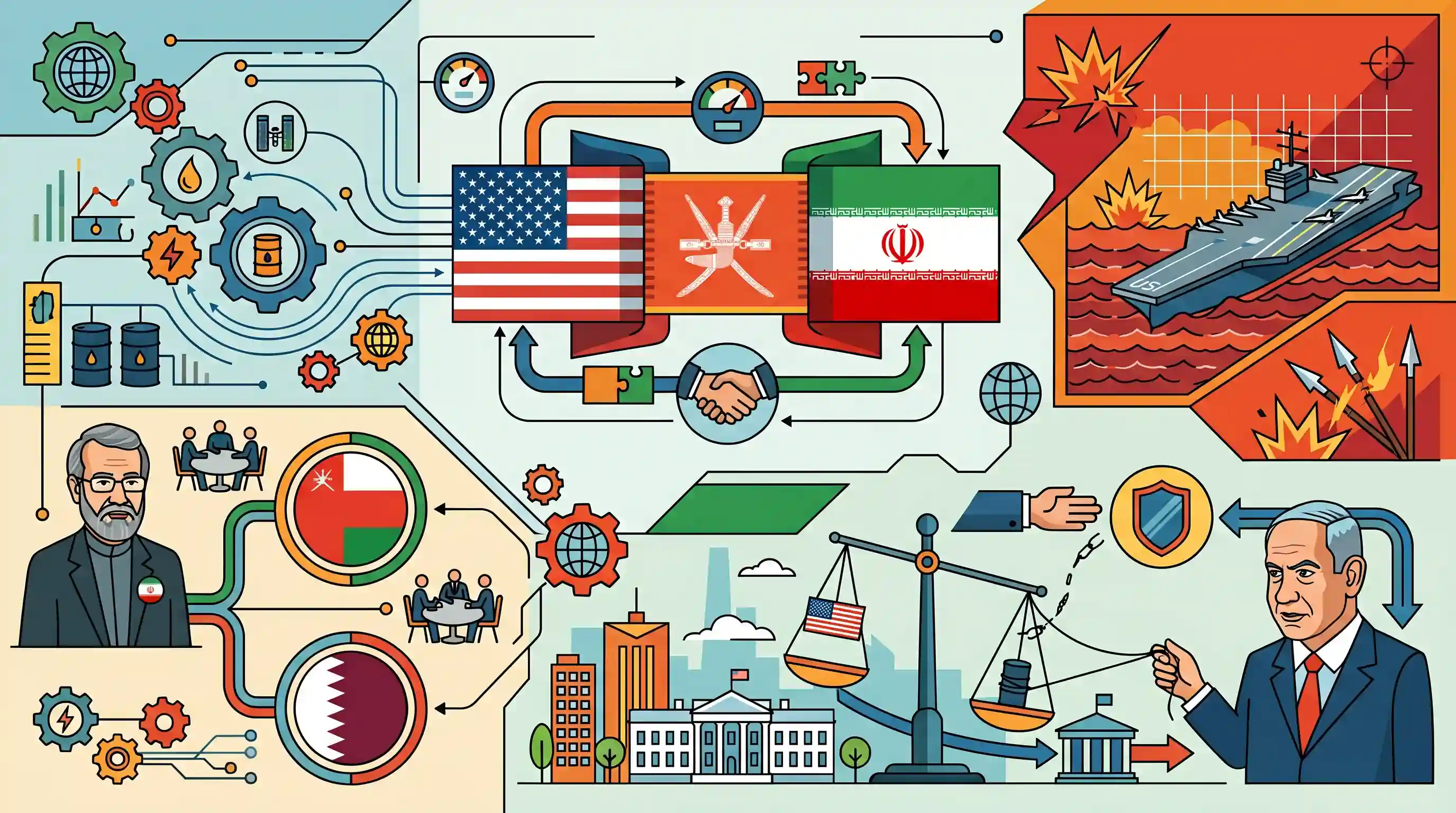
Iran stated that recent indirect nuclear negotiations with the United States, facilitated by Omani mediators, were useful for gauging Washington's seriousness and revealed sufficient consensus to proceed with the diplomatic track. The talks occur amid heightened tensions following US President Donald Trump's deployment of a naval flotilla to the region, which had prompted fears of renewed military conflict. Meanwhile, Ali Larijani, an advisor to Iran’s Supreme Leader, is holding talks in Oman and Qatar. Furthermore, Iran’s foreign ministry urged the US to formulate its policies independently of Israeli pressures, as Israeli Prime Minister Benjamin Netanyahu is anticipated to visit Washington.
Key Points
- Indirect nuclear talks between Iran and the US were recently held through Omani mediators in Muscat.
- Iran's Foreign Ministry stated that the negotiations helped gauge Washington's seriousness and demonstrated sufficient consensus to continue diplomacy.
- The talks take place amid heightened regional tensions following the US deployment of a naval flotilla by President Donald Trump.
- Ali Larijani, an advisor to Iran's Supreme Leader, is conducting diplomatic visits to Oman and Qatar to discuss regional issues.
- Iran urged the US to formulate its policies independently of Israel, anticipating an upcoming visit by the Israeli Prime Minister to Washington.
Important Terms
JCPOA (Joint Comprehensive Plan of Action)

A 2015 landmark agreement between Iran and the P5+1 powers to limit Tehran's nuclear program in exchange for sanctions relief; its status remains a core issue in US-Iran relations.
UPSC context
GS Paper II (International Relations): Essential for understanding global non-proliferation efforts and diplomatic negotiations in West Asia.
Strategic Autonomy
India's foreign policy principle of making independent decisions based on national interest, balancing relationships with competing global powers without joining formal military alliances.
UPSC context
GS Paper II (India's Foreign Policy): Tests the ability to analyze India's diplomatic balancing act between Iran, Israel, and the US.
Strait of Hormuz
A vital maritime chokepoint between the Persian Gulf and the Gulf of Oman, carrying approximately 20-30% of global oil and LNG shipments.
UPSC context
GS Paper I (Geography) and III (Energy Security): Critical for assessing global trade vulnerabilities and India's energy security risks.
West Asia Geopolitics
The strategic landscape of the Middle East, characterized by power struggles between Iran, Israel, and Arab nations, influenced by energy interests and global power dynamics.
UPSC context
GS Paper II (Effect of Policies of Developed/Developing Countries): Significant for India's economic stability, energy security, and diaspora interests.
Oman (Mediator Role)
The Sultanate of Oman's role as a neutral diplomatic intermediary, often hosting "back-channel" or indirect negotiations (Muscat Channel) between hostile states like the US and Iran.
UPSC context
GS Paper II (International Relations): Tests knowledge of regional diplomacy and conflict resolution mechanisms in a volatile region.
Nuclear Diplomacy
The use of negotiations and international agreements to prevent the spread of nuclear weapons, typically involving enrichment limits, IAEA inspections, and verification regimes.
UPSC context
GS Paper II (International Treaties): Evaluates understanding of global security frameworks and international non-proliferation standards.
Prelims Trap
"The Strait of Hormuz is bordered by Iran to the north and the United Arab Emirates to the south."
The southern coast of the Strait of Hormuz is formed by the Musandam Peninsula. This territory is actually an exclave of Oman, not the UAE.
Static Concepts Connected
What is the geographical and strategic significance of the Strait of Hormuz?
- Location: It is a critical maritime chokepoint connecting the Persian Gulf to the Gulf of Oman and the broader Arabian Sea.
- Bordering Nations: Bounded by Iran to the north and Oman (via the Musandam Peninsula) to the south.
- Economic Chokepoint: It facilitates the transit of roughly 20% of global oil consumption, making it vital for India's energy security.
What were the core components of the 2015 JCPOA agreement?
- The P5+1: Signed between Iran, the EU, and the P5+1 (US, UK, France, Russia, China, plus Germany).
- The Deal: Lifted crippling economic and financial sanctions on Iran in exchange for strict, verifiable limits on its nuclear program.
- US Withdrawal: The US unilaterally withdrew in 2018 under President Trump, prompting Iran to eventually exceed the agreed uranium enrichment limits.
Cross-Topic Patterns
Iran tensions & INSTC viability
Escalation in the Persian Gulf threatens India's strategic connectivity investments, specifically the Chabahar port and the International North-South Transport Corridor (INSTC) bypassing Pakistan.
I2U2 vs. Iran engagement
India balances the Middle East through strategic autonomy, participating in the US-Israel I2U2 grouping while independently maintaining crucial energy and transit ties with Tehran.

Map-based questions on the Strait of Hormuz/Oman exclave or MCQs pairing US-Iran tensions with INSTC viability are highly likely in 2026.
Linked PYQs · 2
Linked PYQs · 2
- 2025MainsGS2
"Energy security constitutes the dominant kingpin of India's foreign policy, and is linked with India's overarching influence in Middle Eastern countries.” How would you integrate energy security with India's foreign policy trajectories in the coming years?
- 2022MainsGS2
How will I2U2 (India, Israel, UAE and USA) grouping transform India's position in global politics?
