Iran defends ballistic missile program as non-negotiable asset
Source:The Hindu ↗
Why It Matters
The persistent conflict and nuclear friction between Iran and Israel directly affect Middle Eastern stability. For India, prolonged instability in West Asia poses severe threats to energy security, diaspora safety, and regional connectivity corridors.
Summary
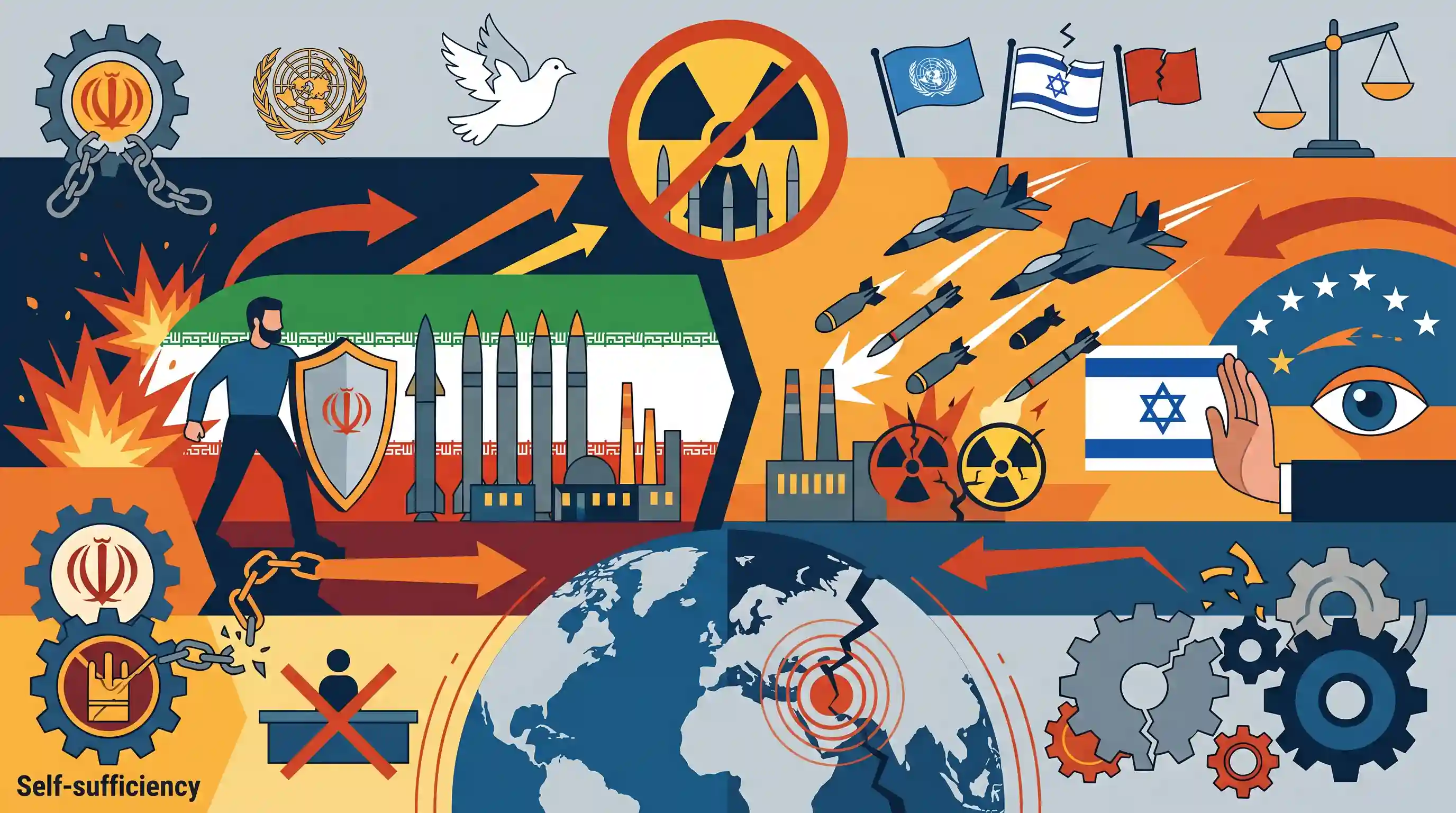
Iran has reaffirmed that its ballistic missile programme is defensive and completely non-negotiable, responding to ongoing pressure from Israel and the West. This assertion comes in the wake of a brief 12-day war in June 2025, during which Israel, briefly supported by the U.S., launched direct strikes against Iranian military and nuclear facilities. While Israel perceives Iran's weapons programs as an existential threat and contemplates further strikes, Iran maintains that its robust domestic arms industry—built post-1979 revolution due to broken U.S. ties—is essential for its national security. The escalating tensions pose severe risks to West Asian stability and global non-proliferation efforts.
Key Points
- Iran has explicitly stated that its ballistic missile programme is purely defensive and non-negotiable.
- This declaration follows a 12-day conflict in June 2025, sparked by unprecedented Israeli attacks on Iranian nuclear and military installations.
- Israel considers Iran's nuclear and missile capabilities an existential threat and has suggested potential future strikes to prevent their reconstruction.
- Iran's domestic arms industry was developed out of necessity following the 1979 Islamic revolution and the subsequent severing of relations with the US.
Important Terms
Joint Comprehensive Plan of Action (JCPOA)

A 2015 landmark agreement between Iran and the P5+1 powers to limit Iran's nuclear activities in exchange for lifting international economic sanctions.
UPSC context
GS Paper 2: International Relations. Crucial for understanding global non-proliferation, energy security, and India's 'Link West' policy.
International Atomic Energy Agency (IAEA)
An autonomous UN-linked organization that promotes peaceful nuclear energy use and verifies non-proliferation through safeguards and inspections of national nuclear facilities.
UPSC context
GS Paper 2: International Institutions. Tests knowledge of global governance and the verification of international treaties.
Ballistic Missile Programme (Iran)
Iran's domestic development of long-range missiles, which it asserts is a defensive deterrent and non-negotiable for national security despite international pressure.
UPSC context
GS Paper 2: International Relations. Relevant to regional security, asymmetric warfare, and the defense-industrial complex of middle powers.
West Asia Geopolitics
The complex interplay of political, economic, and military interests in the Middle East, primarily defined by the Iran-Israel rivalry and US-Iran tensions.
UPSC context
GS Paper 2: Regional/Global Groupings. Essential for India's energy security, diaspora safety, and connectivity projects like Chabahar.
Strategic Autonomy
The ability of a state to pursue national interests and foreign policy independently, often through domestic defense production and resisting external alliances.
UPSC context
GS Paper 2: Foreign Policy. A frequent theme in Indian and Iranian diplomacy regarding sovereignty and self-reliance.
12-Day War (June 2025)
A June 2025 conflict where Israel launched strikes on Iranian nuclear and military sites, significantly damaging Iran's missile launchers and accelerating regional tensions.
UPSC context
GS Paper 2: International Relations. Represents a critical escalation point in contemporary West Asian security dynamics.
Prelims Trap
Due to its contested nuclear weapons program, Iran, like Israel and India, is not a signatory to the Non-Proliferation Treaty (NPT).
Iran is actually a founding signatory to the NPT. The geopolitical friction centers entirely on its compliance with IAEA safeguards and uranium enrichment limits, not its membership status.
Static Concepts Connected
What are the core parameters of the Missile Technology Control Regime (MTCR)?
- Primary Objective: To limit the spread of ballistic missiles and UAVs capable of delivering a 500 kg payload over a range of 300 km or more (Category I items).
- Legal Status: It is an informal political understanding among 35 member states, not a legally binding international treaty under the UN framework.
- Membership Contrast: India is a formal member of the MTCR (joined in 2016), whereas Iran, Israel, Pakistan, and China are not members.
What is the legal difference between the NPT and the JCPOA?
- NPT Framework: A binding global treaty (1968) requiring non-nuclear weapon states (like Iran) to pledge not to acquire nuclear weapons, subject to baseline IAEA safeguards.
- JCPOA Provisions: A specific 2015 political agreement (P5+1 and Iran) that imposed stricter, temporary curbs on Iran's enrichment and mandated the IAEA Additional Protocol for snap inspections.
Cross-Topic Patterns
Strait of Hormuz + India's Energy Security
Iran-Israel direct state conflict raises the risk of blockades in the Strait of Hormuz, directly linking West Asian security crises to India's imported inflation, Current Account Deficit, and Strategic Petroleum Reserves.
Hypersonic Tech vs Ballistic Interceptors
Iran's Fattah missile links IR to Science & Tech. Aspirants must contrast traditional parabolic ballistic trajectories with the maneuverable, low-altitude glide of hypersonic missiles that evade traditional exo-atmospheric interceptors.

Expect 2026 Prelims to test MTCR/NPT membership pairings (India, Iran, Israel) combined with the physics of hypersonic vs ballistic flight.
Linked PYQs · 3
Linked PYQs · 3
- 2018MainsGS2
In what ways would the ongoing US-Iran Nuclear Pact Controversy affect the national interest of India? How should India respond to this situation?
- 2015PrelimsGS1
The area known as 'Golan Heights' sometimes appears in the news in the context of the events related to
- 2023PrelimsGS1
Consider the following statements: Statement-I: Israel has established diplomatic relations with some Arab States. Statement-II: The 'Arab Peace Initiative' mediated by Saudi Arabia was signed by Israel and Arab League. Which one of the following is correct in respect of the above statements?
