Iran Wartime Internal Security Measures and Surveillance Actions
Source:Indian Express ↗
Why It Matters
Understanding the domestic fallout of the Iran-Israel war is important for evaluating the broader geopolitical stability of the Middle East, a critical region for India's energy security and foreign policy. It also sheds light on state responses, internal security apparatuses, and human rights issues during modern wartime crises.
Summary
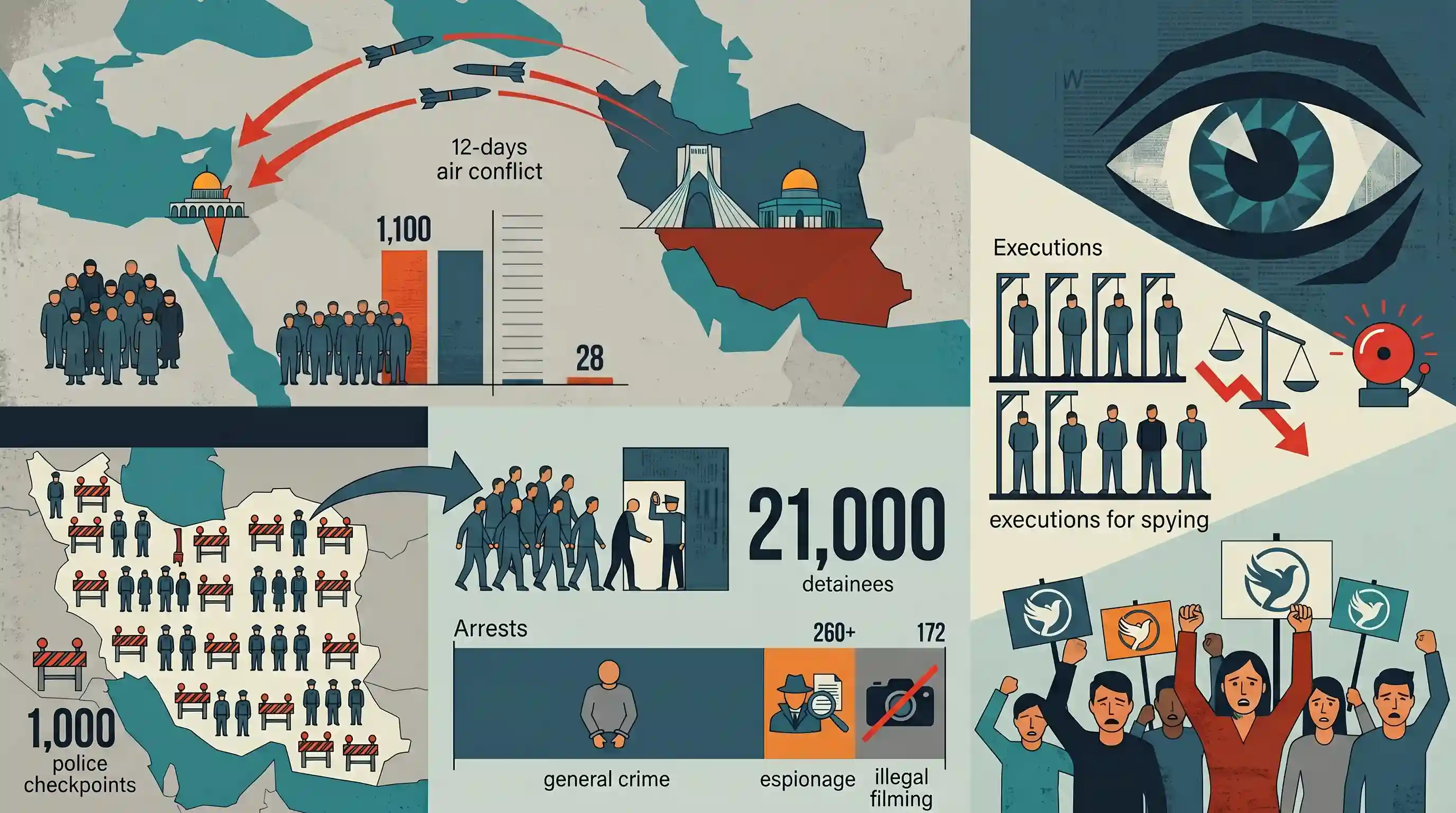
Iran reported detaining 21,000 suspects during its 12-day air war with Israel in June 2025, deploying over 1,000 checkpoints nationwide. While most arrests targeted general crime, over 260 individuals were held on espionage charges and 172 for illegal filming. Following the conflict, which claimed nearly 1,100 Iranian and 28 Israeli lives, Iran has executed seven individuals convicted of spying for Israel, raising alarm among human rights activists over wartime internal security measures and state surveillance.
Key Points
- Iran's police detained 21,000 suspects during the 12-day air war with Israel in June 2025.
- The arrests included over 260 individuals suspected of spying and 172 for illegal filming.
- Wartime security measures involved setting up over 1,000 police checkpoints across the country.
- Seven men have been executed by Iran for allegedly spying for Israel since the end of the conflict, sparking human rights concerns.
- The conflict resulted in the deaths of nearly 1,100 people in Iran and 28 in Israel.
Important Terms
West Asia Geopolitics

The strategic interactions and power dynamics between nations in the Middle East, driven by regional rivalries, energy resources, and the influence of external global powers.
UPSC context
GS-II: International Relations; crucial for India's energy security, diaspora welfare, and strategic balancing between rival powers.
Internal Security
The maintenance of peace, law, and order within a nation's borders by state agencies, focusing on countering threats like espionage, terrorism, and civil unrest.
UPSC context
GS-III: Security; tests understanding of state responses to external threats manifesting internally through surveillance and detentions.
Espionage
The act of obtaining secret political or military information without permission; in Iran's 2025 conflict, hundreds were detained for alleged collaboration with foreign intelligence agencies.
UPSC context
GS-III: Security; relates to intelligence-led threats and the legal framework for handling state secrets during wartime.
Human Rights
Fundamental rights inherent to all individuals; concerns often arise during conflicts regarding arbitrary detentions, the right to fair trials, and the use of capital punishment.
UPSC context
GS-II: Governance & Social Justice; tests knowledge of international norms, ethics of executions, and state accountability during emergencies.
FARAJA (Law Enforcement Force of Iran)
The primary law enforcement agency of Iran, responsible for nationwide policing and border control; it carried out 21,000 detentions during the June 2025 conflict.
UPSC context
GS-II/III: International Relations/Security; understanding foreign security mandates and their role in regional conflicts impacting global order.
Strait of Hormuz
A strategically vital waterway between the Persian Gulf and the Gulf of Oman, serving as the world's most important chokepoint for global oil supplies.
UPSC context
GS-I/II/III: Geography/IR/Energy Security; tests knowledge of maritime trade routes and India’s vulnerability to energy supply disruptions.
Prelims Trap
Iran and Israel share a land border in the Middle East.
Despite fighting a direct 'air war' and being primary regional adversaries, Iran and Israel do not share a border. They are separated by Iraq, Syria, and Jordan.
Static Concepts Connected
What are the key maritime chokepoints critical to Middle East energy trade?
- Strait of Hormuz: Located between Iran and Oman/UAE; it forms the strategic chokepoint connecting the Persian Gulf to the Gulf of Oman and the Arabian Sea.
- Bab el-Mandeb: Located between Yemen and Djibouti/Eritrea; it serves as the crucial link connecting the Red Sea to the Gulf of Aden and the Indian Ocean.
How does Indian law handle espionage and offenses against the State?
- Official Secrets Act: The colonial-era 1923 Act remains the primary Indian legislation criminalizing spying, unauthorized entry into restricted areas, and sharing of state secrets.
- BNS Offenses: The Bharatiya Nyaya Sanhita (BNS) penalizes acts like waging war against the Government of India, which can attract the death penalty.
- Preventive Detention: Under Article 22, the state can utilize laws like the National Security Act for preventive detention to preemptively neutralize threats during wartime.
Cross-Topic Patterns
Wartime surveillance vs. Article 21
Iran's mass detentions mirror the perennial debate in India over balancing national security laws (like NSA or UAPA) with fundamental constitutional civil liberties during extraordinary national crises.
Geopolitics and imported inflation
Escalations in the Iran-Israel conflict threaten global crude oil supply chains through the Strait of Hormuz, risking imported inflation and a widened current account deficit for India.

Map-based questions on Iran's borders, Strait of Hormuz, and Chabahar Port are highly probable in 2026 amidst ongoing regional conflict.
Linked PYQs · 3
Linked PYQs · 3
- 2025MainsGS2
"Energy security constitutes the dominant kingpin of India's foreign policy, and is linked with India's overarching influence in Middle Eastern countries.” How would you integrate energy security with India's foreign policy trajectories in the coming years?
- 2018MainsGS2
“India’s relations with Israel have, of late, acquired a depth and diversity, which cannot be rolled back.” Discuss.
- 2023MainsGS3
What are the internal security challenges being faced by India? Give out the role of Central Intelligence and Investigative Agencies tasked to counter such threats.
