Strait of Hormuz Closure and Energy Security Risks for India
Source:The Hindu ↗
Why It Matters
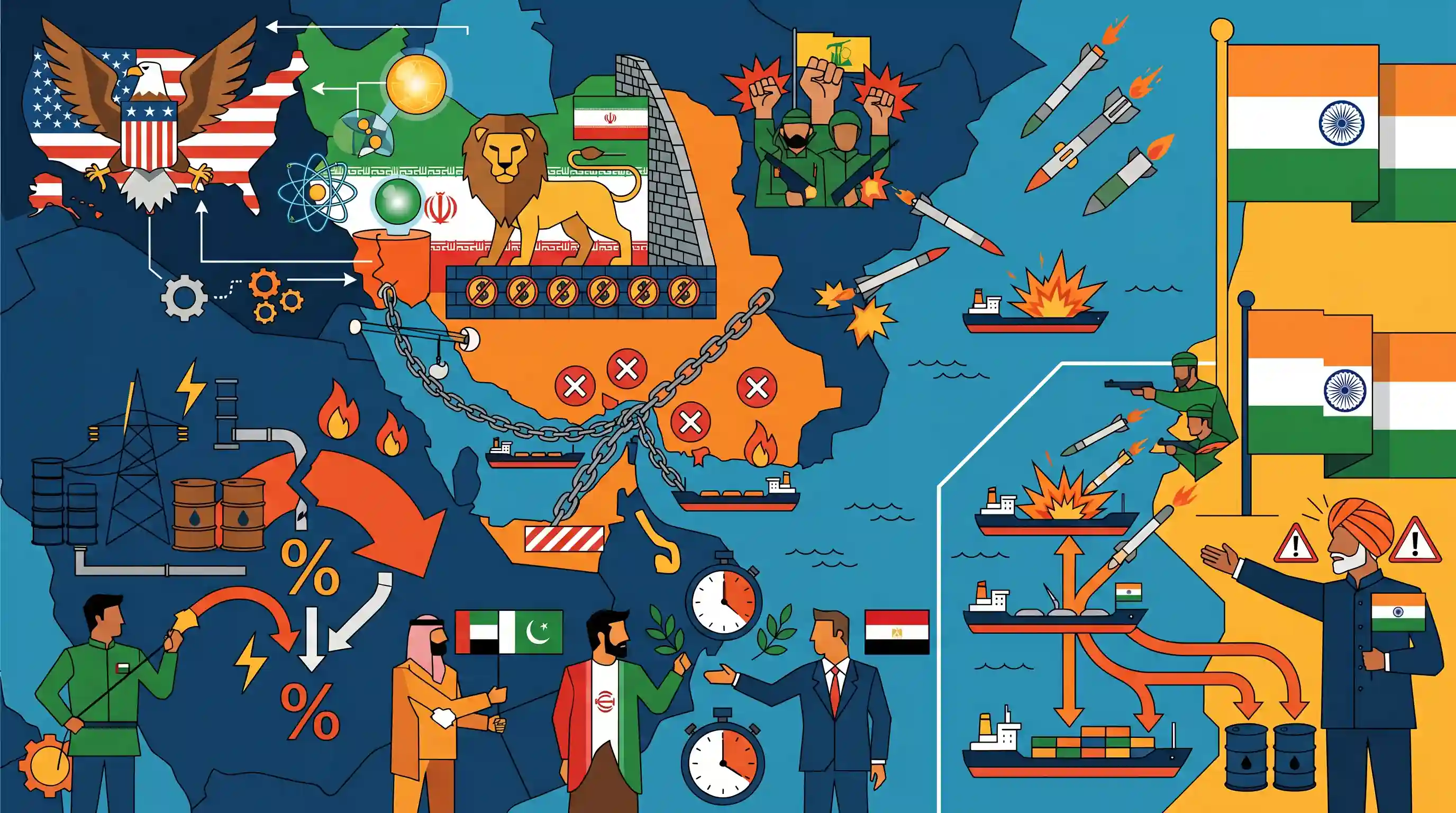
The Strait of Hormuz is a vital geopolitical chokepoint for global energy flows. Its closure directly impacts India's energy security and inflation levels. Furthermore, attacks on Indian-flagged vessels and the broader regional instability in West Asia have direct implications for India's diplomatic engagements, diaspora safety, and strategic autonomy, making it a highly relevant issue for GS2 (International Relations) and GS3 (Energy Security/Economy).
Summary
Iran has announced that a final nuclear deal with the United States remains "far off," as it refuses to reopen the strategic Strait of Hormuz until the U.S. lifts its blockade on Iranian ports. The closure of the strait—a critical maritime chokepoint through which 20% of the world’s oil and LNG transits—has severely disrupted global energy supplies. While Pakistan and Egypt are attempting to mediate amidst an impending ceasefire deadline, tensions remain high. The U.S. is demanding the surrender of Iran's highly enriched uranium, and the regional conflict has expanded with incidents involving Hezbollah in Lebanon and the targeting of commercial vessels. Notably, India has launched diplomatic protests after Iranian forces fired upon Indian-flagged ships, highlighting the direct threat to India's maritime and energy security.
Key Points
- Iran has stated that a final nuclear agreement with the U.S. is distant, conditioning the reopening of the Strait of Hormuz on the lifting of U.S. blockades on Iranian ports.
- The U.S. insists on Iran handing over its stockpiles of near-weapons-grade enriched uranium before progressing on a final deal.
- The blockade of the Strait of Hormuz, a critical maritime chokepoint handling a fifth of global oil and LNG, has heavily disrupted global energy markets and supply chains.
- Pakistan and Egypt are actively mediating to de-escalate the standoff before a temporary ceasefire expires.
- India has summoned the Iranian ambassador to lodge a formal protest after the Revolutionary Guards targeted Indian-flagged commercial vessels in the region.
Important Terms
Joint Comprehensive Plan of Action (JCPOA)

A 2015 agreement between Iran and the P5+1 (USA, UK, France, China, Russia, and Germany) to limit Iran's nuclear program in exchange for lifting international sanctions.
UPSC context
GS Paper II (IR); critical for West Asia geopolitics, nuclear non-proliferation, and India’s energy security/connectivity interests.
Strait of Hormuz
A strategic waterway between Oman and Iran connecting the Persian Gulf with the Gulf of Oman; it is the world’s most critical oil transit chokepoint.
UPSC context
GS Paper I (Geography) and GS II; essential for analyzing global energy supply chains and maritime security.
Islamic Revolutionary Guard Corps (IRGC)
An elite branch of Iran’s military, independent of the regular army, tasked with defending the country’s Islamic system and overseeing regional paramilitary operations.
UPSC context
GS Paper II (IR); key to understanding Iranian influence in West Asia and regional security dynamics.
Hezbollah
A Lebanese Shia militant group and political party backed by Iran. It operates as a powerful non-state actor and a primary member of the "Axis of Resistance."
UPSC context
GS Paper II (IR); important for studying proxy warfare, regional conflicts in West Asia, and international security.
Maritime Chokepoint
A narrow geographical passage, such as a strait or canal, that funnels significant global shipping and energy traffic, creating strategic and economic vulnerabilities.
UPSC context
GS Paper I (Geography) and GS III; vital for questions on global trade routes and sea-lane protection.
Uranium Enrichment
The process of increasing the concentration of the isotope Uranium-235 to make it suitable for nuclear fuel or, at higher levels, nuclear weapons.
UPSC context
GS Paper III (S&T/Security); fundamental to nuclear diplomacy, IAEA safeguards, and global non-proliferation regimes.
Prelims Trap
The Strait of Hormuz is a critical maritime chokepoint connecting the Red Sea to the Arabian Sea.
The Strait of Hormuz connects the Persian Gulf to the Gulf of Oman. The Bab el-Mandeb connects the Red Sea to the Gulf of Aden. Map-based geographical swaps are a classic UPSC trap.
Static Concepts Connected
What are the key maritime chokepoints in West Asia and their connecting water bodies?
- Strait of Hormuz: Connects the Persian Gulf to the Gulf of Oman and Arabian Sea. Bordered by Iran to the north, and Oman and the UAE to the south.
- Bab el-Mandeb: Connects the Red Sea to the Gulf of Aden and the Indian Ocean. Flanked by Yemen on the Arabian Peninsula, and Djibouti and Eritrea in Africa.
What distinguishes Low Enriched Uranium (LEU) from Highly Enriched Uranium (HEU)?
- Low Enriched Uranium: Contains roughly 3-5% of the fissile U-235 isotope. It is typically used to fuel commercial light-water nuclear power reactors for civil energy generation.
- Highly Enriched Uranium: Contains 20% or more U-235. Weapons-grade uranium, necessary for nuclear warheads, requires an enrichment level of approximately 90% U-235.
Cross-Topic Patterns
Chabahar Strategy + US Sanctions
US blockades on Iranian ports threaten India's operational control at Chabahar, jeopardizing the International North-South Transport Corridor (INSTC) strategy to bypass Pakistan for Central Asian access.
Maritime Chokepoints + Imported Inflation
Closure of Hormuz halts 20% of global oil and LNG, causing crude price spikes. For India, this translates directly to widened Current Account Deficits (CAD) and imported inflation.

Expect a Prelims question pairing West Asian straits (Hormuz, Bab el-Mandeb) with bordering nations and current conflict actors in 2026.
Linked PYQs · 3
Linked PYQs · 3
- 2018MainsGS2
In what ways would the ongoing US-Iran Nuclear Pact Controversy affect the national interest of India? How should India respond to this situation?
- 2017MainsGS2
The question of India's Energy Security constitutes the most important part of India's economic progress. Analyze India's energy policy cooperation with West Asian countries.
- 2024PrelimsGS1
Consider the following statements : Statement-I : Sumed pipeline is a strategic route for Persian Gulf oil and natural gas shipments to Europe. Statement-II : Sumed pipeline connects the Red Sea with the Mediterranean Sea. Which one of the following is correct in respect of the above statements?
