US Iran nuclear negotiations and West Asian maritime security
Source:The Hindu ↗
Why It Matters
The US-Iran dynamic and the status of the Strait of Hormuz are critical to global energy security. For India, instability in West Asia directly impacts crude oil supplies, the safety of the Indian diaspora, and strategic investments like the Chabahar port. Furthermore, geographical locations like the Litani River and the Levant are frequent targets for UPSC Prelims mapping questions.
Summary
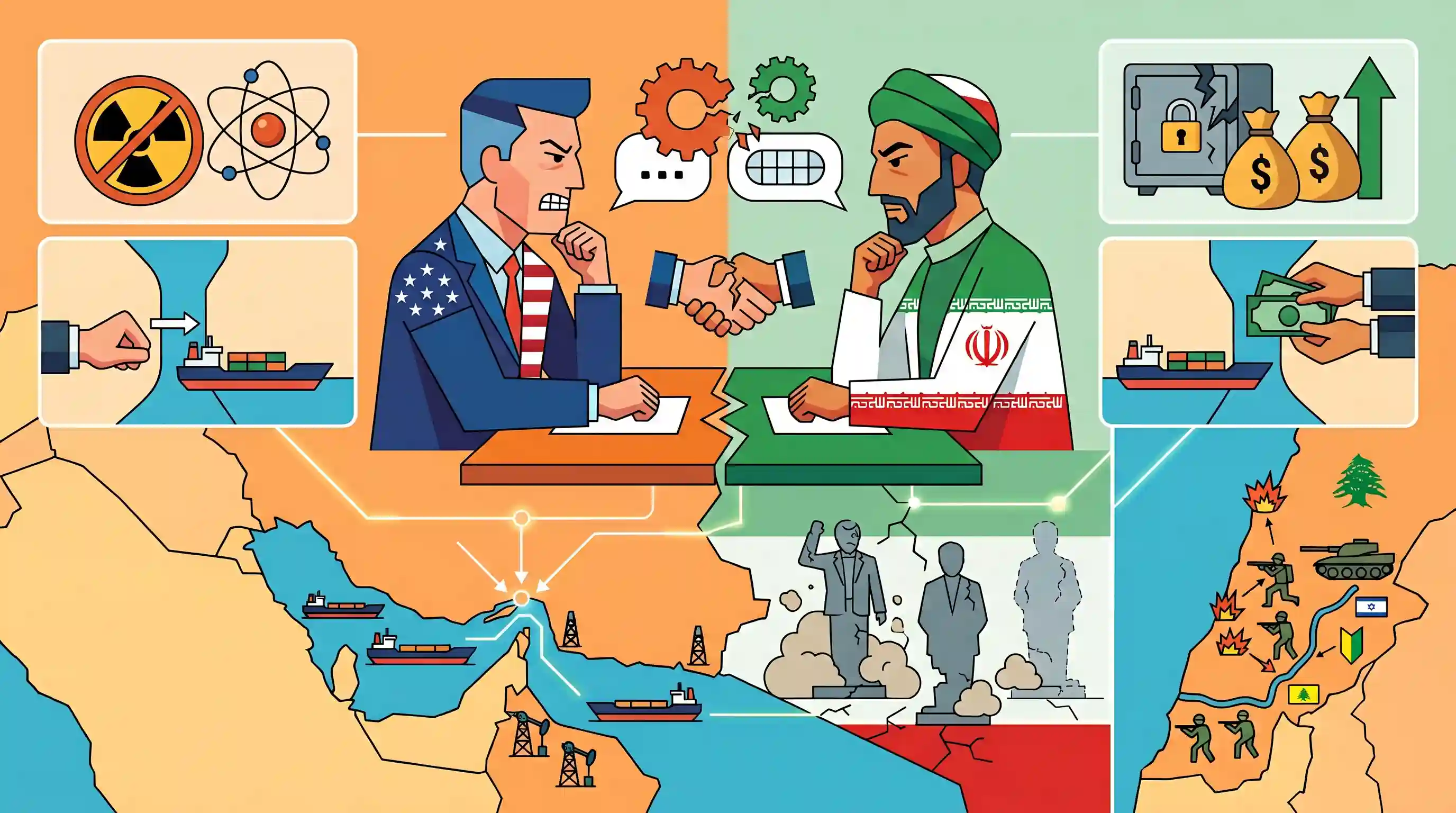
The article outlines the strained negotiations between Iran and the Trump administration over a new regional and nuclear framework. Iran's chief negotiator, Mohammad Bagher Ghalibaf, stated that Tehran distrusts the US due to its tougher terms, which include a strict ban on Iranian nuclear weapons and unrestricted, toll-free access through the Strait of Hormuz. Iran, recovering from the loss of senior leadership in earlier US-Israeli strikes, demands the unfreezing of $12 billion in assets and the right to levy administrative fees on maritime traffic in the Strait. This geopolitical friction is further complicated by the ongoing conflict in Lebanon, where Israeli forces have crossed the Litani River to combat Hezbollah.
Key Points
- Iran's chief negotiator Mohammad Bagher Ghalibaf expressed profound distrust of the US following a tougher new regional and nuclear peace framework proposed by the Trump administration.
- The US terms demand strict guarantees against Iranian nuclear weapons development and insist on toll-free transit through the Strait of Hormuz.
- In response, Iran is demanding the release of $12 billion in frozen assets and asserts its right to charge 'administrative fees' for vessels navigating the Strait of Hormuz.
- The negotiations occur against the backdrop of a broader West Asian conflict, where Israeli forces have advanced into Lebanon, crossing the Litani river and capturing Beaufort from Hezbollah.
- Iran is negotiating from a weakened position after losing much of its senior leadership to US and Israeli operations earlier in the year.
Important Terms
Strait of Hormuz

A strategic maritime chokepoint between the Persian Gulf and Gulf of Oman. It is the world's most vital oil transit route, handling roughly 20-21% of global petroleum liquids daily.
UPSC context
GS Paper 1 (World Geography - Locations) and GS Paper 2 (International Relations/Energy Security). Tests understanding of global energy chokepoints and maritime geopolitics.
Litani River
A river in southern Lebanon serving as a critical strategic boundary. Israel seeks a security buffer south of the river to prevent Hezbollah incursions and rocket fire into northern Israel.
UPSC context
GS Paper 1 (Geography) and GS Paper 2 (International Relations). Crucial for questions on West Asian conflicts and UN-mandated security zones.
UN Security Council Resolution 1701
A 2006 UN mandate aimed at ending the Israel-Hezbollah war. It requires the area between the Israeli border and the Litani River to be free of unauthorized armed personnel and weapons.
UPSC context
GS Paper 2 (International Relations - Global Institutions). Relevant for discussions on peace-keeping, sovereignty, and conflict resolution frameworks in the Middle East.
Hezbollah
An Iran-backed Shia militant group and political party based in Lebanon. It is a key actor in regional "Axis of Resistance" and a primary adversary of Israel in the north.
UPSC context
GS Paper 2 (IR) and GS Paper 3 (Security). Tests knowledge of non-state actors, proxy warfare, and West Asian security dynamics.
Mohammad Bagher Ghalibaf
The Speaker of the Iranian Parliament and a top negotiator in high-stakes diplomatic talks with the U.S. regarding the nuclear framework and regional security.
UPSC context
GS Paper 2 (International Relations). Important for identifying key leadership figures shaping the foreign policy and negotiation strategies of major regional powers.
Persian Gulf Strait Authority (PGSA)
A body reportedly established by Tehran to manage maritime traffic and levy "administrative fees" or tolls on commercial vessels transiting the strategic Strait of Hormuz.
UPSC context
GS Paper 2 (International Relations/Maritime Security). Tests understanding of sovereignty claims over international waterways and their impact on global trade and law.
Prelims Trap
Iran has the sovereign right under UNCLOS to levy administrative transit tolls in the Strait of Hormuz.
International straits fall under the 'transit passage' regime (unimpeded, toll-free). Furthermore, Iran signed but never ratified UNCLOS, asserting customary 'innocent passage' instead.
Static Concepts Connected
How does UNCLOS regulate navigation in international straits like Hormuz?
- Transit Passage: This regime applies to straits used for international navigation, guaranteeing ships and aircraft unimpeded and toll-free transit, provided it is continuous and expeditious.
- No Suspension: Unlike innocent passage through standard territorial waters, transit passage cannot be suspended by the coastal state during peacetime for security reasons.
- Iran's Legal Stance: Iran signed UNCLOS in 1982 but never ratified it. Tehran argues that transit passage only applies to ratifying states, treating US vessels under customary 'innocent passage' rules instead.
What are the geographical parameters of the Litani River and Strait of Hormuz?
- Strait of Hormuz: A critical chokepoint linking the Persian Gulf to the Gulf of Oman and Arabian Sea. It is bordered by Iran to the north and Oman (Musandam peninsula) and UAE to the south.
- Litani River: The longest river entirely within Lebanon. It rises in the Bekaa Valley and flows into the Mediterranean Sea.
- UNSC Buffer Zone: The Litani River serves as a designated security buffer zone between Israel and Hezbollah, as mandated by United Nations Security Council Resolution 1701.
Cross-Topic Patterns
UNCLOS & maritime chokepoint vulnerabilities
Iran's threat to impose administrative tolls mirrors past debates around the Malacca Strait. UPSC frequently tests the geopolitical vulnerabilities of these maritime energy chokepoints alongside UNCLOS freedom of navigation regimes.
Mapping physical geography to conflict zones
The Israeli crossing of the Litani River integrates physical geography with contemporary conflict lines, mirroring past UPSC map questions on the Golan Heights, Gaza, and the West Bank.

Expect a 2026 Prelims map question pairing West Asian rivers (Litani, Jordan) with specific UN resolutions or border conflicts.
Linked PYQs · 5
Linked PYQs · 5
- 2018MainsGS2
In what ways would the ongoing US-Iran Nuclear Pact Controversy affect the national interest of India? How should India respond to this situation?
- 2012MainsGS2
How have the US sanctions against Iran affected India's bilateral relations with Iran?
- 2025MainsGS2
"Energy security constitutes the dominant kingpin of India's foreign policy, and is linked with India's overarching influence in Middle Eastern countries.” How would you integrate energy security with India's foreign policy trajectories in the coming years?
- 2022PrelimsGS1
The term "Levant" often heard in the news roughly corresponds to which of the following regions?
- 2023PrelimsGS1
Consider the following pairs: Regions often mentioned in news Reason for being in news 1. North Kivu and Ituri : War between Armenia and Azerbaijan 2. Nagorno-Karabakh : Insurgency in Mozambique 3. Kherson and Zaporizhzhia : Dispute between Israel and Lebanon How many of the above pairs are correctly matched?
