Iran halts cooperation with International Atomic Energy Agency
Source:The Hindu ↗
Why It Matters
The breakdown of Iran's cooperation with the IAEA and the triggering of the snapback sanctions mechanism have severe implications for Middle Eastern stability and global nuclear non-proliferation efforts. For India, tensions involving Iran directly affect energy security, connectivity projects like Chabahar Port, and regional geopolitics.
Summary
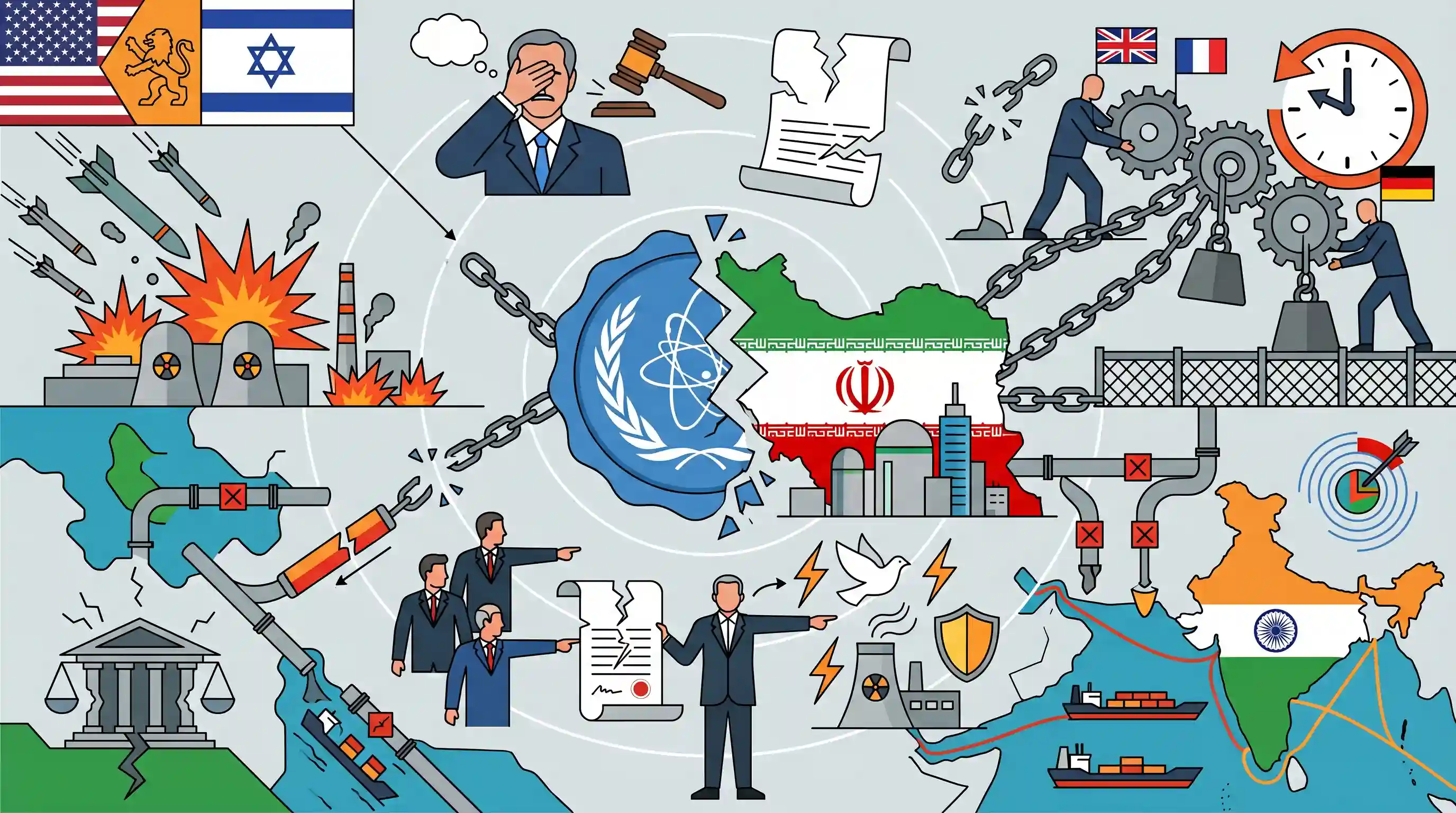
Iran has announced that its cooperation with the UN's nuclear watchdog, the International Atomic Energy Agency (IAEA), is "no longer relevant" due to the reimposition of international sanctions. This development follows the decision by Britain, France, and Germany (the E3) to trigger a "snapback" of UN sanctions against Tehran over non-compliance with nuclear commitments. Iran had previously suspended its cooperation with the IAEA, including a September 'Cairo agreement' on inspections, following Israeli and U.S. strikes on its key nuclear sites in June. Iran argues that the IAEA failed to condemn these attacks despite Iran's status as a signatory to the Non-Proliferation Treaty (NPT). Although some Iranian lawmakers have proposed leaving the NPT, President Masoud Pezeshkian maintains that Iran remains committed to the treaty and its right to peaceful nuclear enrichment.
Key Points
- Iran has declared its cooperation with the IAEA as 'no longer relevant' after the E3 (Britain, France, Germany) initiated a 'snapback' of UN sanctions over non-compliance.
- Tehran had already suspended cooperation and IAEA inspections following Israeli and U.S. strikes on its nuclear installations in June.
- Iran accuses the IAEA of failing to condemn the attacks on its nuclear sites, arguing it has the right to civilian nuclear enrichment under the NPT.
- Despite internal political pressure to withdraw from the NPT, President Masoud Pezeshkian confirmed Iran will remain committed to the treaty.
Important Terms
Non-Proliferation Treaty (NPT)

A 1970 landmark international treaty aimed at preventing the spread of nuclear weapons, promoting peaceful nuclear energy use, and further the goal of disarmament.
UPSC context
GS Paper II (International Relations). Crucial for understanding global nuclear governance and India's 'voluntary moratorium' stance on testing.
Cairo Agreement (2025)
A September 2025 technical arrangement between Iran and the IAEA to restore nuclear inspections following 2025 military strikes; Iran declared it 'invalid' after UN sanctions were reimposed.
UPSC context
GS Paper II. Relevant for studying regional security dynamics in West Asia and the breakdown of international verification frameworks.
Joint Comprehensive Plan of Action (JCPOA)
The 2015 agreement between Iran and the P5+1 powers (including E3) that limited Iran's nuclear activities in exchange for the lifting of international sanctions.
UPSC context
GS Paper II. Significant for India's energy security and connectivity projects like the Chabahar Port.
International Atomic Energy Agency (IAEA)
The UN's nuclear watchdog responsible for verifying that nuclear materials are not diverted for military use, operating under the 'Atoms for Peace and Development' mandate.
UPSC context
GS Paper II (International Institutions). Tests knowledge of global oversight bodies and India's civil nuclear agreements.
E3 (European Trio)
The diplomatic grouping of France, Germany, and the United Kingdom that leads European policy on Iran’s nuclear program and triggered the 2025 'snapback' sanctions.
UPSC context
GS Paper II. Highlights the role of major European powers in international security negotiations and their influence on global policy.
Snapback Mechanism
A provision under UN Security Council Resolution 2231 allowing JCPOA participants to automatically restore prior UN sanctions if Iran significantly violates the nuclear deal.
UPSC context
GS Paper II. Tests understanding of UN Security Council procedures and the legal complexities of international treaties.
Prelims Trap
"The 'Snapback' mechanism to restore UN sanctions against Iran requires a majority vote or consensus at the UN Security Council."
False. It allows any single original JCPOA participant to unilaterally trigger the reimposition of all UN sanctions, specifically designed to bypass P5 vetoes.
Static Concepts Connected
What is the IAEA's 'Additional Protocol' and its significance?
- Intrusive Inspections: Grants IAEA expanded rights to access information and locations, including short-notice intrusive inspections of undeclared sites to verify no diversion of nuclear material.
- UPSC Context: It places civilian nuclear facilities under strict IAEA safeguards. India's ratification of an Additional Protocol was previously tested in Prelims 2018.
- Iran Context: Iran previously suspended its voluntary implementation of the Additional Protocol to pressure the West, severely crippling the IAEA's visibility into its nuclear program.
What are the core pillars and recognized Nuclear-Weapon States under the NPT?
- Three Pillars: The treaty rests on non-proliferation, disarmament, and the right to peacefully use nuclear technology (Article IV, frequently cited by Iran).
- Recognized NWS: Only states possessing nuclear weapons prior to Jan 1, 1967: USA, Russia, UK, France, and China.
- Non-signatories: India, Israel, Pakistan, and South Sudan are non-signatories. North Korea withdrew in 2003.
Cross-Topic Patterns
UNSC Veto vs. Snapback Mechanism
The 'Snapback' provision in UNSCR 2231 acts as a rare legal workaround to the traditional P5 veto system, allowing Western powers to bypass Russian or Chinese opposition to reimpose sanctions.
Conventional conflict vs. Nuclear safeguards
Targeting nuclear sites blends conventional West Asian conflict (Israel-Iran) with global non-proliferation frameworks, severely complicating the IAEA's mandate to inspect and safeguard civilian nuclear facilities during active wartime.

Expect a Prelims question matching 'Snapback Mechanism' to JCPOA, or a multi-statement question on IAEA's inspection powers vs UN status.
Linked PYQs · 4
Linked PYQs · 4
- 2015PrelimsGS1
Consider the following countries: 1. China 2. France 3. India 4. Israel 5. Pakistan Which among the above are Nuclear Weapons States as recognized by the Treaty on the Non-Proliferation of Nuclear Weapons, commonly known as Nuclear Non-Proliferation Treaty (NPT)?
- 2018PrelimsGS1
In the Indian context, what is the implication of ratifying the 'Additional Protocol' with the 'International Atomic Energy Agency (IAEA)'?
- 2018MainsGS2
In what ways would the ongoing US-Iran Nuclear Pact Controversy affect the national interest of India? How should India respond to this situation?
- 2012MainsGS2
How have the US sanctions against Iran affected India's bilateral relations with Iran?
