Iran retaliates with missile strikes following Israeli attacks
Source:The Hindu ↗
Why It Matters
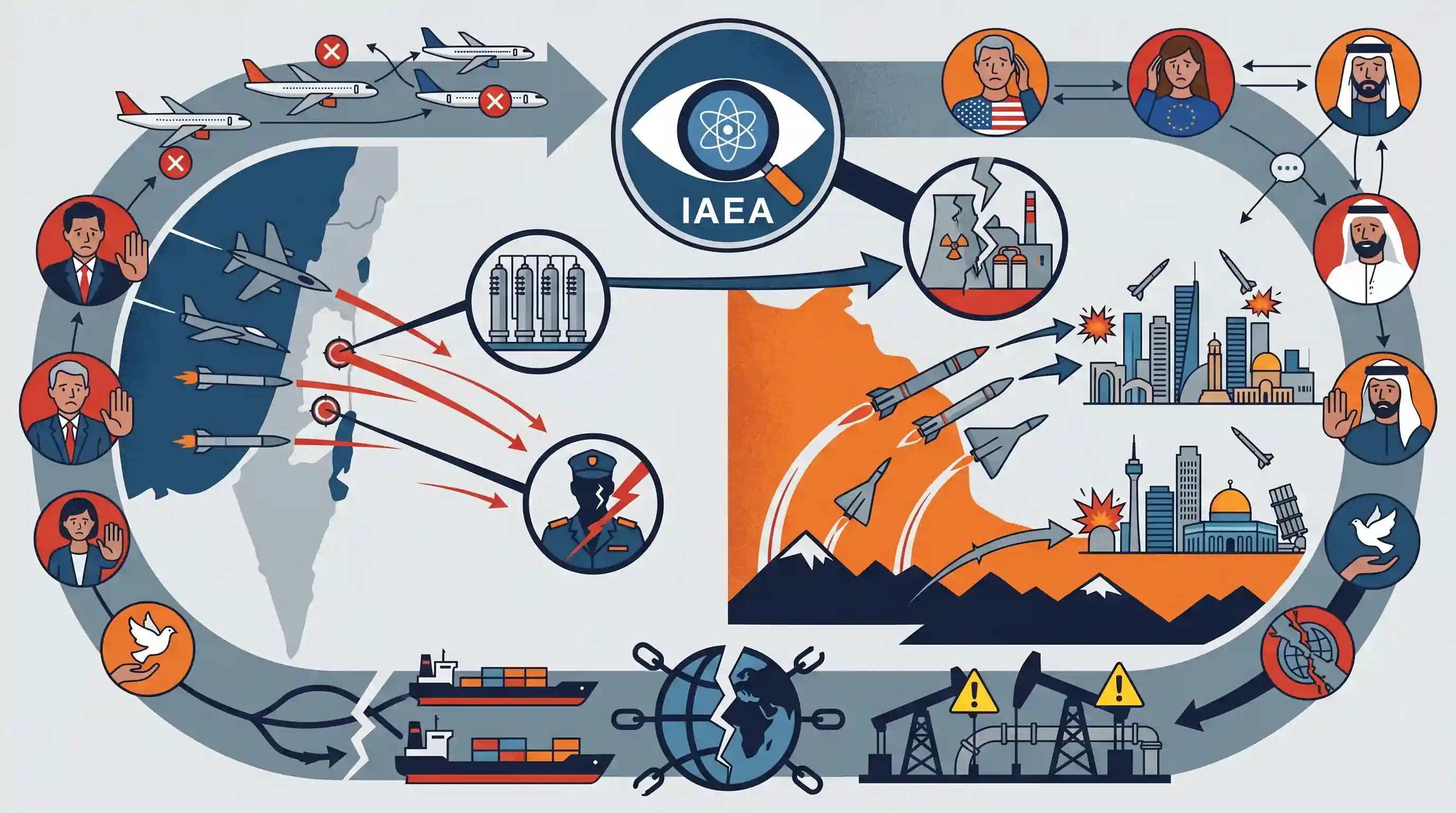
The Israel-Iran conflict directly impacts global energy markets and supply chains (impacting India's energy security), while raising concerns over nuclear proliferation, drone/missile warfare, and the efficacy of international bodies like the IAEA in monitoring nuclear programs.
Summary
Following Israeli airstrikes on Iran's nuclear and military facilities (including Natanz and Fordo) that killed top Iranian military leaders, Iran retaliated by launching ballistic missiles and drones at Israeli cities like Tel Aviv and Jerusalem. The UN's atomic watchdog, the IAEA, confirmed the destruction of the above-ground section of Iran's Natanz nuclear facility. The escalation has prompted global concerns, flight disruptions, and calls for de-escalation from the US and regional powers, highlighting the fragile geopolitical and security situation in the Middle East and its implications for global energy security and stability.
Key Points
- Iran launched a retaliatory strike using drones and ballistic missiles against Israeli cities following Israeli airstrikes on Iranian nuclear and military installations.
- The Israeli strikes resulted in the deaths of top Iranian military commanders, including Mohammad Bagheri and Hossein Salami.
- IAEA chief Rafael Grossi confirmed the destruction of the above-ground portion of Iran's Natanz nuclear facility, a key site for uranium enrichment.
- The escalating conflict has disrupted international aviation routes and heightened global concerns over wider regional instability and energy security.
Important Terms
IAEA (International Atomic Energy Agency)

The UN's nuclear watchdog (est. 1957) promotes peaceful nuclear energy and prevents military use through inspections and verification. It is currently monitoring Iran’s enrichment levels and facility safety.
UPSC context
GS Paper 2: International Institutions. Important for global governance and India's civil nuclear agreements.
IAEA Safeguards
Technical verification measures (inspections, monitoring) applied by the IAEA to ensure nuclear material and technology are not diverted from peaceful uses to weapons development.
UPSC context
GS Paper 3: Security; GS Paper 2: Nuclear Policy. Tests knowledge of non-proliferation mechanisms and India’s 'Additional Protocol' status.
Natanz and Fordow
Iran's two primary uranium enrichment sites. Natanz is the largest facility (above and underground), while Fordow is a heavily fortified underground site designed to withstand airstrikes.
UPSC context
GS Paper 2: International Relations/West Asia. Frequently featured in Prelims (Map-based) and Mains (Middle East security).
JCPOA (Joint Comprehensive Plan of Action)
The 2015 landmark agreement between Iran and P5+1 powers to limit Iran's nuclear activities in exchange for sanctions relief. It remains fragile following the 2018 U.S. withdrawal.
UPSC context
GS Paper 2: International Agreements. Crucial for understanding West Asian stability and its impact on India's energy and strategic interests.
Strait of Hormuz
A vital maritime chokepoint between the Persian Gulf and the Gulf of Oman, through which approximately 20% of global oil and LNG supplies flow.
UPSC context
GS Paper 1: World Geography; GS Paper 3: Energy Security. Critical for India’s crude oil supply and diaspora safety.
West Asia Geopolitics
The complex interplay of power, conflict, and diplomacy in the Middle East, currently dominated by the Iran-Israel rivalry and its impact on regional stability and global markets.
UPSC context
GS Paper 2: Effect of policies of developed/developing countries on India's interests. Focuses on India's 'Link West' policy.
Prelims Trap
"Like India and Israel, Iran is not a signatory to the Nuclear Non-Proliferation Treaty (NPT)."
Iran IS a signatory to the NPT. Its current standoff involves breaching JCPOA limits and suspending the IAEA Additional Protocol, not NPT withdrawal.
Static Concepts Connected
What is the IAEA Additional Protocol?
- Core Purpose: Grants the IAEA expanded legal rights to verify that a state has no undeclared nuclear material or activities.
- Intrusive access: Allows inspectors intrusive, short-notice access to all parts of a state's nuclear fuel cycle.
- India's status: India signed an 'India-specific' Additional Protocol in 2009, which is limited strictly to its declared civilian nuclear facilities.
What are the strategic geographical realities surrounding Iran?
- Strait of Hormuz: A critical global energy chokepoint connecting the Persian Gulf to the Gulf of Oman, handling over 20% of global oil consumption.
- Land borders: Shares land borders with seven nations: Iraq, Turkey, Armenia, Azerbaijan, Turkmenistan, Afghanistan, and Pakistan.
- Fortified nuclear sites: Facilities like Natanz and Fordo are deliberately built deep underground or into mountains to withstand conventional bunker-buster munitions.
Cross-Topic Patterns
I2U2 and IMEEC geoeconomic viability
Direct Israel-Iran warfare severely threatens the geoeconomic logic of the India-Middle East-Europe Economic Corridor (IMEEC) and the I2U2 grouping, requiring India to recalibrate its regional balancing act.
Asymmetric drone swarm warfare
Iran's reliance on Shahed-136 kamikaze drones highlights a global shift in defense tech toward cheap, swarm-capable UAV tactics, bypassing traditional air dominance.

Expect a 2026 map question pairing Iran's nuclear sites (Natanz/Fordo) with chokepoints (Hormuz) or a statement-based Q on IAEA protocols.
Linked PYQs · 5
Linked PYQs · 5
- 2018MainsGS2
In what ways would the ongoing US-Iran Nuclear Pact Controversy affect the national interest of India? How should India respond to this situation?
- 2025MainsGS2
"Energy security constitutes the dominant kingpin of India's foreign policy, and is linked with India's overarching influence in Middle Eastern countries.” How would you integrate energy security with India's foreign policy trajectories in the coming years?
- 2018PrelimsGS1
In the Indian context, what is the implication of ratifying the 'Additional Protocol' with the 'International Atomic Energy Agency (IAEA)'?
- 2020PrelimsGS1
In India, why are some nuclear reactors kept under "IAEA Safeguards" while others are not?
- 2023PrelimsGS1
Consider the following statements: Statement-I: India, despite having uranium deposits, depends on coal for most of its electricity production. Statement-II: Uranium, enriched to the extent of at least 60%, is required for the production of electricity. Which one of the following is correct in respect of the above statements?
