Iran Rejection of US Missile Program Allegations and Sanctions
Source:The Hindu ↗
Why It Matters
The ongoing standoff between the US and Iran over nuclear enrichment and ballistic missiles significantly impacts stability in West Asia. Any escalation or resolution directly influences global energy security, the safety of maritime trade routes like the Strait of Hormuz, and India's strategic investments and diaspora in the region.
Summary
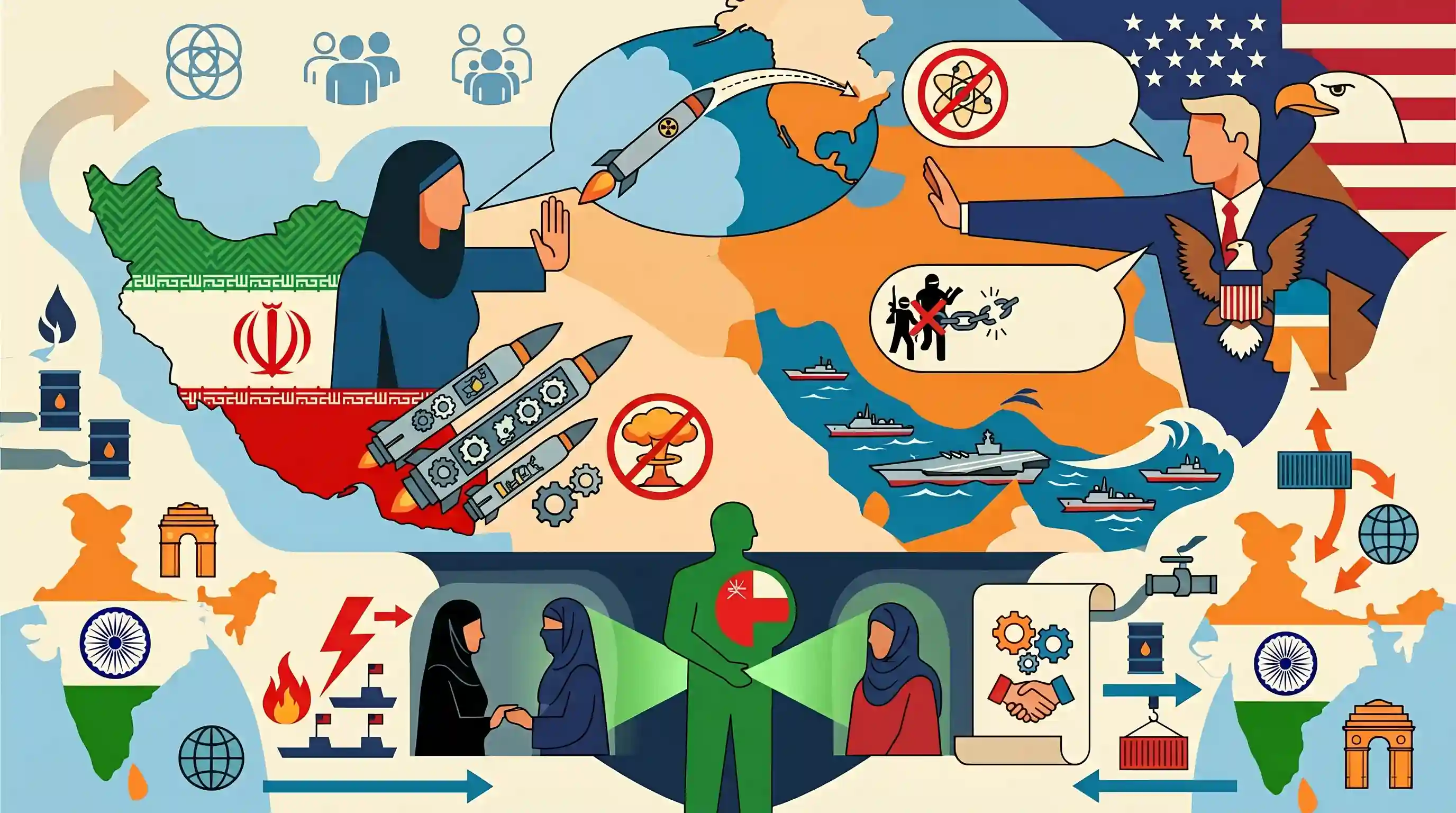
Iran has strongly rejected assertions by US President Donald Trump regarding its missile capabilities, dismissing claims that it is building weapons capable of striking the US mainland. Amidst heightened tensions and a US naval deployment to the Middle East, Iran maintains its ballistic missile program is purely defensive and lacks a nuclear warhead dimension. The geopolitical friction is characterized by hardline US demands for zero uranium enrichment and an end to Iran's regional militant proxy support. Concurrently, back-channel diplomatic efforts mediated by Oman are underway to reach a framework agreement on the nuclear program, as Iran warns it would retaliate against US regional bases if attacked.
Key Points
- Iran dismissed US President Donald Trump's claims that it is developing missiles capable of striking the United States as 'big lies.'
- Iran maintains its ballistic missile program is strictly defensive and not designed to carry nuclear warheads.
- The US demands zero uranium enrichment from Iran, along with constraints on its missile program and cessation of support for regional militant groups.
- Back-channel negotiations are currently being mediated by Oman to broker a new agreement on the nuclear program following previous geopolitical fallout.
- Iranian officials warned that while they cannot strike the US homeland, they possess the capability to target American military bases across the Middle East in retaliation to any preemptive attack.
Important Terms
Joint Comprehensive Plan of Action (JCPOA)

The 2015 agreement between Iran and world powers (P5+1) limiting Iran's nuclear activities in exchange for lifting economic sanctions. The US withdrew in 2018, leading to current tensions.
UPSC context
GS Paper 2: Important International agreements affecting India's energy security and regional connectivity projects like Chabahar.
Uranium Enrichment
The process of increasing the percentage of the fissile isotope U-235. Low enrichment (3-5%) is for power; high enrichment (90%) is required for nuclear weapons.
UPSC context
GS Paper 3: Science and Technology/Nuclear energy; crucial for understanding non-proliferation and weaponization timelines.
Ballistic Missile Program
Iran's arsenal of guided missiles, the largest in the Middle East, serving as a regional deterrent. Its potential to carry nuclear warheads is a major international security concern.
UPSC context
GS Paper 3: Security challenges and their management in the context of regional stability and global non-proliferation.
United States Department of Defense
The executive department of the US government responsible for coordinating and supervising all agencies and functions of the government concerned directly with national security and the United States Armed Forces.
UPSC context
GS Paper 2: Role in international security architectures and bilateral military tensions affecting global trade.
Iranian Foreign Ministry
The government body responsible for Iran's diplomatic relations. While it manages formal negotiations like the JCPOA, strategic decisions are often influenced by the Supreme Leader and the IRGC.
UPSC context
GS Paper 2: Diplomatic machinery in West Asia; essential for navigating bilateral ties and regional peace.
West Asia Geopolitics
The study of political and strategic relationships in the Middle East. For India, this involves balancing ties between rivals (Iran, Saudi Arabia, Israel) for energy and security.
UPSC context
GS Paper 2: Effect of policies and politics of developed and developing countries on India’s interests.
Prelims Trap
"The original JCPOA agreement mandated a complete halt to all uranium enrichment activities by Iran."
The JCPOA capped enrichment at 3.67% for civilian energy; it did not enforce 'zero enrichment.' Zero enrichment is a hardline US demand, not a past treaty provision.
Static Concepts Connected
What is the IAEA Additional Protocol?
- Purpose: Grants IAEA inspectors expanded physical access and information rights to verify the peaceful nature of a country's nuclear program.
- Scope: Allows verification of both declared nuclear material and suspected undeclared nuclear facilities or activities.
- India's Status: India signed an India-specific Additional Protocol in 2009 with a restricted scope, applicable only to its civilian nuclear facilities.
What are the core parameters of the MTCR?
- Objective: An informal multilateral export control regime aimed at preventing the proliferation of missiles and UAVs capable of carrying WMDs.
- Payload & Range: Strictly regulates the transfer of complete rocket systems capable of carrying a 500 kg payload for at least 300 km.
- India's Membership: India joined as a full member in 2016, enabling it to export the BrahMos missile and access high-end drone technology.
Cross-Topic Patterns
Oman as regional diplomatic mediator
Oman's non-aligned stance enables it to broker US-Iran talks. For India, Oman's stability is vital to safeguard strategic maritime access, particularly the Duqm port and crucial energy transit routes.
Chabahar Port & US secondary sanctions
Escalating US-Iran tensions risk triggering secondary sanctions, which could complicate India's operational control over Chabahar port and its broader International North-South Transport Corridor (INSTC) connectivity ambitions.

Mapping West Asian straits (Hormuz) against US-Iran flare-ups, combined with IAEA Additional Protocol provisions, is a highly probable MCQ.
Linked PYQs · 2
Linked PYQs · 2
- 2018PrelimsGS1
In the Indian context, what is the implication of ratifying the 'Additional Protocol' with the 'International Atomic Energy Agency (IAEA)'?
- 2025MainsGS2
"Energy security constitutes the dominant kingpin of India's foreign policy, and is linked with India's overarching influence in Middle Eastern countries.” How would you integrate energy security with India's foreign policy trajectories in the coming years?
